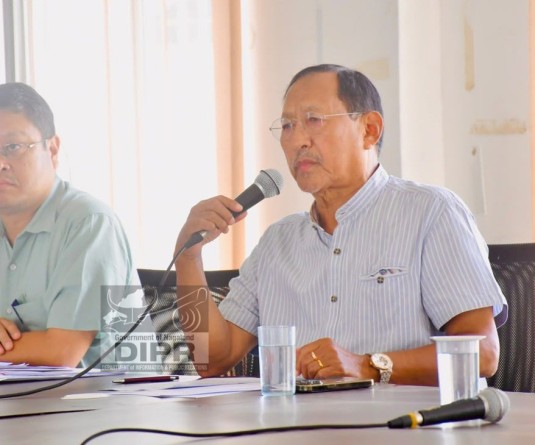
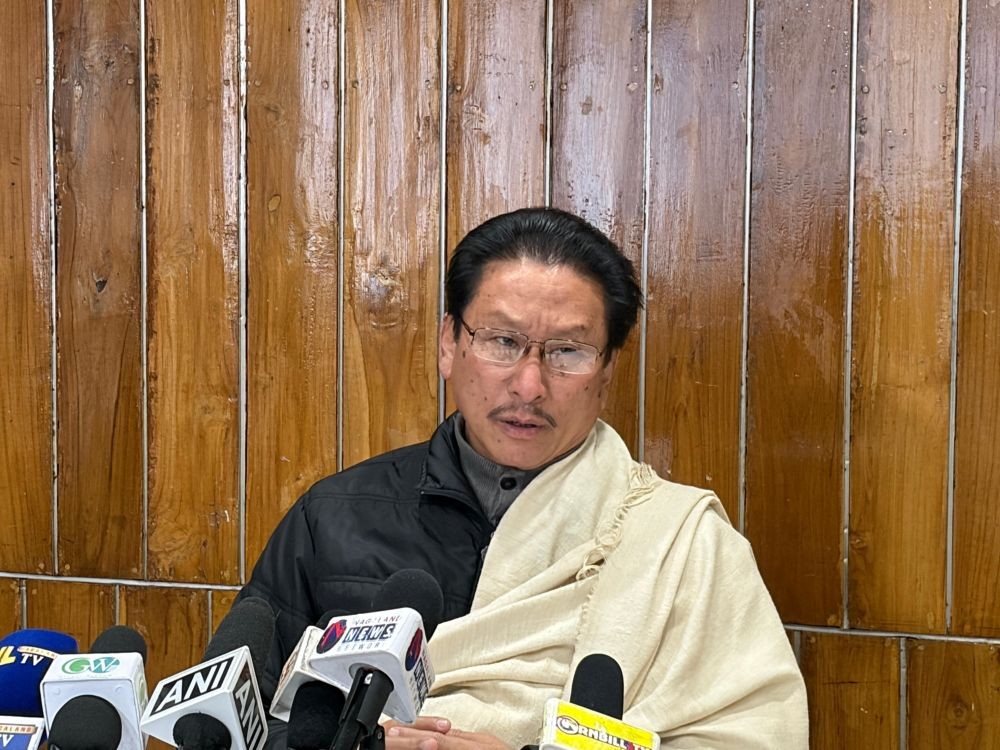
Minister KG Kenye addresses the media at Hotel Japfü, Kohima on February 4. (Morung Photo)
Morung Express News
Kohima | February 4
The Union Government is expected to make an announcement regarding the Eastern Nagaland People’s Organisation’s (ENPO) demand for Frontier Nagaland Territorial Authority (FNTA) on February 5.
Nagaland Minister for Power and Government Spokesperson KG Kenye indicated the likelihood of such an announcement while addressing the media on February 4 at Hotel Japfü, Kohima, while updating on the State Cabinet meeting held on February 3 at Rhododendron Hall, Chümoukedima.
Apart from the ongoing engagement between the Eastern Nagaland People’s Organisation (ENPO) and the Government of India on the FNTA proposal, the Cabinet meeting took stock of several key political, administrative and developmental issues, with a focus on FNTA, oil and gas exploration, landholding reforms and the re-imposition of the Protected Area Permit (PAP), he said.
The discussions on FNTA were scheduled to take place in New Delhi on February 4, and the Centre may make an announcement on Thursday, he informed.
Meanwhile, a delegation of ministers, MLAs and leaders is already in New Delhi in connection with the ENPO–FNTA issue.
“We are keeping our fingers crossed that after having pursued it for more than a decade, almost one and a half decades, it should be put to rest as per the wishes and desires of our people,” he added.
Kenye also informed that, to strengthen engagement with the Centre on FNTA and other matters, the Cabinet decided to constitute a sub-committee under the Political Affairs Committee (PAC), headed by the Chief Minister as the convenor, and including the two Members of Parliament, two Deputy Chief Ministers and a few Cabinet members.
Some members, he said, have left for Delhi and will take up issues related to the Free Movement Regime and PAP, and persuade the Centre to review the re-imposition of PAP and the exploration of oil and natural gas.
Backs oil, gas exploration citing Article 371A
Referring to the exploration of oil and natural gas, Kenye stated, “it’s a long-drawn issue and the matter has become very contentious after it went to the court,” adding that the government was hoping for a clearance in reference to Article 371A.
However, in light of the delay, the Cabinet, he informed, has decided that the State would proceed with the exploration and exploitation of natural resources based on constitutional guarantees under Article 371A, which vests ownership of land and its resources with the people of Nagaland.
Referring to Article 371A, Kenye said Nagaland enjoys a unique constitutional provision under which ownership of land and all natural resources rests with the private landowners and the people, unlike in other states.
“Thereby, the elected and mandated government of the people, that is the state government, is fully the owner of the resources at hand. So, along with the consent of the owners, the government may act as per its best judgement and decision. This has always been there,” he asserted.
The Centre’s position that petroleum and natural gas fall under central jurisdiction has been challenged by Nagaland, which maintains that Article 371A overrides such provisions in the State’s case.
Although the matter went to court following petitions filed by a local organisation, he said the organisation has since withdrawn its case, raising questions over the continued pendency of the matter.
The Cabinet also discussed landholding regulations, acknowledging that previous laws and memorandums, including the SARFAESI Act, have not been decisively implemented in the State.
New directives on land usage
After reviewing proposals from the Land Revenue Department, Kenye stated that the government has decided to move towards clearer directives.
“In the face of all these inner-line permit regulations, the Bengal Eastern Frontier Regulations, and the Register of the Indigenous Inhabitants of Nagaland, putting all this together and summing up, for a long term, we need to settle on some concrete decisions,” he added.
Under the new directives, he informed, non-cadastral areas or government-occupied lands, which so far were not issued individual pattas, would be required—along with organisations and individuals—to obtain land pattas after proper registration and pay revenue to the government, as other private owners do.
Regarding the upcoming Assembly session, the Minister informed that although the Business Advisory Committee is yet to meet, the session is tentatively expected around February 18 or 19.