Chizokho Vero
Kohima | October 15
Good news! The scenario of pig production in Nagaland is looking bright as the Japaness technology on smell-less pig sty, has, reached the state. Welcoming the arrival of the system, the Department of Veterinary and Animal Husbandry is all set to propagate this system in an effective way for adopting across the state and launched a week long training programme on the related technology this morning at the District Veterinary Office, Kohima as part of the Year of Farmers.
“Livestock & poultry rearing form an essential source of meat food and subsidiary income generation for the local population of Nagaland. It is usual to rear pigs and poultry in proximity to human habitation owing to space problem and for convenient management and security reasons,” the department said adding that this practice, however, results in environmental pollution in the form of undesirable foul smell.
The problem lies in the housing and management practices where the organic remains in the form of excreta and other waste materials needs to be reduced to the most minimal possible extent in order to ensure sanitary condition that is conducive to human habitation and hygienic animal husbandry practices.
“We are proud to introduce a housing technique whereby pigs and poultry can be reared hygienically by considerably reducing the usual foul smell and thereby check nuisances and pollution,” the department said adding that the system can be easily implemented in Nagaland by making use of locally available materials.
The resource person of the training, Hitoshi Yokota, who came all the way from Japan was optimistic that the system will be effectively used here, thereby increasing the pig production in the state. Proper dissemination of the system to the farmers, according to Yokota, is necessary in order to increase the pig production and uplift the rural economy.
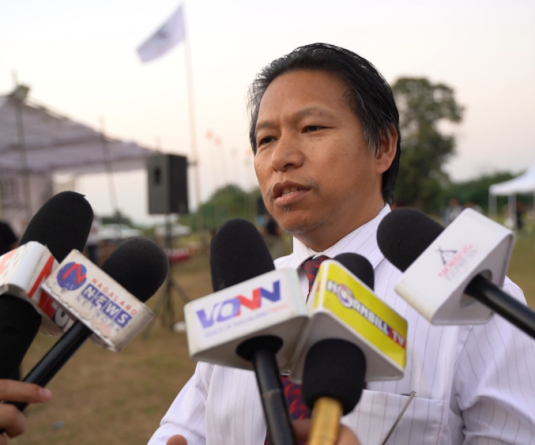
We must think for poor farmers, he said adding that concerted effort must be extended for the benefit the farmers. Dr. Y. Yisao Lotha, Director Veterinary & Animal Husbandry maintained that the technology should pass on to rural areas, adding that the successful implementation of the system will certainly increase pig production in the state. “I am very sure that every Naga will adopt this system of rearing pigs in Nagaland,” he said.
Admitting that rearing of pigs in towns and cities have become a problem due to its smell, Dr. I. P. Khala, Deputy Director (Piggery) expressed hope that the arrival of smell-less pig sty system will solve this problem to a great extent. The department has demonstrated this system at Agri Expo 2006 and it has attracted many people, he claimed. The department has constructed one smell-less pig sty within Kohima DVO office, which will play as demonstration unit.
When this system becomes a reality, it will benefit the state in increasing the pig production as well as minimize the health hazard, said Dr. Hathungo Lotha, Joint Director. Dr. Walling told this correspondent that the system has already been adopted in some pockets of the state.
The system is a microorganism-based technology (A Japanese approach). Indigenous Micro Organism is prepared by collecting certain materials containing the desired microorganisms in natural form from various forests, which is cultured and further processed, and then presented in the form of crude particles. When mixed with the bedding materials of the sty/poultry shed, the IMO digests the putrefying substances responsible for the production of unwanted foul smell. During this process, certain amount of heat is generated which help the bedding materials to remain warm thereby giving comfort to the housed pigs/birds. Thus it saves certain amount of electric power consumption. No cleaning and washing of the style/shed is necessary which saves considerable amount water, time, energy and labour etc., thereby reducing considerable amount of expenditure in terms of maintenance and production, the department says.
The training will be imparted to DVOs, piggery farm managers, extension officers on the system and they will latter disseminate the technology to the farmers in their respective district. Questions, evaluation and action plan will mark the last day of the training, ie. October 26. The inaugural function concluded with vote of thanks tendered by Dr. David Sema, Deputy Director (Extension).