Ashraf Rehman
India’s announcement that it aims to reach net zero emissions by 2070 and to meet fifty percent of its electricity requirements from renewable energy sources by 2030 is a hugely significant moment for the global fight against climate change. India is pioneering a new model of economic development that could avoid the carbon-intensive approaches that many countries have pursued in the past – and provide a blueprint for other developing economies.
Energy poverty is described as a situation in which the households do have adequate energy to meet the basic essential needs. It does not only pose a major obstacle for the vision of Viksit Bharat, but, it stands as a challenge in India’s swiftly urbanizing environment.
According to various reports, India requires around USD 10 Trillion dollars by 2070 to achieve its energy transition goals. This huge demand for funding and investment makes financial an important constraint for energy transition in India.
With the tremendous rise in the population of India, it is expected to hit around 814 million by 2030; this rise in population also creates a surge in the demand for sufficient and affordable energy and its infrastructure.
Socio-Economic Vulnerabilities & Gender Equality
Increase in the energy expense not only affects the state, but, most importantly, it worsens the struggles of the down trodden population, notably living at poverty line. The individuals residing in informal urban areas are also affected by the high expenditure on energy consumption. And, these groups frequently encounter various obstacles like; access to infrastructure, financial constraints, and social exclusion, which increases their vulnerability to energy poverty.
Furthermore, with the sheer size of India’s energy demand, it is documented to grown more than any country in the following years. However, to met the target of “Net-Zero Emissions” by 2070, most of the energy demand has to be fulfilled with low-carbon emission sources and the equal distribution of energy is also necessary.
Therefore, effective policies can facilitate women’s involvement in decision making regarding energy infrastructure, thereby promoting economic independence, gender equality, and enhance energy accessibility and improve the livelihood for the disadvantaged families.
With lack of coordination or collaboration from among stakeholders, government, public and various organizations, creates poor communication to achieve holistic goal for energy transition. And, due to high dependency on coal, with around 73 percent of India’s total power generation accounts from coal itself. This huge reliance on coal creates a significant obstacle for energy transition to renewable sources.
As the need to increase the use of renewable energy increases, there is a pressing need for the infrastructural development for grid capacity and flexibility is needed, such as: investments in battery storage systems and transmission lines
The Political Economy of Energy Deprivation: Structural Bottlenecks in the NER
To understand energy poverty in India’s North Eastern Region (NER), one must move beyond national averages and interrogate the unique convergence of geography, political economy, and cultural ecology that governs the region. In mainstream policy discourse, rural energy access is often treated as a linear progression: laying transmission lines or distributing liquefied petroleum gas (LPG) cylinders is assumed to automatically eliminate deprivation. However, the empirical reality of the NER exposes deep-seated structural friction, characterized by what can be termed the Topography-Tariff Paradox.
The exceptionally rugged, landslide-prone, and heavily forested terrain of the Northeast dramatically inflates both the capital expenditure (CapEx) and operational expenditure (OpEx) of centralized grid infrastructure. Building and maintaining traditional transmission lines across fragile mountain ecologies means that regional power distribution companies (DISCOMs) face exorbitant maintenance costs and structurally high Aggregate Technical and Commercial (AT&C) losses.
Due to the intense financial pressure on these DISCOMs, they are caught in a pattern of underinvestment, resulting in very unreliable power delivery, constant voltage instabilities, and extended outages. As a result, rural consumers encounter a backward paradox: they deal with elevated structural expenses for a service that is very irregular, discouraging them from moving away from decentralised, self-sufficient alternative sources.
This grid instability directly supports the occurrence of biomass stacking where contemporary, clean energy sources do not take the place of traditional fuels but are simply added next to them. In the NER, the ongoing use of firewood and bamboo is not simply a sign of market failure; it represents a logical socio-economic strategy that is profoundly rooted in the local political economy.
Initially, biomass is a resource with no monetary cost that is effortlessly collected from forests managed by the community and jhum (shifting cultivation) fallows, rendering it very competitive with commercial fuels.
Secondly, renewable energy options do not consider the diverse applications of domestic energy in mountainous regions. Typical LPG cooking stoves deliver focused cooking heat but fail to mimic the essential secondary roles of traditional open hearths, which are crucial both culturally and structurally for heating spaces during extended winters, curing meats, and drying crops in very humid conditions.
Ultimately, the political economy of supply chains in the NER presents significant vulnerabilities. The area's reliance on limited logistical routes like the Siliguri Corridor makes its energy supply chains very vulnerable to climate-related disturbances. Throughout the prolonged monsoon period, heavy rainfall causes significant landslides that effectively isolate distant valleys for weeks.
When the supply chain fails, LPG cylinder refills are either entirely inaccessible or offered at outrageous prices in the black market. For a vulnerable rural family, dependence on modern clean energy poses an unacceptable systemic threat to food security. In contrast, traditional biomass offers complete sovereign dependability. Consequently, energy deprivation in the NER
When the supply chain breaks down, LPG cylinder refills become completely unavailable or are sold at exorbitant black-market premiums. For a vulnerable rural household, a reliance on modern clean energy represents an unacceptable systemic risk to food security. Traditional biomass, by contrast, provides absolute sovereign reliability.
Therefore, energy poverty in the NER cannot be solved by uniform, supply-side mandates; it requires decentralized, climate-resilient frameworks such as localized solar micro grids that directly align with the agro-ecological and cultural realities of the frontier.
Infrastructure and Affordability
Due to the absence of modernized and accessible infrastructure in the rural and tribal region of India. It has led to the rise in inequality between energy distributions, further contributing to energy poverty. Therefore, in the light of the mentioned obstacle, the Government of India aims to build a network for solar rooftops infrastructure to the remote and inaccessible geographical location, to reduce energy poverty and built a state on clean and renewable energy.
Affordability of energy sources has been a major concern in India; a major chunk of population living in rural areas relies on biomass gas not only due to the lack of infrastructure, but, also due to the cost associated with the installation of solar panels for clean energy. However, in order to transit from fossil fuels to renewable sources of energy, the constraint of affordability needs to be solved by subsidizing clean and renewable energy.
Regional-Geographical Disparity
India’s ethnic, geographical, regional, socio-political diversity does makes it one of the most unique and diverse state in Asia. But, along with it, comes the constraints to equally manage distribute the energy sources to every region; rural, hilly and remote areas. This regional disparity does contribute to the large chunk of the population living excluded to access and afford energy sources.
Apart, from regional disparity, behavioural factor does play an important role in shaping the energy consumption in India. Like, the community infrastructure, their tradition in terms of energy consumption, availability of resources near their locations, can significantly determine energy consumption of a household. Moreover, sometimes, the cultural preferences may also influence the use of fossil fuels.
Various papers advocate that higher consumption is correlated with reduction in energy poverty. It has been documented that the household that can allocate more resources towards energy services can have better access to modernised and clean energy sources.
Education and Awareness:
Although, the educational qualification of the consumer might not significantly influence or lead to energy poverty. However, awareness of clean and renewable energy does make a significant impact in the consumption or transition to clean and renewable energy. But, education qualification might indirectly influence energy choices by promoting and understating the available government schemes related to clean and renewable energy.
Household Energy Poverty Index (HEPI) of North Eastern Region (NER), India: What does data says?
In this section of the article, using data from National Statistical Survey Office (NSSO 68th Round), we aim to understand the Household Energy Poverty Index (HEPI) in context of state-wise, region-wise and also aim to document the rural-urban disparity. The indicators says that the lower the below of HEPI the better the state is performing compared with its higher value states which is in energy poverty.
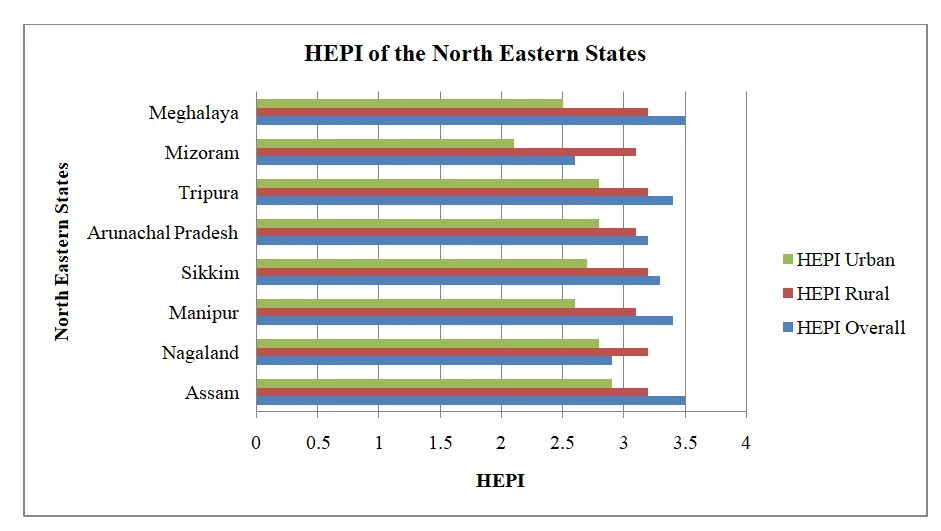
Figure 1: Household Energy Poverty Index of the North Eastern States
Source: NSSO 68th Round
Analyzing the Rural-Urban Energy Divide
Rural-Urban disparity has been a key concern for the policymakers in India. Therefore, it is important to document and study the rural-urban disparity when energy poverty is taken into consideration.
It is also clearly evident from the above data that, there exists stark difference between rural-urban in terms of energy security, accessibility or affordability in the North Eastern Region of India.
In addition, the data clearly advocates that the urban areas are more energy secured and are less deprived from accessibility of energy sources compared to the rural regions.
The existing energy poverty in India poses a significant hurdle to its development aspiration, particularly in achieving the vision of Viksit Bharat.
Policy Interventions and the Path Forward
The mentioned state-wise and the rural-urban disparities in energy accessibility, affordability, infrastructural facilities, awareness of renewable energy source demands the policy intervention by the Government of India. .
Moreover, with the findings revealed from the Household Energy Poverty Index (HEPI), it highlights that states like Assam, Bihar and Jharkhand need strong policy formation with subsidized clean energy and solar rooftops infrastructure, and reduce carbon emissions to combat energy poverty in India. However, it cannot be alone done with infrastructural development or policy formation, but, a transition to sustainable and clean energy is also needed. Government initiatives such as: PM Surya Ghar Muft Bijli Yojana, which aims to provide subsidies of up to 60 percent for systems up to 2 kw and 40 percent for 2-3 kW systems, is a remarkable initiative to combat energy poverty in India.
Ashraf Rehman, Fellow, The Green Institute and former Pre Doctoral Fellow at the Indian Institute of Technology. He is a Researcher and Energy Policy and Development Columnist based in North East, India. His work includes publications in The Policy Edge, The Asian Confluence, Policy Circle, Journal of Development Policy and Practice to name few.