

Officials along with the participants during the awareness-cum-training programme on the scientific package held at Hezheto village under Niuland Block on March 3.
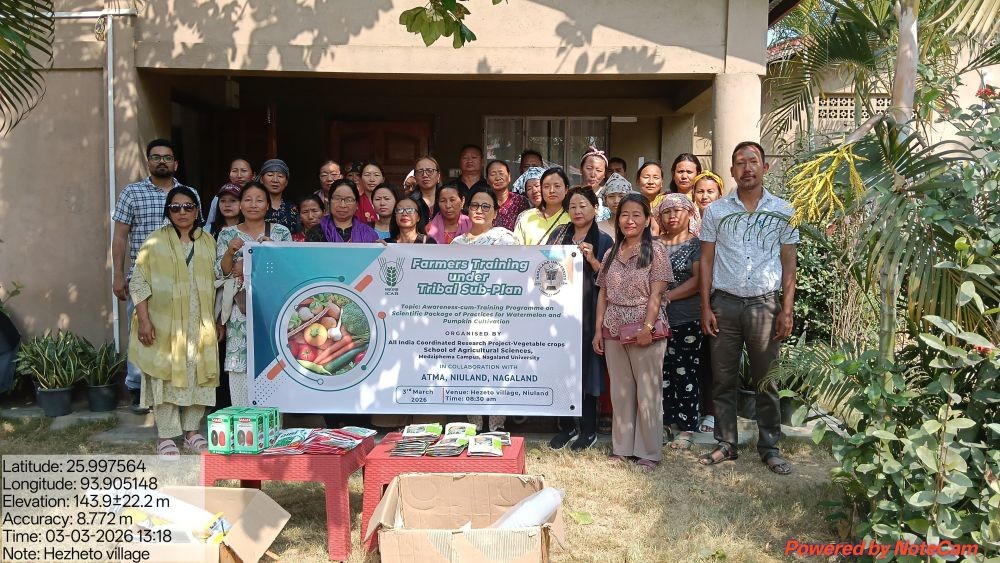
Niuland, March 4 (MExN): An awareness-cum-training programme on the scientific package of practices for watermelon and pumpkin cultivation was conducted on March 3 at Hezheto village under Niuland Block.
The programme was organised under the Tribal Sub-Plan (TSP) by the All India Coordinated Research Project (AICRP) on Vegetable Crops, School of Agricultural Sciences, Medziphema Campus, Nagaland University, in collaboration with the Agricultural Technology Management Agency (ATMA), Niuland.
The programme was chaired by Demalu Hasnusa, Block Technology Manager (BTM), ATMA, Niuland Block. It was graced by Prof Akali Sema, TSP In-charge, AICRP–Vegetable Crops and Professor In-charge, Research Cell, School of Agricultural Sciences, Nagaland University.
Dr Ashwini Ananda, Scientist, AICRP–Vegetable Crops, School of Agricultural Sciences, Nagaland University, Medziphema Campus, served as the resource person for the training.
During the technical session, Dr Ananda delivered a comprehensive lecture on scientific packages of practices for cucurbitaceous crops, including watermelon and pumpkin. He elaborated on improved production techniques, nutrient management, and the identification and management of major diseases and insect pests.
A live demonstration was also conducted on the proper use of different agro-chemicals, highlighting the correct timing, method of application and recommended dosages to ensure effective and safe crop protection.
A good quantity of quality seeds, pesticides, fungicides and various insect traps were distributed among 30 farmers from Hezheto village and Aghunaqa village under Niuland Block to support the adoption of scientific vegetable cultivation practices.
Addressing the gathering, Prof Akali Sema urged farmers to actively engage in vegetable farming as a means of financial upliftment. She emphasised that consistent efforts in scientific farming would not only improve income levels but would also be documented and reported to higher authorities, bringing recognition and laurels to the villages.
The programme concluded with active interaction between scientists and farmers, reflecting a strong commitment towards enhancing vegetable production and empowering tribal farmers in Niuland district.
.jpg)
.jpg)
.jpg)
