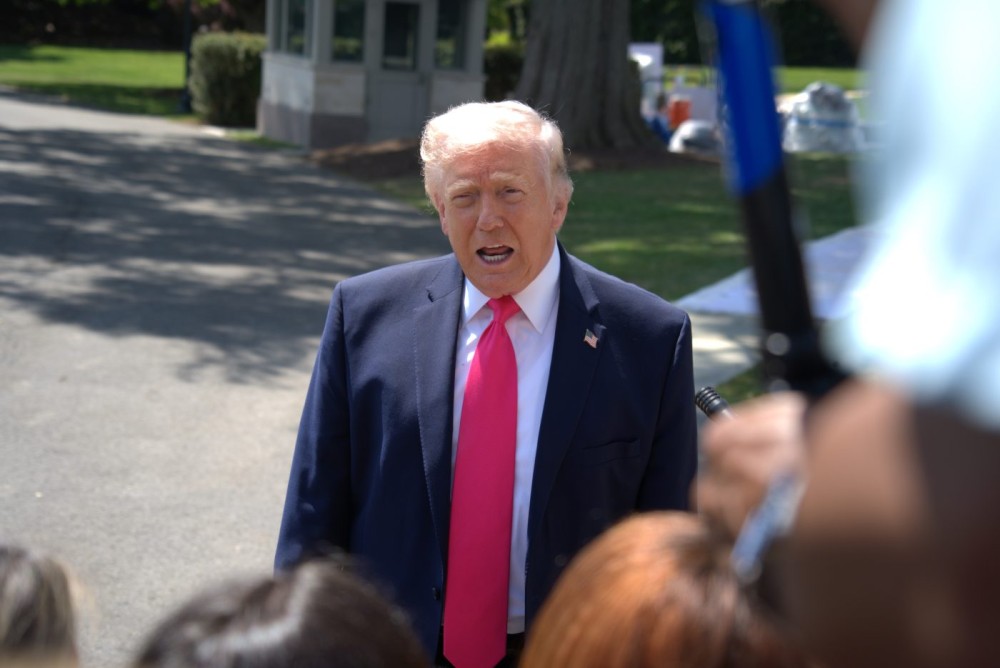
Washington, D.C.: U.S. President Donald Trump speaks to the press on the South Lawn of the White House in Washington, D.C., the United States, April 16, 2026. (Photo: Xinhua via IANS)
Washington, June 15 (IANS) US President Donald Trump said Monday that the agreement his administration has reached with Iran would make the Strait of Hormuz “permanently toll-free”, claiming the deal would secure one of the world's most important energy corridors while preventing Tehran from developing a nuclear weapon.
In an exclusive interview with The New York Times, Trump said the agreement would ultimately ensure that the strategic waterway remained open while reducing the risk of a wider regional conflict. The newspaper reported that Trump said the accord would assure that the Strait of Hormuz was “permanently toll-free” and argued that he had “saved Israel from nuclear obliteration”.
According to The New York Times, the agreement between the US and Iran is expected to reopen the Strait of Hormuz, a vital shipping route for global oil and gas supplies.
Trump also warned that military action could resume if negotiations collapse. According to The New York Times, he said that if Iran failed to reach a final nuclear accord with the United States, he would restart military attacks on Tehran.
The US President used the interview to defend his decision to launch military strikes against Iran earlier this year. The newspaper reported that Trump contended that the attacks and the subsequent naval blockade had shifted the regional balance in America's favour and helped produce the agreement now on the table.
Trump also praised Chinese President Xi Jinping and Russian President Vladimir Putin, saying their actions had helped the diplomatic process. At the same time, he criticised Israeli Prime Minister Benjamin Netanyahu, describing him as “a very difficult guy” and suggesting that Israeli military actions had nearly derailed the agreement, according to The New York Times.
Despite Trump's confidence, significant questions remain unresolved. The full text of the agreement has not been released, and future negotiations are expected to address contentious issues surrounding Iran's nuclear programme, sanctions relief and the handling of Tehran's stockpile of enriched uranium. The New York Times reported that both sides have deferred some of the most difficult issues to later rounds of talks.
The proposed agreement is also expected to dominate discussions at the Group of Seven summit in France. According to a report in The Wall Street Journal, allied leaders have yet to review the text of the accord and are seeking clarity on how the arrangement will be implemented and monitored in the coming months.
Shipping companies have welcomed the prospect of the Strait reopening but remain cautious. Reporting from the Gulf region, The New York Times said many operators are waiting for concrete security guarantees before resuming normal traffic through the waterway, where hundreds of vessels were stranded during the conflict.