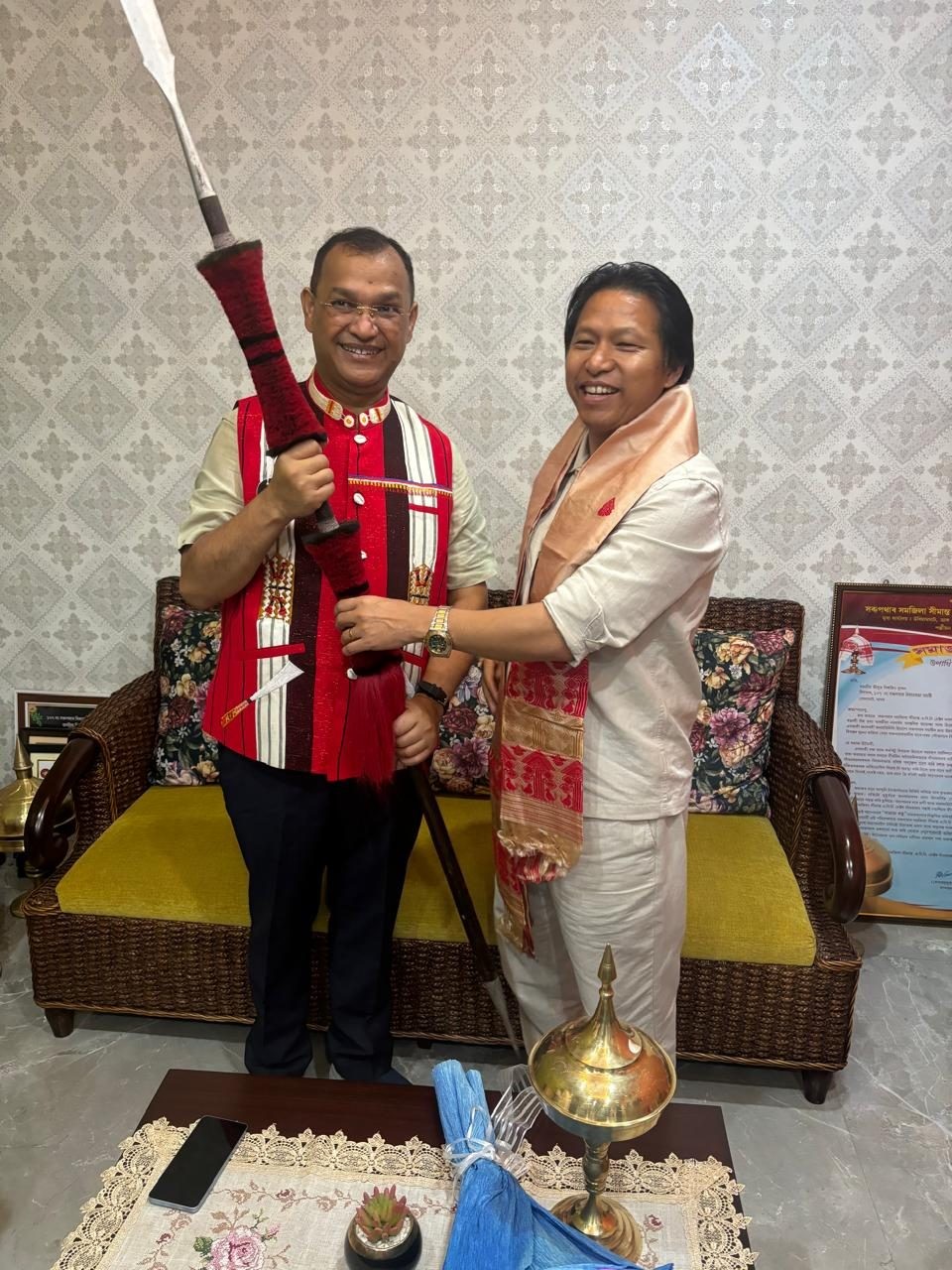
Assam’s Sarupathar MLA Biswajit Phukan (left) with Nagaland’s Bhandari MLA Achumbemo Kikon following their meeting in Sarupathar, Golaghat, on September 19.
• CSOs, BMs in committee
• Proposes summit of CMs
• For tree plantation
• Not territorial grab
Morung Express News
Dimapur | September 19
Two MLAs from Assam and Nagaland have proposed setting up a Sarupathar-Bhandari Joint Peace and Coordination Committee for coordinating the handling of disputes. Biswajit Phukan, the MLA representing Assam’s Sarupathar Assembly seat said that the move was initiated jointly with Nagaland’s Bhandari MLA Achumbemo Kikon. Sarupathar falls in Golaghat district bordering Bhandari, wherein lies a large stretch of the unresolved border Disputed Area Belt (DAB) shared by Assam and Nagaland.
Phukan made the announcement at a friendship meet-cum-cultural exchange programme between communities, from the two states, living along the DAB on September 19. The event was hosted by the Golaghat administration at Hatidubi, near Uriamghat. It also honoured the legacy of Assam’s cultural icon, Zubeen Garg on his first death anniversary. Cultural troupes from both states performed.
The two-time Sarupathar MLA told the media that he and Kikon met at the former’s residence in Sarupathar earlier in the morning to discuss setting up the proposed committee for the Golaghat and Wokha border belt. “We discussed forming a Joint Coordination Committee comprising people (public/CSO representatives) and administration officials (Border Magistrates) from both sides. If any dispute arises, this committee will attempt to resolve that dispute,” he said.
.webp)
While stating that modalities would have to be worked out, he maintained that the essence of the initiative is to “resolve the issues between us.” He declined to comment on the border issue, a territorial row that has been the source of frequent friction between the two neighbours. “Today we have gathered as one. Therefore, regarding the border dispute, it is better not to talk about it today,” he said.
In tandem with sustaining regular people-to-people contact, he said that economic development of the disputed border has to be addressed in earnest by both state governments. According to him, whatever untoward that has happened should be left in the past and create a new history of love, warmth, progress and prosperity.
Phukan added that plans are afoot to organise a border summit, and a ceremonial tree plantation drive, between Chief Ministers Himanta Biswa Sarma and Neiphiu Rio in the DAB.
In his address to the gathering, Phukan pointed out that while the interstate boundary row remains pending before the Supreme Court, people in the border villages cannot afford living in a constant state of uncertainty. He said that wealthier residents can pay to relocate to places with better amenities but poorer families cannot afford that luxury.
“The border problem is on the table of the Supreme Court, and the court will decide it. We cannot solve the boundary line ourselves, so there is no point fighting here. If we can settle local issues amicably outside the court through talks, that is the way forward,” Phukan said.
.webp)
Among the development plans include an “express road” between Chungajan and Dimapur, which will cut travel time to the Dimapur Airport to around 15 minutes from the current 35 to 40 minutes. To enable income generation in the disputed border belt, he said that the Assam government plans to supply 5 lakh tissue-cultured bamboo saplings that mature within a year. The crop will serve as feedstock for the Numaligarh Refinery’s bamboo bio-refinery. He added that 1 lakh saplings worth around Rs 50 lakh will also be given free to Naga residents.
He sought to clarify that tree plantation drives should not be treated as territorial grab. Citing erratic climate patterns and recent floods in Nagaland's Mon district and Assam's Sivasagar and Charaideo, he said planting trees was strictly an environmental measure. “Plantation has nothing to do with politics,” he said.
Reminding the gathering of the Ahom ‘mita’ friendship tradition — through which the Nagas and Assamese of old built lifelong friendships and exchanged gifts — Phukan called on both sides to look past old grievances.