(File photo; source: X/@SecScottBessent)
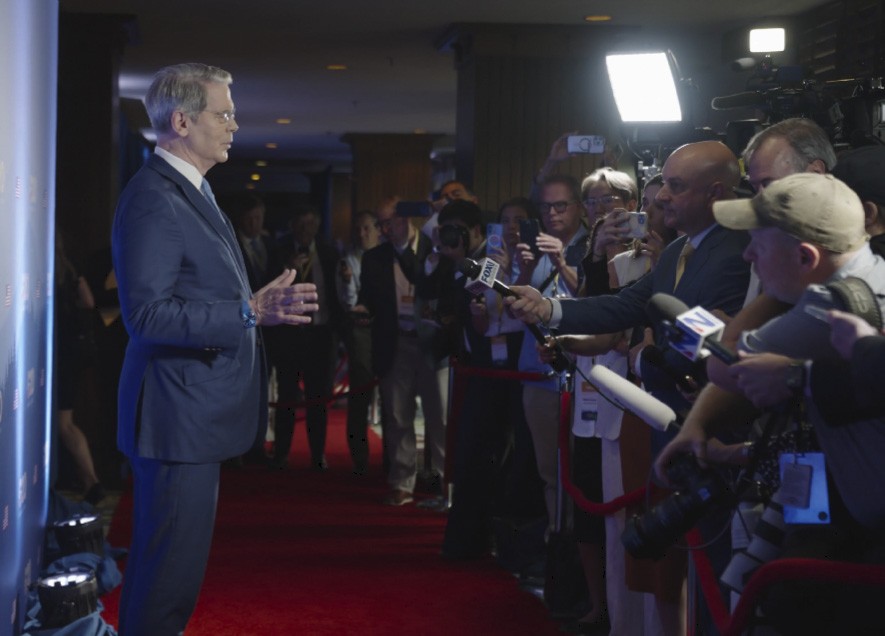
Washington, September 9 (IANS) The United States will account for 80 per cent of global computing power by 2028, Treasury Secretary Scott Bessent has said, casting artificial intelligence as a critical strategic contest with China.
Bessent made the projection during a wide-ranging conversation at SMU's Cox School of Business in Dallas. He said the US held half of global computing capacity in 2025 and was rapidly extending that lead.
"In 2025, the US had 50 per cent of global computing power. By 2028, we're going to have 80 per cent of global computing power," he said.
Asked how much China would have, Bessent replied: "China will be 15, and the rest of the world will be the rest of the world."
Bessent argued that America's AI advantage had emerged through private-sector innovation rather than state direction.
"Why do we have this big lead in AI? And it's all been completely organic in AI," he said. "The Chinese have their model. They have central planning on AI, which will never work."
He said the US needed to protect that advantage. "We are ahead of the Chinese. We have to stay ahead because if we get behind, nothing else matters."
The Treasury secretary also linked the AI race to Washington's wider economic relationship with Beijing.
"I managed the China relationship for the US. And I say we don't want to decouple, but we have to de-risk," he said.
Bessent said the Covid-era disruption had shown the danger of depending on overseas supply chains. He identified semiconductors, medicines and critical minerals as strategic industries that should be brought back to the US for national security reasons.
He said Washington had included private companies in a G20 session on AI, describing it as the first such move under the US presidency. Manufacturing, pharmaceutical and medical technology executives explained how they were using AI in supply chains and customer services, he said.
Bessent offered a blunt assessment of Europe's position in the competition. Asked what was happening there in AI, he answered: "Nothing".
He said Europe had no large cloud company comparable to Microsoft, Amazon or Google in the US, or Alibaba and Tencent in China. He blamed risk aversion and a regulatory-first approach for the gap.
Bessent also warned students that AI proficiency was becoming an employment test.
"AI is probably not going to take your job. Someone who knows how to use AI will take your job," he said.
Computing power, often called compute, covers the chips, data centres and energy infrastructure used to train and operate AI systems. Access to it has become a key measure of national and corporate capacity in advanced artificial intelligence.