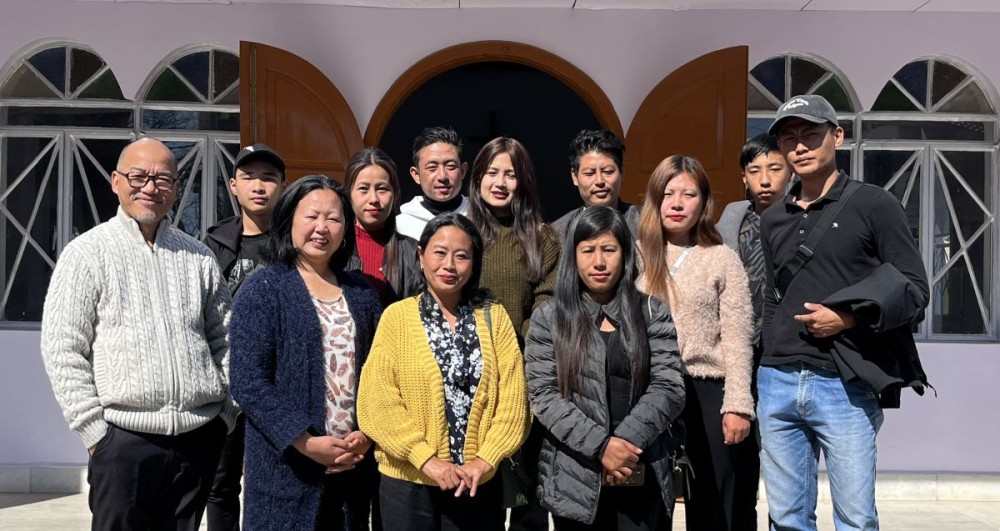
The writer with young friends of Baptist Church, Dibuia Compound (Nagaland).
Meyu Changkiri
One quiet morning, our home was filled with youthful laughter and warm greetings as a group of young people, accompanied by church leaders from Dibuia Compound Baptist Church, came to visit our family. Their cheerful voices filled the living room, and what began as a simple visit soon became a meaningful time of fellowship. We sat together without hurry, shared stories, listened with interest, and encouraged one another. Moments like these remind me that Christian fellowship is not merely social interaction - it is the sharing of life, faith, and hope.
As tea was poured and conversations unfolded, I was struck by how easily relationships are strengthened when people take time to visit one another. In a busy world where communication is often reduced to phone calls and messages, face-to-face fellowship still carries a warmth that technology cannot replace.
During our conversation, I asked one of the high school students whether he had ever walked on foot from Dibuia to Changki. He smiled shyly and said, “No.” His answer stirred a memory that has lived quietly within me for decades.
A Journey That Shaped My Childhood
In the early 1980s, I walked to Dibuia with my parents to attend my cousin’s wedding - a journey of nearly 22 kilometres from our home in Changki. There was no public transport then, and we never imagined owning a private car as many families do today. The road had no blacktopping; it was bare earth, shaped by rain, footsteps, and time. Walking was not unusual - it was simply how people travelled.
I still remember the narrow winding road through the hills of Jangpetkong, the rhythm of steady footsteps, and the quiet strength of the adults walking ahead of us. At times I grew tired and wondered how much farther we had to go, but my parents kept moving with calm determination. We carried simple food for the journey and rested when needed. There were no complaints - only endurance and purpose.
I remember sitting on a rock to rest, listening to the wind moving through the trees and watching the older people speak calmly about the distance yet to be covered. No one dramatized the hardship; walking was simply part of life.
When we finally reached the village, the atmosphere was filled with warmth and celebration. I can still recall the smell of wood smoke rising from kitchen fires, the sound of people gathering, and the joyful anticipation surrounding the wedding feast. As a child, I was captivated by the sense of community - people working together, laughing together, and celebrating together.
At that age, I did not realize that the journey itself would become one of the most treasured memories of my life. Today, I thank God for my parents who allowed me to experience that moment. It taught me perseverance, patience, and belonging in ways no classroom ever could.
That memory also helps me appreciate the stories told by elders who once walked long distances from the hills of Nagaland to Assam to buy salt and other necessities. Their journeys were not adventures; they were responsibilities. They walked because survival demanded it. They carried back not only goods but also stories, resilience, and the quiet dignity of hard-earned provision.
Today, roads have replaced footpaths and convenience has replaced endurance. While we are grateful for progress, I sometimes wonder whether ease has quietly taken away some of the resilience that once defined our communities. The older generation endured hardship with courage. Their lives remind us that strength is often formed through difficulty and that perseverance is a virtue cultivated over time.
When Suffering Carries Purpose
Recently, during one of our monthly book-reading gatherings with fellow pastors, I had the opportunity to lead a discussion on a chapter titled “Brothers, Our Affliction Is for Their Comfort” from Brothers, We Are Not Professionals by John Piper. The chapter led us into a deep and honest conversation about ministry challenges, suffering, faith, and pastoral responsibility.
The apostle Paul writes in 2 Corinthians 1:6, “If we are afflicted, it is for your comfort and salvation.” These words challenge our instinct to see suffering as pointless or unfair. Instead, Paul suggests that suffering may carry divine purpose.
The suffering of Jesus Christ was not accidental. It was part of God’s redemptive plan for humanity. Throughout Scripture, we see God allowing suffering in the lives of His servants so that others might be strengthened through their testimony. Pain, when surrendered to God, can become a channel through which comfort flows to others.
This truth does not make suffering easy, but it makes it meaningful. When pain is viewed through the lens of God’s redemptive work, it ceases to be merely a burden and becomes a tool in the hands of a compassionate God.
Faith in the Valley of Pain
Faith is not merely a belief we profess in good times; it is a trust that sustains us when life becomes uncertain. It is tested in hospital corridors, in homes grieving the loss of loved ones, in seasons of financial strain, and in silent struggles with anxiety and loneliness.
Suffering is not an abstract idea. It lives in real homes and real hearts. Some carry the burden of illness. Others struggle through broken relationships. Many carry quiet worries about their children’s future. Still others endure grief that words cannot adequately express.
In such moments, people do not primarily need explanations. They need presence. They need someone to sit beside them, listen without judgment, and remind them that they are not alone.
Pastoral ministry has taught me that comfort is often wordless. I remember sitting beside a grieving father who could not speak after losing his child. We sat in silence. After some time, we prayed softly.
No sermon could have replaced that moment. On another occasion, I returned weeks after a funeral, when the visitors had stopped coming and the house felt unbearably quiet. Grief often grows louder when the crowd disappears.
I have also seen how simple acts of care - a shared meal, a hand placed gently on a shoulder, or a prayer whispered through tears - can bring profound reassurance. Compassion expressed through presence often speaks more powerfully than carefully chosen words.
True comfort is not hurried. It does not rely on impressive speech. It flows from compassion, patience, and shared humanity.
Walking Together in Hope
We are called to comfort those who suffer with the comfort we ourselves have received. Sometimes the most meaningful ministry is simply showing up - bringing a meal, helping with daily tasks, listening patiently, or praying with sensitivity. Genuine comfort comes from hearts that have themselves experienced God’s comfort.
Scripture reminds us that suffering is not wasted. Even when we feel weak or ineffective, God may be using our struggles to console and strengthen someone else. Pain softens harsh judgments, deepens empathy, and teaches us to depend on God rather than ourselves.
Affliction strips away self-reliance and reminds us of our need for divine strength. In our weakness, we discover a deeper reliance on God, and in that dependence we find grace sufficient for each day.
Looking back, I see a connection between the childhood journey I once walked, the resilience of earlier generations, and the calling to walk alongside people in their pain. Life is a pilgrimage. Some seasons lead us along paths of joy; others take us through valleys of grief. Yet none of us walks alone.
Who walked beside you during your darkest moment?
Who listened when you felt unheard?
Who prayed with you when words failed?
Just as we have received comfort, we are called to extend comfort.
Our wounds, when surrendered to God, can become wells of compassion. Our struggles can become bridges of hope. Our pain can become a testimony that strengthens others.
Faith does not deny suffering. Rather, it anchors the weary heart in the assurance that God is present, God is compassionate, and God is working even through sorrow to bring healing and hope.
As I reflect on the young visitors in our home, the childhood journey to Dibuia, the resilience of our elders, and the calling to minister to those in pain, I am reminded that the Christian life is not meant to be lived in isolation. We walk together. We carry one another’s burdens. We comfort one another with the comfort we ourselves have received from God.
And so the words of the apostle Paul continue to guide and reassure us: If we are afflicted, it is for your comfort and salvation.