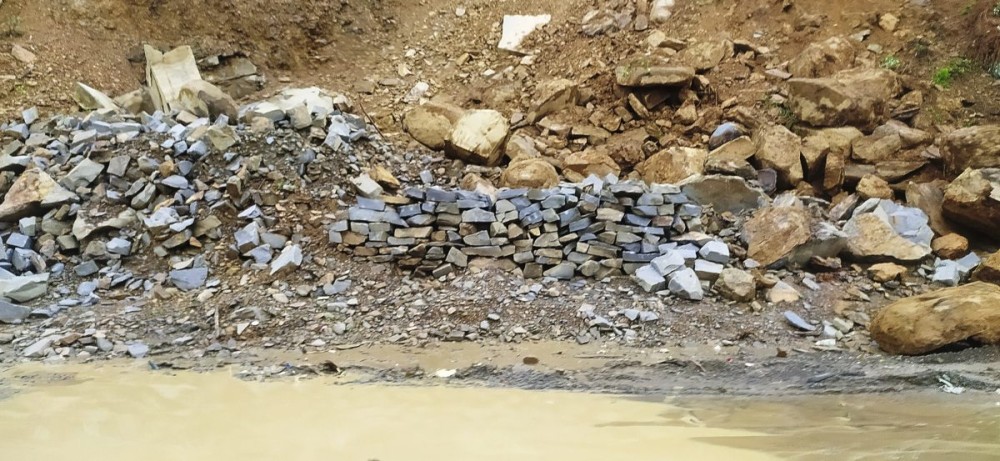
A section of the road in Wokha town covered with mud and rainwater. (Morung Photo)
Dr N Janbemo Humtsoe
Wokha
A decade ago, travelling from Wokha to Kohima took more than three hours, while the journey from Wokha to Dimapur often exceeded five hours. Today, with significant improvements in road infrastructure, travel time has been drastically reduced, allowing commuters to reach Kohima in about two hours and Dimapur in three hours. The reduction in travel time has brought significant benefits to commuters and transporters alike. Shorter journeys mean lower fuel consumption, reduced vehicle wear and tear, and savings on transportation costs. Improved roads also allow people to save valuable time, enabling quicker access to markets, schools, hospitals, offices, and other essential services. In many ways, better roads not only improved connectivity but also enhance economic activity and the overall quality of daily life.
Roads are the arteries of economic life. Trade flourishes, industries grow and tourism expands when roads are good. On the contrary, when roads are weak and neglected, development slows, investment declines, and people remain isolated from opportunities. For a state like Nagaland, where air and rail connectivity is confined to Dimapur, road connectivity is not merely an infrastructure issue; it is a question of economic survival and future progress.
History repeatedly shows that nations that invested heavily in road infrastructure laid the foundation for rapid economic transformation. The rise of the United States as a global economic power was significantly strengthened by the Interstate Highway System initiated in the 1950s. The network connected cities, industries, ports, and rural regions, encouraging commerce and mobility. Similarly, China invested massively in expressways and rural roads over the past decades. Today, its extensive highway network has helped transform China into one of the world’s largest economies.
Closer to home, Assam has undertaken an ambitious road project with initiatives such as the Asom Mala project playing a central role in improving connectivity and driving economic growth. The Asom Mala project focuses on upgrading and constructing thousands of kilometers of state highways and major roads to improve inter-district connectivity. In 2025 alone the government of Assam allocated Rs. 3217 crores for the Asom Mala 3.0, envisioning the development of a high-speed transport corridor spanning 883 km of roads and the construction of 36 new bridges across 34 districts.
Unfortunately, Nagaland continues to suffer from poor quality road construction. Roads in Nagaland frequently deteriorate within one or two years of completion, and in some case within 6 months, creating frustration among citizens and damaging public trust in the government and contractors. During monsoon seasons, many roads become unusable or hazardous due to landslides and potholes. In 2025, at some point, the state capital Kohima was cut off from three sides: Dimapur, Wokha, and Imphal, due to landslides in all three sides.
Instead of becoming tools of development, roads have often become symbols of neglect, poor monitoring and administrative failure. The reasons behind this problem are complex but not impossible to identify. One major concern is the alleged deduction of funds at various levels before projects reach actual implementation. When a significant portion of the sanctioned amount is lost before construction begins, contractors are left with insufficient resources to execute quality work. As a result, substandard materials are used, proper engineering standards are ignored, and durability is sacrificed.
Another major issue is weak monitoring and accountability. In many cases, projects are certified as completed despite projects showing visible defects or incompleteness. Contractors who repeatedly produce substandard work often face little consequence, encouraging a culture of negligence. The problem is also linked to a lack of long-term vision. Roads are sometimes treated as temporary political projects rather than long-term economic assets. A road built cheaply may appear cost effective initially, but repeated repairs and reconstruction ultimately cost the government more in the long run.
Another growing problem is road encroachment by private individuals. Over the years, many roads have gradually become narrower because individuals extend fences, shops, staircases, retaining walls, or buildings into public road space. This not only creates traffic congestion but also makes it extremely difficult to develop pedestrian footpaths and parking areas. In many towns, pedestrians are forced to walk on the roads themselves because there is simply no space left for footpaths. Authorities must seriously address this issue. Illegal encroachments on public roads should be properly identified through surveys and strict action must be initiated against violators, regardless of influence or status. Public roads belong to the people and cannot be gradually occupied for private convenience.
The blockage of roadside drainage and culverts is another issue that deserves urgent attention. In some places, individuals deliberately block drains near their area, often to prevent water from entering their compounds. However, when drainage systems are obstructed, rainwater accumulates on roads causing road damage. Nagaland also needs a serious change in its approach towards road development. Instead of focusing on constructing more roads every year, the government must prioritize building roads that genuinely last. A smaller number of high quality roads is far better than a large number of poorly constructed roads that collapse after every monsoon. At the very minimum, roads should be built with the target of lasting at least five years without major damage. This requires stricter monitoring, use of standard materials, and independent quality inspections before projects are approved.
Transparency in fund utilization should also be strengthened. Citizens deserve to know how much public money is sanctioned for projects and how it is being spent. Contractors with repeated records of poor workmanship should face blacklisting, while honest and capable contractors should be encouraged. Community participation can also make a difference. Village councils, youth bodies, civil society organizations should actively monitor road projects in their areas. Public vigilance can discourage corruption and negligence.
Roads are not merely development projects; they are investments into the future. Nagaland cannot aspire for economic progress while its roads continue to deteriorate year after year. The state needs roads that are wider, stronger, free from encroachment, and built with long-term vision.