Moa Jamir
Dimapur | February 1
Data from Gender Statistics 2025, the eighth edition published by the State’s Directorate of Economics and Statistics highlighted that women form the majority in medical and allied undergraduate courses in Nagaland, while engineering programmes continue to remain male-dominated.
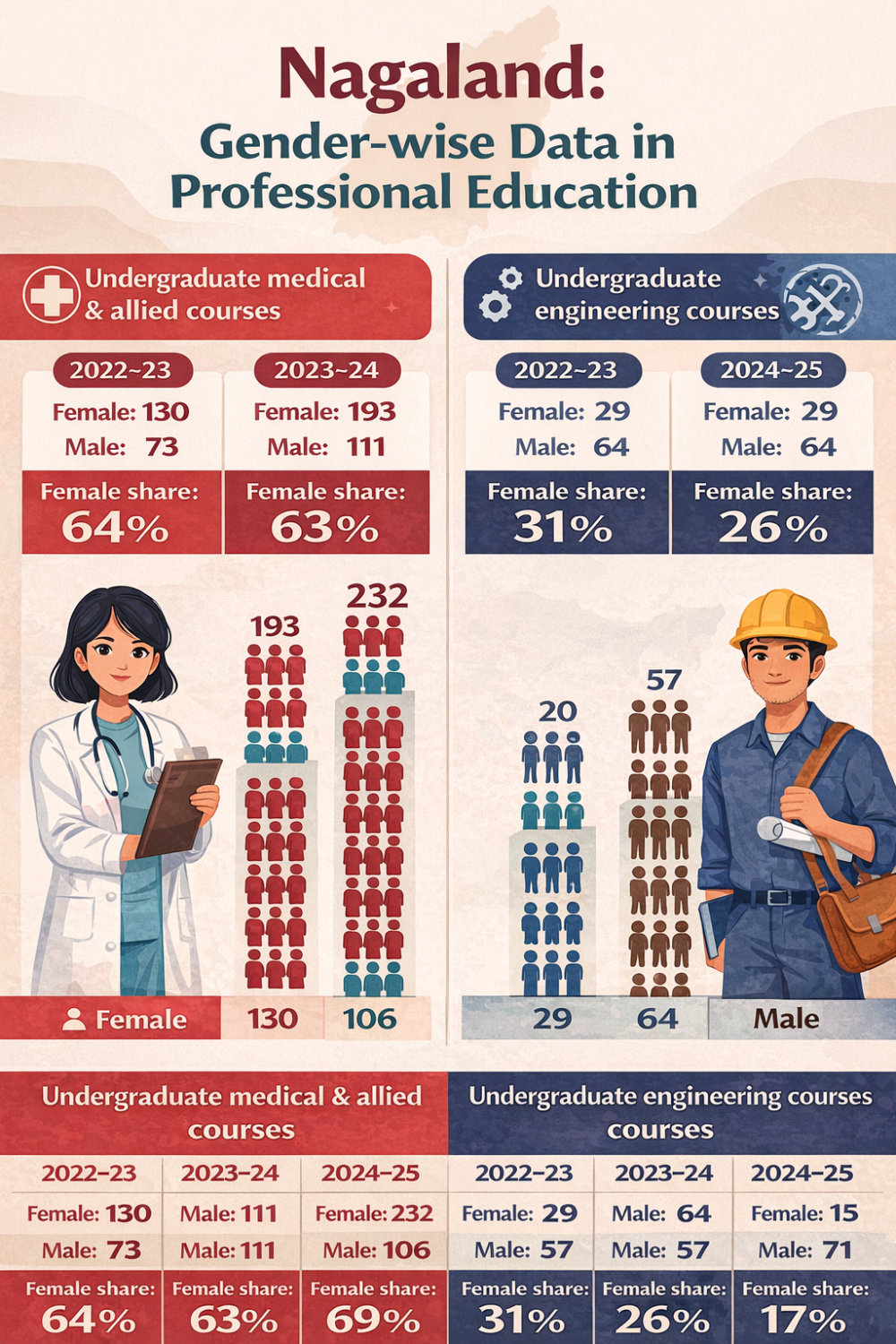
Data covering the academic years 2022–23 to 2024–25 shows that female enrolment in medical, para-medical and agriculture-allied undergraduate courses has consistently exceeded male enrolment.
In 2022–23, women accounted for 64% of total enrolment, with 130 female students compared to 73 males.
The trend continued in 2023–24, when 193 women were enrolled against 111 men, giving women a 63% share.
By 2024–25, the gender gap widened further, with 232 women and 106 men, indicating over two-third (69%) of students in these streams were female.
Course-wise data indicates strong female representation in programmes such as MBBS, BDS, B.Sc Nursing, B. Pharmacy, and B. Sc. MLT, among others.
Notably, MBBS enrolment has been female-dominated for the past few years. During the period from 2022–23 to 2024–25, out of 369 students opting for the MBBS course, 225 were women and 144 were men.
In proportional terms, women accounted for about 61% of total MBBS enrolment, translating to roughly six female students for every ten MBBS seats during the three-year period.
The gender gap widened further in 2024–25, when 95 women, nearly two-thirds of the intake, were enrolled, compared to 57 men, reinforcing the pattern of sustained female dominance in MBBS admissions.
Engineering remains male bastion
In contrast, undergraduate engineering courses continue to show a pronounced male skew.
In 2022–23, engineering programmes enrolled 29 women and 64 men, with women forming 31% of the total.
Female enrolment declined to 20 students in 2023–24, even as male numbers remained high at 57, reducing the female share to 26%.
By 2024–25, female enrolment fell further to 15 students, while male enrolment rose to 71, leaving women with just 17% of total engineering enrolment, despite overall enrolment increasing to 86 students.
Visible dominance across higher education
The increasing presence of women in Nagaland’s medical and allied professional sectors could be rooted in a broader trend across the state’s educational pipeline.
The Gender Statistics 2025 report, citing the Directorate of School Education (UDISE+) data, noted that total enrolment in Higher Secondary classes (Classes 11–12) in 2024–25 stood at 35,730 students, with 19,015 females and 16,715 males, indicating a clear female majority.
This trend was also evident in examination outcomes. In the HSSLC 2025 examinations, 7,820 female candidates cleared the exam, compared to 5,905 male candidates.
Likewise, in the HSLC 2024 examinations, 8,878 female candidates cleared the exam, compared with 7,893 male candidates.
At the tertiary level, AISHE data shows that out of 34,937 students enrolled across various streams in colleges in Nagaland, 19,239 were women and 15,698 were men, confirming that women continue to form the majority in higher education enrolment.
Representation in government employment improves but modest
Data from the Personnel Information Management System (PIMS), referred in the report, indicated a gradual improvement in female representation within Nagaland Government employment, even as overall workforce growth remains sluggish in recent years.
As per the PIMS report, women constituted 22.65% of total government employees in 2016, a share that rose to 27.54% by 2025, reflecting a steady but moderate increase over the nine-year period.
The highest representation of female government employees in 2025 was in Class-II posts (35.81%), followed by Class-I posts (33.71%). Female representation in Class-III and Class-IV posts stood at 29.39% and 22.99%, respectively.
However, among teaching staff, there was a clear female majority. Citing the Directorate of Higher Education’s AISHE report, Gender Statistics 2025 highlighted that out of 2,007 college teachers in Nagaland, 1,258 were women, while 749 were men.
Likewise, in school education, government teacher strength data for 2024–25 showed that out of 18,102 government teachers in Nagaland, 9,366 were women and 8,736 were indicating a marginal female majority.
Meanwhile, PIMS data further shows that overall employment growth in Nagaland Government service has remained negative in recent years. The average annual exponential growth rate of government employees stood at –0.03% in 2023, –0.02% in 2024, and –0.24% in 2025. Female employment growth followed a similar trend, registering –0.022% in 2024 and –0.025% in 2025.