

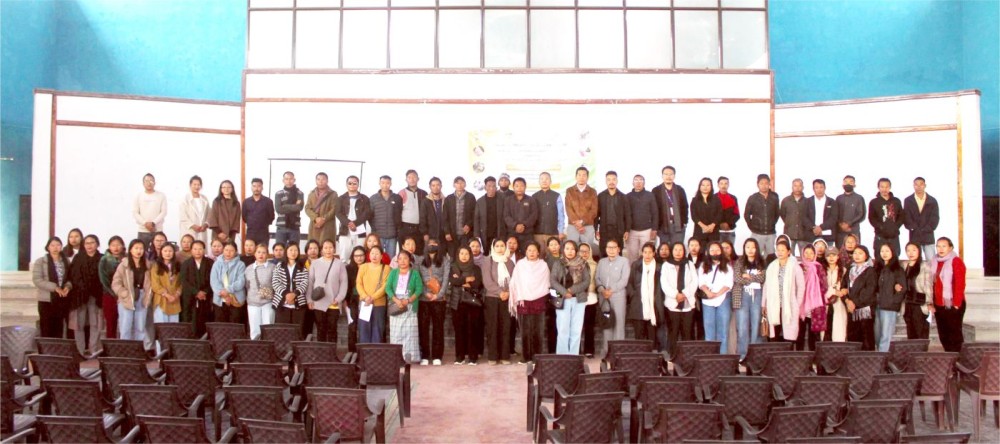
Kezhaletuo Khruomo, Functional Manager, MSME-DFO Dimapur along with others at PM Vishwakarma Awareness Workshop in Zunheboto on February 13. (Morung Photo)
Morung Express News
Zunheboto | February 13
A one-day awareness workshop under the PM Vishwakarma scheme to empower traditional artisans and craftspeople was organised by the MSME-Development & Facilitation Office Dimapur in association with the District Industries Centre Zunheboto at the Multipurpose Hall, Zunheboto, on February 13.
Delivering the keynote address, Er N Toky Chishi, General Manager, DIC Zunheboto, highlighted that the PM Vishwakarma scheme was launched on September 17, 2023, by the Ministry of MSME, Government of India.
He emphasised that the scheme covers 18 traditional crafts aimed at supporting rural and urban artisans across the country. The trades include carpenters, goldsmiths, potters, blacksmiths, tailors and basket, doll/toy makers, among others.
He described the scheme as one of the most beneficial bank-linked initiatives offering collateral free enterprise development loans at a concessional interest rate of 5%. The loan is provided in two tranches Rs 1 lakh for 18 months as the first installment and Rs 2 lakh for 30 months as the second installment. The government provides an interest subvention of up to 8%.
Chishi stated that the objective of the programme was to guide beneficiaries on product registration, packaging, marketing strategies and financial management. Concluding his address, he urged participants to cooperate and make the most of the learning opportunity provided through the programme.
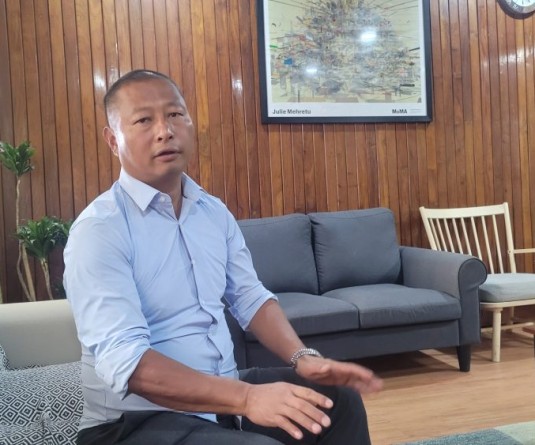
Kezhaletuo Khruomo, Functional Manager, MSME-DFO Dimapur highlighted various programmes and schemes under MSME and the Entrepreneurs Skills Development Programme (ESDP), which aims to build entrepreneurial skills. He noted that the PM Vishwakarma scheme provides artisans with training incentives and toolkits. He also spoke about international cooperation schemes, including trade fairs and exhibitions sponsored by the government.
Gloria Phuleshe, founder of Musa Mix, shared her experiences in product design. She stressed that design plays a crucial role in determining the value of a product, adding that first impressions matter greatly. She mentioned that she has customers in Zunheboto, Dimapur and other states, but prioritises serving local customers.
Drawing inspiration from films and social media, she has created more than 100 unique bag designs. She encouraged aspiring entrepreneurs to take on challenging tasks rather than opting for easy ones, as greater learning comes through challenges. She also advised artisans to become brand ambassadors for their own products, focus on investment and returns, and pay attention to finishing touches. Acknowledging that criticism is inevitable, she urged beneficiaries not to give up and to persevere.
‘Take on challenges, don't give up’
The State Programme Management Unit Team, Kohima, Sunep Tulu jamir elaborated on the PM Vishwakarma scheme, highlighting that it involves a three-step verification process at the village level and a two step verification process in urban areas. In Zunheboto, two training centres have been set up one at the ITI centre and another at KPA, Atoizu. However, most training sessions are conducted at the ITI centre due to accessibility issues in Atoizu. So far, three batches of basket-making training and one batch of carpenter training have been completed.
The training programme spans six days, during which biometric fingerprint attendance is mandatory. Upon successful completion, participants receive a stipend credited to their bank accounts. After
certification, applications are forwarded to banks for loan processing. The team underscored the wide range of opportunities available under the scheme.
The programme was earlier moderated by Ikupu Tuccu, Inspector, DIC Zunheboto. A session on branding and marketing was conducted by Gabriel, Area Coordinator, NSRLM RD. Financial literacy and banking insights were shared by Ploketo Awomi, Field Officer, SBI Main Branch, Zunheboto. The programme concluded with an interactive discussion session, followed by closing remarks from Er. N. Toky Chishi, GM, DIC Zunheboto.
.jpg)
.jpg)
.jpg)
