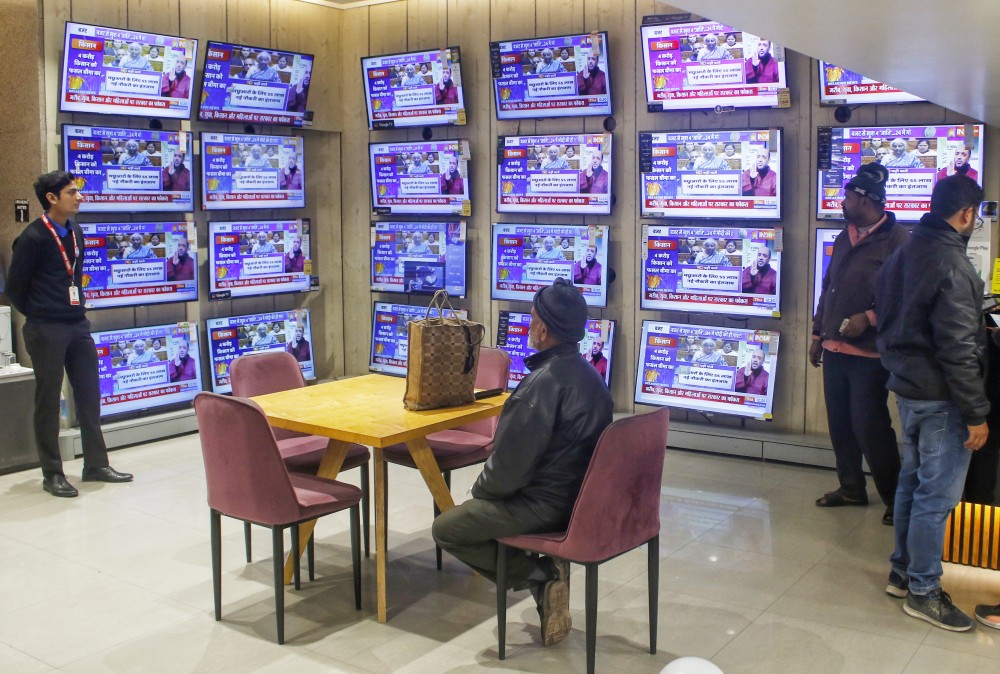
New Delhi : People watch Union Finance Minister Nirmala Sitharaman presenting the Interim Budget 2024 in Parliament, at a television showroom in New Delhi on Thursday, Feb. 1, 2024. (Photo: IANS/Wasim Sarvar)
New Delhi, March 24 (IANS) India’s media and entertainment (M&E) sector entered a decisive phase of scale, digital dominance and structural transformation in 2025, reaching Rs 2.78 trillion with a 9 per cent growth, outpacing nominal GDP expansion, according to a report.
As per a joint analysis by the FICCI and EY, the M&E sector is expected to grow 2.8 per cent to reach Rs 2.86 trillion ($32.9 billion) in 2026, and Rs 3.3 trillion ($37.9 billion) by 2028.
Digital media has emerged as the largest segment, accounting for over Rs 1 trillion in revenues. Digital advertising contributed 63 per cent of total ad spends, while subscriptions surged, driven by OTT platforms, premium sports and regional content.
In contrast, television continued its gradual decline, falling to Rs 617 billion in 2025 and expected to shrink further at a negative 5 per cent CAGR, even as total TV households are projected to cross 200 million by 2028.
A key structural shift is the rise of regional storytelling, with regional languages accounting for over half of OTT consumption and nearly two-thirds of film production.
The industry produced nearly 200,000 hours of content in 2025, led by television and supported by OTT and short-form formats, even as traditional media remains under pressure from shifting ad spends and declining subscriptions.
Advertising remained a major growth driver, expanding 13.5 per cent to Rs 1.5 trillion, led by digital formats, e-commerce and SME participation.
In live events, "The organised segment experienced a 44 per cent increase, fuelled by higher spending on ticketed events, personal functions such as weddings, government events and religious gatherings, including the Maha Kumbh Mela," the report noted.
However, the report flagged challenges, including declining pay-TV households, weak monetisation in news and regulatory disruptions in gaming, with the segment expected to contract at a CAGR of (-)22 per cent between 2025 and 2028.
Anant Goenka said the sector is at the forefront of India’s creative and digital transformation, driven by evolving audience behaviour and rapid technological change.
Calling 2025 a “pivotal inflection point”, Kevin Vaz said the industry has entered a new phase of “scale, innovation and transformation”. "These trends highlight an industry expanding in scale, innovating across platforms and embracing technology," he added.
The sector is projected to cross Rs 3 trillion by 2027 and reach Rs 3.3 trillion by 2028, with digital media driving growth and new formats such as creator-led platforms, micro-dramas and immersive experiences shaping the next phase.