Moa Jamir
Dimapur | June 21
The backlog of cases in Nagaland's district judiciary continued its gradual upward climb in May, with courts across the State unable to keep pace with the inflow of new cases.
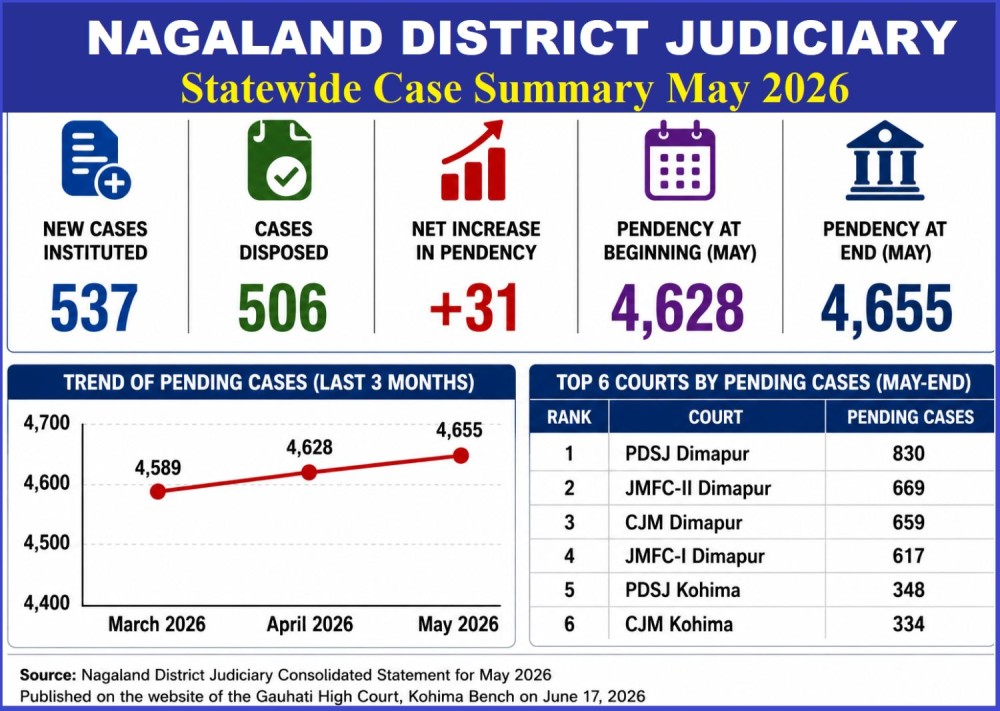
As per the Nagaland District Judiciary's consolidated statement for May 2026 published on of the Gauhati High Court, Kohima Bench website on June 17, courts across the State received 537 new cases during the month.
However, with total disposal at 506, the total pendency rose from 4,628 at the beginning of May to 4,655 by month-end.
The latest figure continued a three-month upward trend in pending cases, rising from 4,589 at the end of March to 4,628 in April and 4,655 in May.
Dimapur bears bulk of judicial caseload
Meanwhile, Dimapur remained the focal point of the State's caseload with more than half of the 4,655 pending cases concentrated in five courts in the commercial hub.
The Principal District and Sessions Judge (PDSJ) Court, Dimapur, had the highest pendency in the State with 830 cases, followed by Judicial Magistrate First Class (JMFC)-II, Dimapur, with 669 cases, Chief Judicial Magistrate (CJM), Dimapur, with 659 cases, and JMFC-I, Dimapur, with 617 cases.
At the end of May, 148 cases were pending before the Family Court, Dimapur, while the State's sole Fast Track Special Court (FTSC), also based in the district, had a pendency of 47 cases.
Together with the district's other courts, the total pending caseload stood at 2,970 cases in Dimapur, accounting for nearly two-thirds of all pending cases in Nagaland's district judiciary.
The disposal pattern within Dimapur also reflected significant variation. While both the PDSJ and CJM courts disposed of 102 cases each during the month, JMFC-I and JMFC-II disposed of only three and 14 cases, respectively, contributing to a rise in their pending caseloads.
In contrast, some courts succeeded in reducing their backlog. The PDSJ, Kohima, disposed of 59 cases against 57 fresh filings, bringing pendency down to 348 cases.
The CJM, Kohima, recorded an even sharper reduction, disposing of 51 cases against 29 new institutions and reducing its pending caseload to 334.
Several other courts, including the District and Sessions Judge (DSJ) courts in Wokha, Tuensang, Mon and Kiphire also ended the month with fewer pending cases than they had at the beginning.
Zero disposals
On the other end, the CJM Court, Mokokchung recorded neither fresh case institution nor disposal during May, leaving its pending caseload unchanged at 104 cases.
It was the only court in the State to register zero disposals during the month.
The figure represents an improvement from April, when six courts reported no case disposals: JMFC-II, Dimapur; JMFC, Zunheboto; JMFC, Kohima; DSJ, Mon; DSJ, Longleng; and DSJ, Kiphire.
In March, PDSJ, Tuensang; JMFC, Tuensang; DSJ, Mon; CJM, Longleng; and DSJ, Kiphire recorded zero disposals.
Steady increase in case backlog
While the overall increase in May was modest, the figures suggest that the district judiciary has yet to consistently dispose of more cases than it receives, allowing the backlog to inch upward month after month.
This is evident from the Annual Administrative Report 2025–26 of the Department of Law and Justice, Nagaland, tabled in the Nagaland Legislative Assembly in March 2026.
According to the report, pending cases in the subordinate courts, or district judiciary, increased from 3,911 at the beginning of 2025 to 4,363 by year-end, representing an increase of 452 cases, or 11.6%.
The rise appeared to have continued into 2026.
By the end of May, pendency had climbed further to 4,655 cases, an increase of 292 cases, or nearly 6.7%, over the December 2025 figure.
Notably, the increase recorded in the first five months of 2026 amounts to nearly two-thirds of the total rise registered during the whole of 2025.
In contrast, the Gauhati High Court's Kohima Bench recorded an improvement in pendency during 2025. The total number of pending cases declined from 883 at the end of 2024 to 826 by December 2025, a reduction of 57 cases, or 6.5%, reflecting higher disposal rates across key case categories.