Snapshot of the office of the Transport Commissioner, Nagaland’s responses to queries from The Morung Express on the State’s vehicle profile. (Image created with AI assistance)
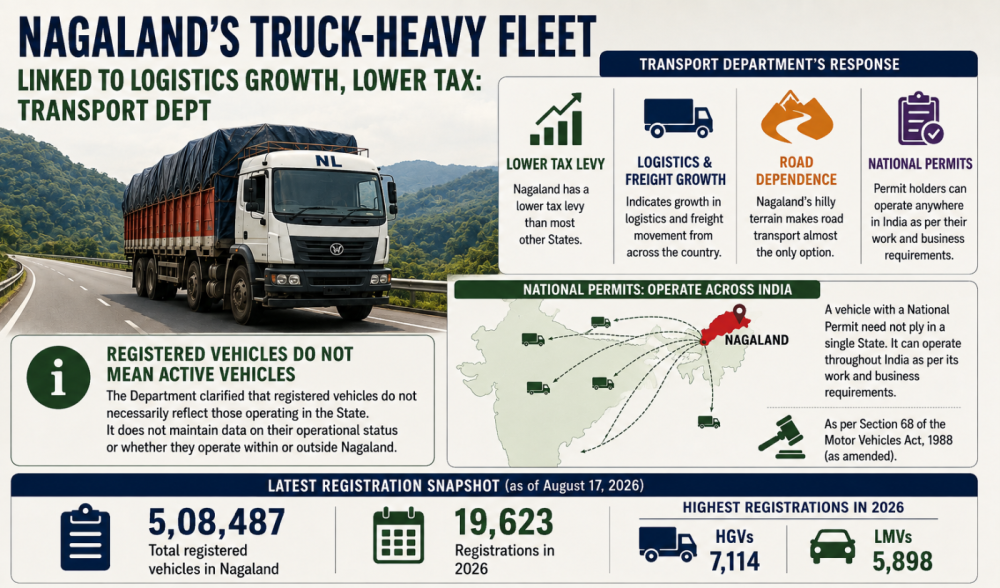
• Truck-heavy fleet linked to logistics growth, lower tax
• Road dependence, National Permits also shape vehicle profile
• No data on operational patterns
• Transport collections substantial
Moa Jamir
Dimapur | August 17
Nagaland’s unusually truck-heavy vehicle registration profile may be linked to the State’s growing logistics and freight movement, comparatively lower vehicle tax and near-total dependence on road transport, according to the State Transport Department.
Responding to queries from The Morung Express following its analysis of data on the VAHAN Dashboard, the department pointed to Nagaland’s “lower tax levy than most other States” as one factor behind the concentration of heavy and goods-carrying vehicles.
It also cited the State’s hilly terrain and dependence on road transport for logistics and freight movement.
However, the department does not maintain data on how many of the 5,04,942 registered vehicles are operational or whether they primarily operate within or outside Nagaland.
The response follows queries sent to the Office of Transport Commissioner Nagaland after The Morung Express’s July 9 report, “Nagaland: A Truck State?”, which found that nearly 40% of the State’s registered vehicles were HGVs or HMVs (Heavy Goods/Motor Vehicles), while Goods Carriers accounted for more than 83% of its transport fleet. (Read the previous report here: “Nagaland: A Truck State?”
Registration does not mean active vehicles
The Transport Department clarified that the 5.04 lakh registrations should not be interpreted as the number of vehicles currently operating on Nagaland’s roads.
Unless a vehicle is reported by its owner as inactive or off-road, the VAHAN data will show it as active, it noted.
Once a vehicle migrates to another State and registration number is reassigned, it will no longer be shown as an active vehicle of Nagaland, it added.
However, when asked whether it maintains any data or assessment of the operational patterns of vehicles registered in Nagaland, including whether they are primarily used within the State or outside it, the department simply stated: “No.”
Lower tax, logistics among factors
Meanwhile, the department attributed the high concentration of heavy vehicles and goods carriers, at least in part, to taxation.
“It may be noted that our State has a lower tax levy than most other States,” the department stated, without elaborating.
The response did not quantify the difference in tax rates or indicate how much of Nagaland’s vehicle registration pattern could be attributed to the State’s tax regime.
The department also linked the vehicle profile to logistics and freight movement, stating that it indicates growth in logistics and freight movement in the State “from across the country”.
It noted that Nagaland is a hilly State with “almost total dependence on road transport” for logistics and freight movement within the State.
The explanation provides some context to the figures identified in the earlier report. Of the over 5.04 lakh registration, 2,50,800 were classified as transport vehicles. Within that category, 2,08,299, or more than 83%, were Goods Carriers. HGVs and HMVs together numbered 1,99,346.
National Permits point to wider operations
The high share of National Permits also requires qualification, according to the department. The earlier analysis found that 1,15,981, or 82.5%, of the 1,40,667 permits recorded in State data were National Permits. The majority of these were processed through the Transport Commissionerate under registration code NL-99.
The department said National Permits in Nagaland are issued by the Secretary of the State Transport Authority under State Code NL-99, which operates in the office of the Transport Commissionerate, with the Transport Commissioner serving as the Secretary of the State Transport Authority.
A vehicle operating on the strength of a National Permit, it said, “need not necessarily ply in a single State” and can operate throughout the territory of India as its work and business requires.
The department said the competencies are exercised in accordance with Section 68 of the Motor Vehicles Act, 1988, as amended.
The presence of Nagaland-registered commercial vehicles on highways across the country has also prompted recurring questions in online discussions and public forums about why so many such vehicles are registered in the State and whether they primarily operate within or outside Nagaland.
The department’s response provides some context to these observations, pointing to the State’s lower tax levy while noting that National Permit holders can operate across India.
Clarification on revenue
The Department also clarified that the transport revenue target cited in the query as Rs 25 crore “appears to be wrong”. The Annual Administrative Report 2025-26 records the target at Rs 24,000 lakh (Rs 240 crore).
The Department’s response further states that Rs 27,474.63 lakh (around Rs 274.75 crore) was collected during 2025-26 through VAHAN and Sarathi, including vehicle-related taxes and fees. This broadly aligns with the Rs 265.23 crore in transport revenue collections recorded on the VAHAN Dashboard for 2025.
The figures indicate the substantial revenue generated for the State through the motor vehicles system, including taxes and fees collected through vehicle registration, permits and other related transactions.
Overall, the Department’s response links Nagaland’s truck-heavy registration profile to its lower tax levy, growing logistics and freight movement, near-total dependence on road transport and the wider operations enabled by National Permits.
Meanwhile, as of August 17, vehicle registrations in Nagaland stood at 5,08,487, including 19,623 registrations in 2026. HGVs accounted for the highest share of 2026 registrations at 7,114, followed by Light Motor Vehicles (LMVs) at 5,898.
Transport Commissioner Nagaland’s responses on State’s Vehicle Profile | ||
| Query | Response |
1 | The VAHAN Dashboard indicates that Nagaland's registered vehicle fleet has crossed 5.04 lakh vehicles (5,04,942 as of July 7, 2026). Does this figure represent all vehicles ever registered in the state, or only those currently considered active? If the former, approximately how many registered vehicles are presently operational? | The data includes all registered vehicles in the state. So long as a vehicle is not reported by the Owner on its status, whether active or off road, the Data will show as active. Once a vehicle migrates to another state and is reassigned that state’s registration number, the data of that particular vehicle will not be shown as an active vehicle of the state. |
2 | Does the Department maintain any data or assessment on the operational patterns of vehicles registered in Nagaland, including whether they are primarily used within the state or outside it? If so, could the Department share its observations? | No. |
3 | The VAHAN Dashboard shows nearly 2 lakh Heavy Goods Vehicles and Heavy Motor Vehicles, along with over 2.08 lakh Goods Carriers, making commercial freight vehicles the largest component of Nagaland’s registered fleet. What factors does the Department believe best explain this vehicle profile? | It may be noted that our State has a lower tax levy than most other states. |
4 | The Department's Annual Administrative Report 2025-26 refers to a revenue target of around ₹25 crore for 2025, whereas the VAHAN Dashboard records transport revenue collections of ₹265.23 crores for the same period. Could the Department clarify what those two figures represent and explain the apparent difference between them? | The Department is consistent in its progressive collection of revenue for the State. Collection often exceeds the target set by the State. The Vahan data records only the collections, tax and fees, on vehicles. The Department collected an amount of Rs.27474.63 lakhs during the 2025-26 which includes collection in both Vahan and Sarathi. Clarification: The query above incorrectly cited the transport revenue target as approximately Rs 25 crore. The Annual Administrative Report 2025-26 records the target as Rs 24,000 lakh (Rs 240 crore). Thus, the Department’s reported collection broadly aligns with the Rs 265.23 crore recorded on the VAHAN Dashboard for 2025. |
5 | State records indicate that over 82% of permits issued in Nagaland are National Permits, with most issued through the Transport Commissionerate (NL-99). What factors explain this concentration, and does it reflect the operational profile of commercial vehicles registered in the state? Does fall in recent times reflect changes in policy, administrative procedures, permit categories, or other factors? | In Nagaland, the National Permits are issued only by the Secretary of the State Transport Authority under State Code NL-99 which operates in the office of the Transport Commissionerate with the Transport Commissioner as the Secretary of the State Transport Authority. |
6 | Overall, does the Department consider the present vehicle profile to be indicative of Nagaland's growing logistics, freight movement and infrastructure sectors, or are there other factors that better explain the trends reflected in the VAHAN database? | Yes, to a certain extent only. A vehicle that is registered in the State and has availed the National Permit from the State does not necessitate it to operate within the State but throughout India. As observed by you, it also indicates growth in logistics and freight movement in the State from across the country. Nagaland is a hilly State with almost total dependence on road transport for its logistics and freight movement within the State. |
Source: Official response from the Transport Commissioner, Nagaland, to queries from The Morung Express.