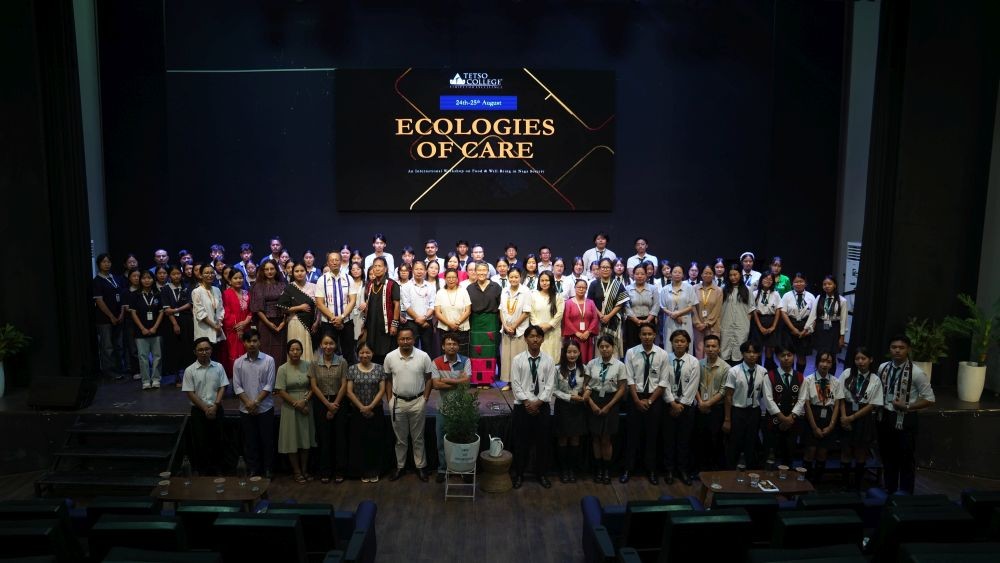
Organisers, participants and representatives from collaborating institutions at the Ecologies of Care workshop at Tetso College held on August 24 and 25. (Photo Courtesy: Tetso College)
‘Ecologies of Care’ international workshop culminates
Chümoukedima, August 25 (MExN): A two-day international workshop on food, ecology and community well-being in Naga society concluded Tuesday with a deep concern that younger generations are losing connection to traditional food systems and with them, the seeds, knowledge and cultural practices that have sustained their ancestors for centuries.
“There is no food system without the seed system,” said Seno Tsuhah, an indigenous food sovereignty activist, in her keynote address at the “Ecologies of Care” international workshop hosted at Tetso College, Chümoukedima. “While a seed may be small, it has the potential to provide food and sustain future generations.”
Tsuhah, who spoke on the opening day, highlighted the importance of inheritance and carrying traditional knowledge forward, expressing concern over the growing disconnect between younger generations and traditional food systems, stated a press release.
She expressed concern over growing dependence on market-based food and commercially produced seeds, questioning whether food production is being driven by profit or community well-being.
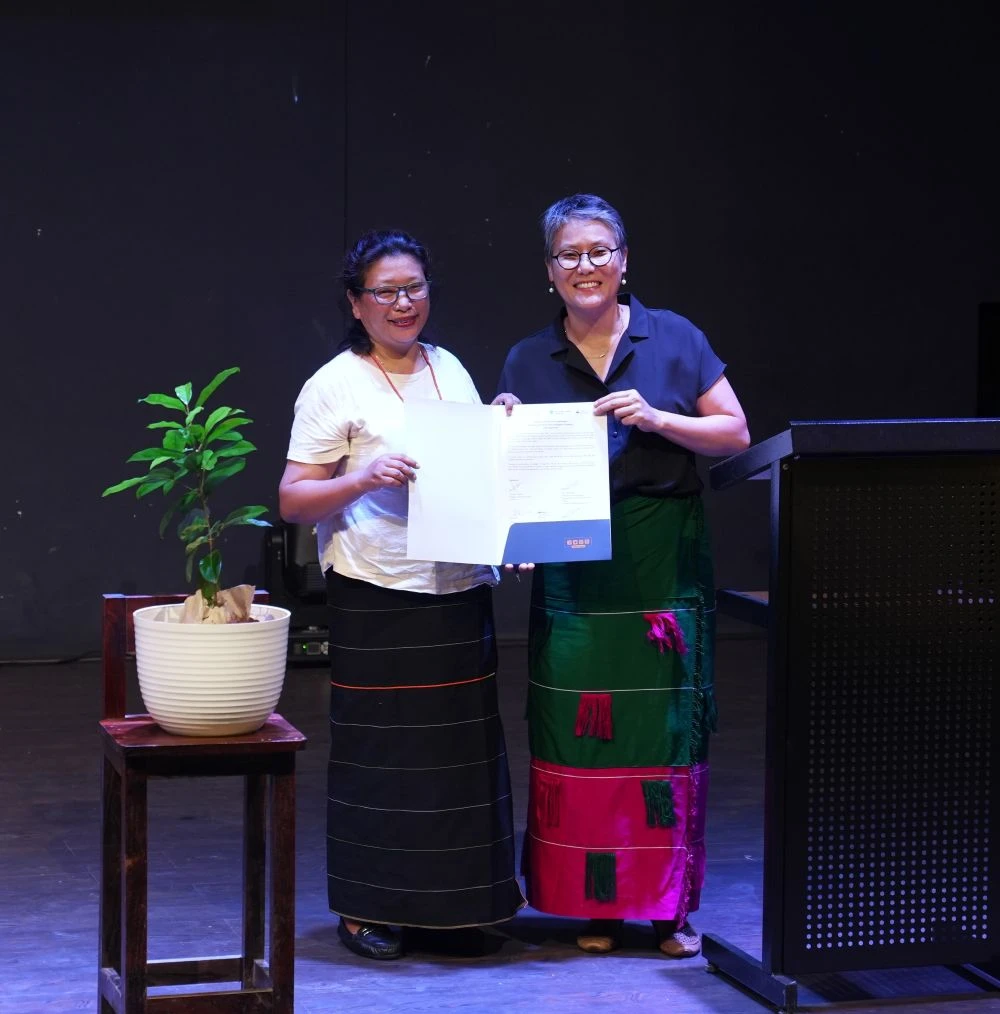
She called for greater intergenerational knowledge exchange and cautioned that preserving seeds is not just about agriculture but about restoring dignity and indigenous identity.
“Preserving seeds can help restore dignity and indigenous knowledge,” Tsuhah had said in her address, “while also giving communities greater freedom over what, where and how they grow their food.”
The workshop, held on August 24-25, brought together scholars, farmers, students and food practitioners to reflect on Naga food systems, ancestral farming, seed preservation and the relationship between faith, culture and nutrition. It was organised collaboratively by Tetso College, Unity College, Asufii Christian Institute (ACI) (Autonomous) Mao, and University of California, Santa Cruz, Centre for South Asian Studies.
.webp)
A central outcome was the launch of seed libraries at all three participating institutions under the initiative “Save a Seed Today: Save the Future.” Conceived under the guidance of Prof Dolly Kikon Professor of Anthropology & Director of Centre for South Asian Studies, University of California, Santa Cruz, it aims to promote seed preservation and foster a greener future among students.
Dr Prithibi Prathibha Gogoi, head of sociology at Tetso College, described seed saving as a cultural tradition, not a modern innovation. “Seed saving now will preserve the food in the future,” she said. Students from the college have already collected seeds from more than six districts, including varieties sourced from weekly markets.
On the second day, technical sessions turned to ancestral foodways and the decline of traditional grains. Dr Daili Neli, Principal of ACI (Autonomous), highlighted the nutritional importance of millet known as Osütho in the Mao Naga dialect and lamented that some varieties are now kept only for decoration. He urged four steps to reverse the trend: Remember, Document, Research and Revive. “Food is more than what we eat,” he said. “It carries cultural knowledge and practices passed down through generations.”
Dr Mary N Odyuo of Nagaland University cautioned that because Naga traditions rely largely on oral transmission, there is a real risk of losing knowledge, practices and customs over time without continuous practice and documentation.
.webp)
A panel discussion titled “The Naga Plate: Where Does Our Food Come From?” explored the intersections of farming, faith and food. Dr James Kalong, a professor of New Testament interpretation, Oriental Theological Seminary, reflected on food as a relational element that connects communities. “Food can connect,” he said, urging participants to consider who grows their food, how it is produced and how the environment is treated in the process.
Farmer Thejiano Makritsu spoke about changes in farming practices and eating habits over the years, emphasising the importance of preserving traditional seeds and noting that their significance was declining with the increasing availability of hybrid seeds. She urged to grow whatever food they could and stressed the need for the present generation to continue farming, sowing seeds and producing food for future generations.
Chef Aketoli H Zhimomi, who has introduced Naga cuisine to audiences outside Nagaland, noted growing interest in Naga food but stressed that the cuisine extends beyond commonly known dishes like smoked meat and fermented soybeans. She highlighted that food tourism could strengthen both the local economy and grassroots preservation of ethnic foods.
The workshop concluded with the signing of the “Naga Well-being Pedagogy Vision” reaffirming a commitment to sustain seed libraries, farming, ecological knowledge and community well-being.