

Former Nagaland Minister Y Vikheho Swu addressing the Cultural Night at Trinity Theological College (TTC), Dimapur, held as part of the National Seminar on ‘Decolonizing Knowledge: Reclaiming Indigenous Identity’ on February 5.
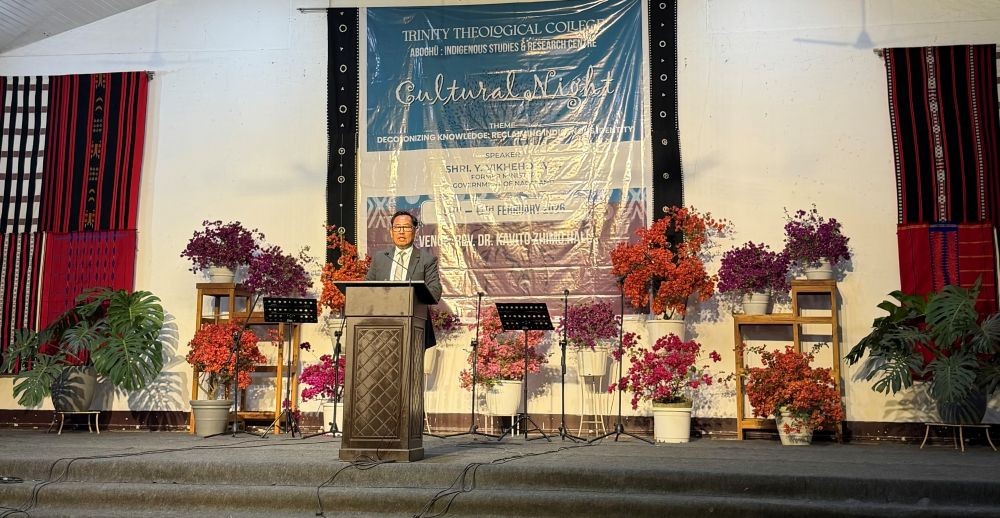
DIMAPUR, FEBRUARY 6 (MExN): Former Nagaland Minister Y Vikheho Swu on February 5 said a strong Naga identity is fundamental to the collective pursuit of peace, justice and truth, while addressing the Cultural Night at Trinity Theological College (TTC), Dimapur, held as part of the National Seminar on ‘Decolonizing Knowledge: Reclaiming Indigenous Identity.’
“A strong unwavering Naga identity is not merely cultural pride. It is the very foundation that enables and strengthens our collective journey towards peace, justice and truth,” Swu said.
Swu said he initially felt apprehensive about speaking on the theme due to the academic nature of the subject but accepted the invitation to share experiences related to indigenous initiatives taken by the Naga Students’ Federation and the Naga Peoples’ Movement for Human Rights.
Quoting Native American leader Chief Dan George, Swu highlighted the historical impact of colonization on indigenous peoples. He also outlined how indigenous issues gained global recognition, referring to the UN declaration of 1993 as the International Year of the World’s Indigenous Peoples and subsequent UN mechanisms including the UN Declaration on the Rights of Indigenous Peoples.
Highlighting the Naga response to the 1993 declaration, Swu recalled the year-long observance led by NSF and NPMHR, culminating in the “Naga Week” celebration at Kohima from December 1 to 5, 1993. He said 28 Naga tribes constructed traditional huts during the event and described it as one of the largest Naga gatherings after the 1951 plebiscite.
Swu said the event marked the first international participation of NSF and NPMHR in indigenous forums such as the Asia Indigenous Peoples Pact and noted that NPMHR is a founding member of the organisation.
Addressing colonization in the Naga context, Swu said British colonial expansion fragmented Naga society and later political boundaries divided Naga-inhabited areas across several states and Myanmar. He said while Western education brought political consciousness and social reform, it also contributed to the erosion of indigenous institutions such as the morung system.
Swu said indigenous heritage must be preserved alongside modern development. He congratulated TTC for initiating academic discussion on indigenous identity and wished the seminar success.
The National Seminar on “Decolonizing Knowledge: Reclaiming Indigenous Identity” is being held at Trinity Theological College, Dimapur, on February 5 and 6.
The programme was led by Skyli Achumi, assistant professor, TTC, with invocation by Dr Vivi Achumi, associate professor, welcome address by Dr Hukato N Shohe, principal, TTC, and benediction by Arev Dr James Inaho Swu, associate professor, TTC. The event featured cultural attire displays, presentations on Sumi folk dance, fusion dances and other cultural performances.
.jpg)

.jpg)
