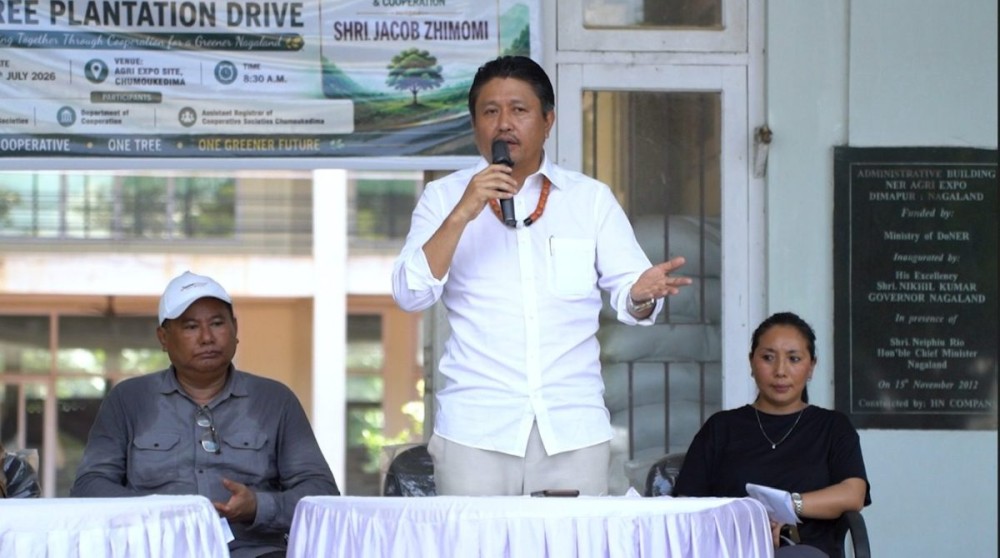
Nagaland PHED Minister Jacob Zhimomi at the culmination programme of Cooperative Week 2026: Sahakar se Samriddhi (Prosperity through cooperation) in Chümoukedima, on July 6. (Morung Photo)
Morung Express News
Dimapur | July 6
Nagaland Minister for Public Health Engineering Department (PHED), Jacob Zhimomi, said that success of state policy-framing and development implementation is directly linked to enumeration of accurate demographic data. The Minister made the comment at the culmination programme of Cooperative Week 2026: Sahakar se Samriddhi (prosperity through cooperation) in Chümoukedima, on July 6. A tree plantation drive was also organised as a part of the event. With development funding relative to head-count, Nagaland has a history of inflating demographic figures. However, he said that imprecise, or falsifying, demographic data sends planning and resource allocation into disarray. Zhimomi urged citizens to ensure honest representation in the Census 2027, the house-listing process for which is on already.
In 2011, Nagaland’s population rate nosedived to negative figures (-0.58 percent), after recording growth rates 50 percent that of the national average, over the preceding Censuses.
As per the 2011 Census, Nagaland’s population was 19.78 lakh. While stating that the population has grown to an estimated 20.5 lakh since then, Zhimomi insisted against individuals maintaining registrations in multiple places. “Without exact data, we are lagging behind,” he said, stating that residents must choose a single, genuine place of representation.
Turning to the state's financial structure, Zhimomi called on cooperative societies to drive Nagaland's transition from a consumerist economy to a manufacturing one. He said that the local markets are inundated with imported consumer goods, and that the state should work towards reversing the consumerist trend. Cooperatives are one of the key players to realising this vision, he said.
He urged cooperatives to build sustainable local businesses through agricultural and allied-sector production. “If we only consume, borrow, and don't manufacture anything, what will we eat?” he questioned, adding that economic strengthening must start at the village level.
However, he noted that only about 2000 of Nagaland’s 8200 registered cooperative societies are currently active.
The Minister also called for putting an end to the Naga penchant for availing government subsidies without producing tangible results on the ground. Citing data, he said that the success rate of enterprises dependent solely on subsidies is less than 10 percent. “If our priority is only to think about subsidies, we will fail,” he said. According to him, public grants should serve as value additions to existing businesses, not as the primary incentive to establish them.
Zhimomi further addressed the reluctance of commercial banks to provide credit in the state, attributing it to historically poor recovery rates and high loan default volumes. He explained that financial institutions remain hesitant to extend loans because borrowers frequently fail to meet repayment obligations. To establish financial accountability, he highlighted the ongoing central government computerisation of Primary Agricultural Credit Societies (PACS), which will mandate the triennial update of member records.
Furthermore, he said that Chümoukedima, alongside Dimapur and Niuland, is poised to become one of the commercial hubs of Nagaland. He added that realising this potential would require cooperative societies across the three districts establishing joint networks, mirroring integrated models like the National Capital Region (NCR).