Morung Express News
Kohima | March 15
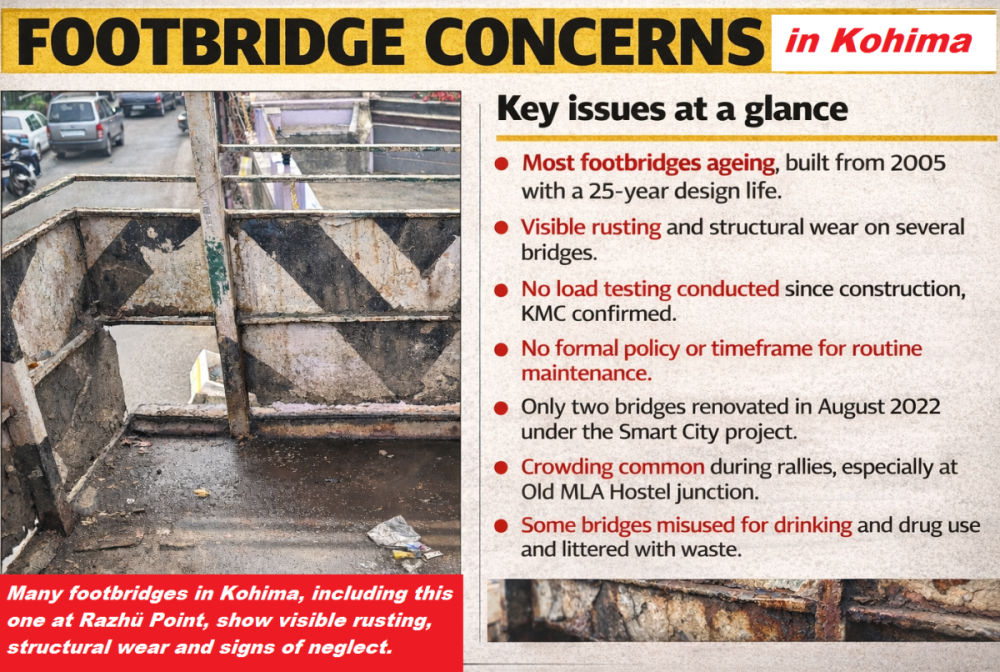
Several pedestrian footbridges in Kohima that serve thousands of daily commuters are showing visible signs of rusting and structural wear, raising fresh safety concerns even as official disclosures point to gaps in their maintenance.
Information obtained under the Right to Information (RTI) Act, 2005 has revealed shortcomings in the maintenance of ageing metal overbridges located at High School Junction/Police Point, Razhü Point, Old MLA Hostel Police Point and above Mezhür Higher Secondary School.
The revelations came in response to an RTI application filed by a concerned citizen seeking details about the pedestrian metal foot overbridges in these areas.
Site visits by The Morung Express also found visible corrosion and structural wear on several of the footbridges, raising concerns about their structural integrity and pedestrian safety.
With the bridges approaching the end of their minimum design life in the coming years, the RTI responses highlight the need for structural assessments, periodic maintenance and safety audits to ensure that the infrastructure remains safe for public use.
The absence of load testing has also raised safety concerns, particularly during public rallies and demonstrations when large numbers of people often gather on the footbridges.
This is especially common at the Old MLA Hostel junction, where the bridge frequently becomes crowded.
According to information provided by the Urban Engineering Wing (UEW) under the Directorate of Urban Development, construction of these pedestrian footbridges began in 2005 and the structures were designed for a minimum lifespan of 25 years.
.webp)
When asked about the timeframe or government policy for routine maintenance of the footbridges, the department stated that after construction was completed, the structures were handed over to the Kohima Municipal Council (KMC) for operation and maintenance.
Regarding queries on whether any maintenance work had been carried out on the metal structures by qualified engineers or technical experts and whether any load testing had been conducted, the Urban Engineering Wing (UEW) responded that “the same may be sought from KMC.”
In a subsequent RTI response, the KMC informed that renovation works were carried out on two of the footbridges—at Old MLA Hostel Police Point and Razhü Point, in August 2022 under the Kohima Smart City Development Limited project.
.webp)
However, the council also confirmed that no load testing has been conducted on any of the footbridges since their construction.
The council further stated that there is currently no formal timeframe or specific government policy in place for routine maintenance of these metal pedestrian structures.
Maintenance lapses and misuse
Although built to ensure safe pedestrian passage, the foot overbridges are reportedly being used for drinking and drug use, and are frequently littered with waste and red betel nut spit.
In an earlier report, this newspaper had also highlighted the poor condition of the bridges, including the presence of human excreta on one of the structures.
Meanwhile, speaking on condition of anonymity, an official acknowledged that the bridges may have already exceeded their intended lifespan.
“I’m afraid they may have outlived their lifespan. It is not without risk. Even earlier, signs were emerging that they were beginning to pose hazards,” the officer said.
The official also noted that pedestrian-friendly infrastructure remains limited in many towns and cities despite the growing need for safe walkable spaces.
Calls for Sector Magistrate, civic responsibility
At the same time, he stressed that civic responsibility must go hand in hand with governance. “To improve the situation, we must invest in public sensitisation campaigns and strengthen monitoring through coordination among the district administration, police, the Municipal Affairs Department, Urban Development Department, KMC, and local wards.”
He further suggested activating the system of Sector Magistrates under the Deputy Commissioner, noting that Kohima is already divided into sectors, each overseen by designated officers.
“By introducing a standard monitoring template and requiring monthly reports from these Sector Magistrates on issues such as sanitation, roadside parking, building materials, liquor outlets, and public spaces, authorities could significantly improve urban management,” he stated.
He added that if implemented sincerely, such a system could produce positive results, noting that Kohima’s relatively small size makes coordinated monitoring more feasible.
“I am very critical of the fact that those of us who are paid to do the job do not always do it, but conveniently heap the blame on the citizens. If we sincerely show our efforts, the public will slowly but surely comes out volunteering.”