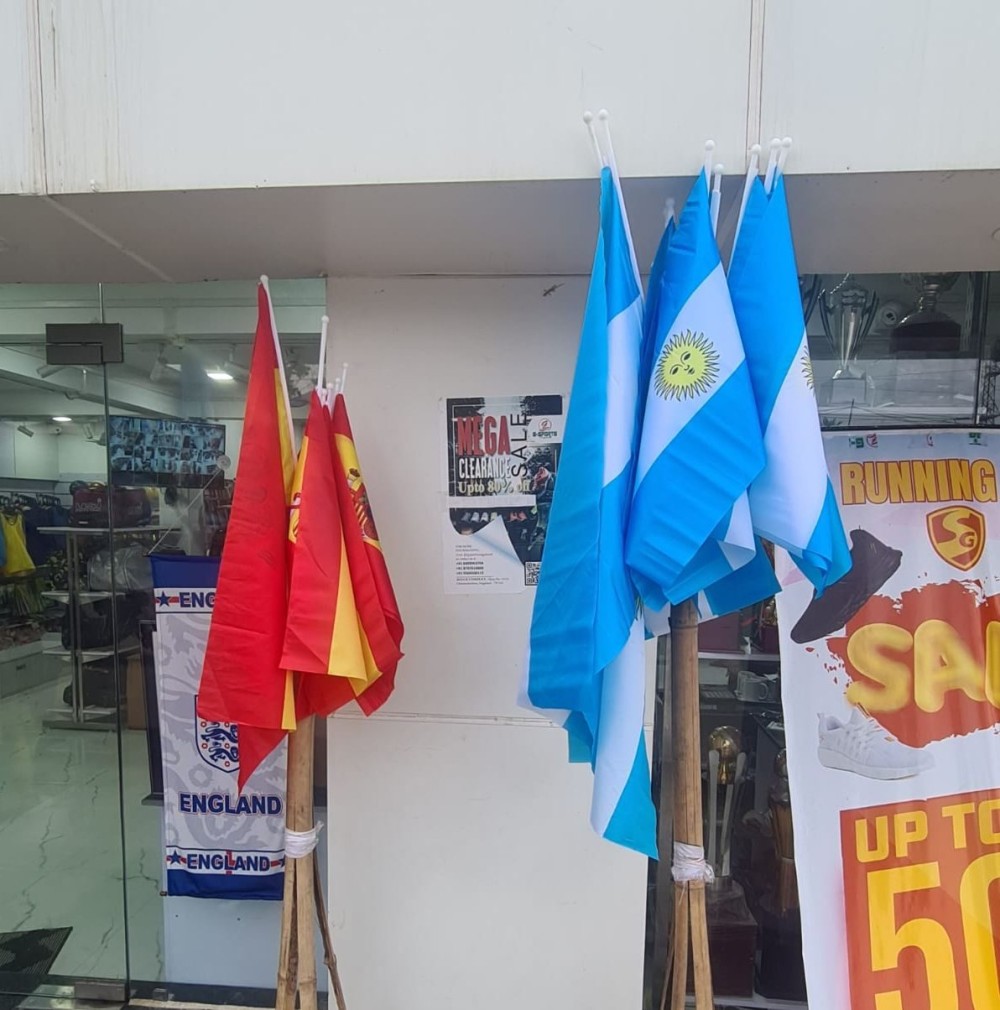
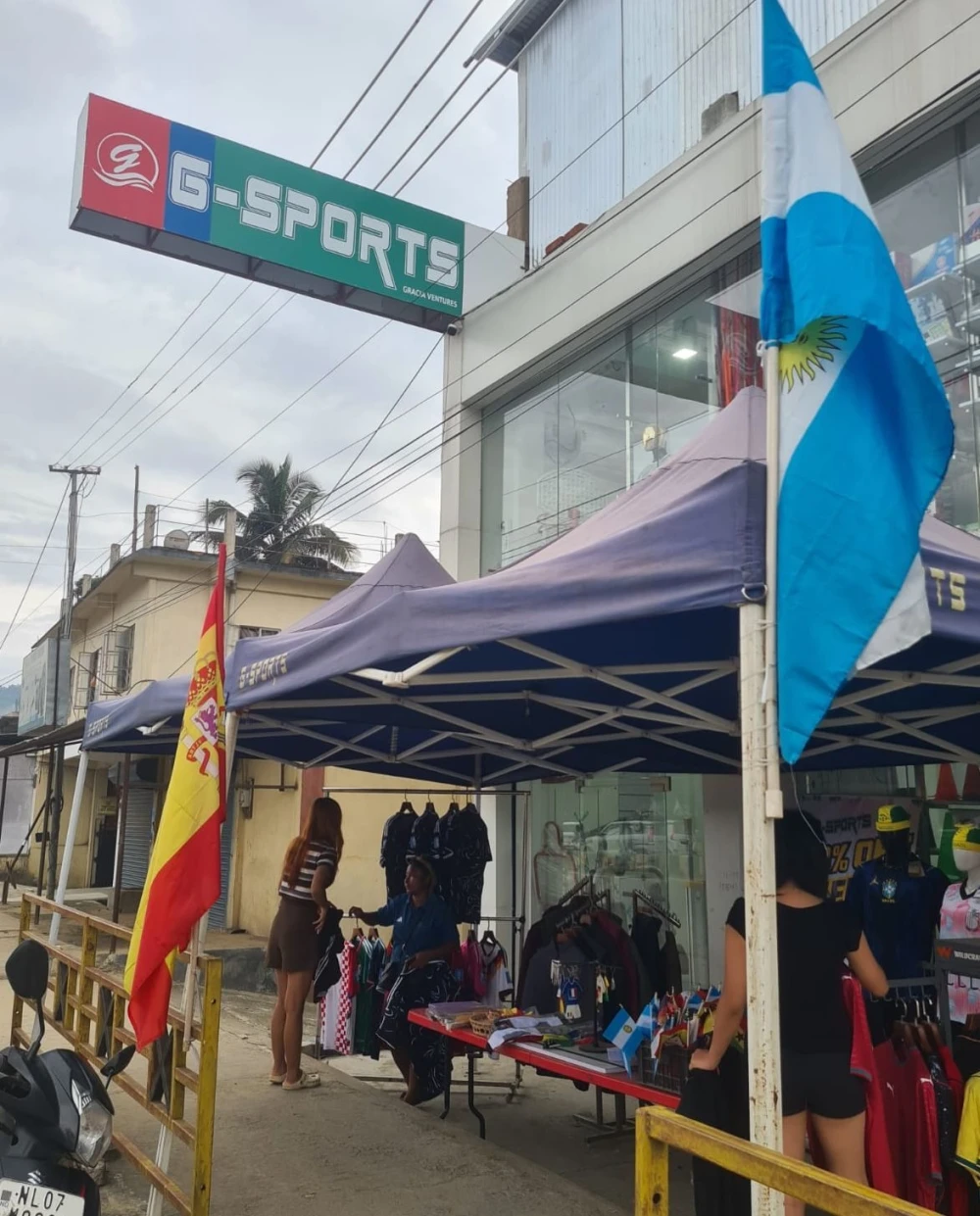
The Spanish and Argentine flags are seen outside a shop in Chümoukedima on July 18, the penultimate day of the 2026 FIFA World Cup. (Morung Photo)
Moa Jamir
Dimapur | July 18
And then there were two.
After 47 days, 104 matches and a World Cup bigger than any before it, football has arrived at its simplest equation: Argentina or Spain.
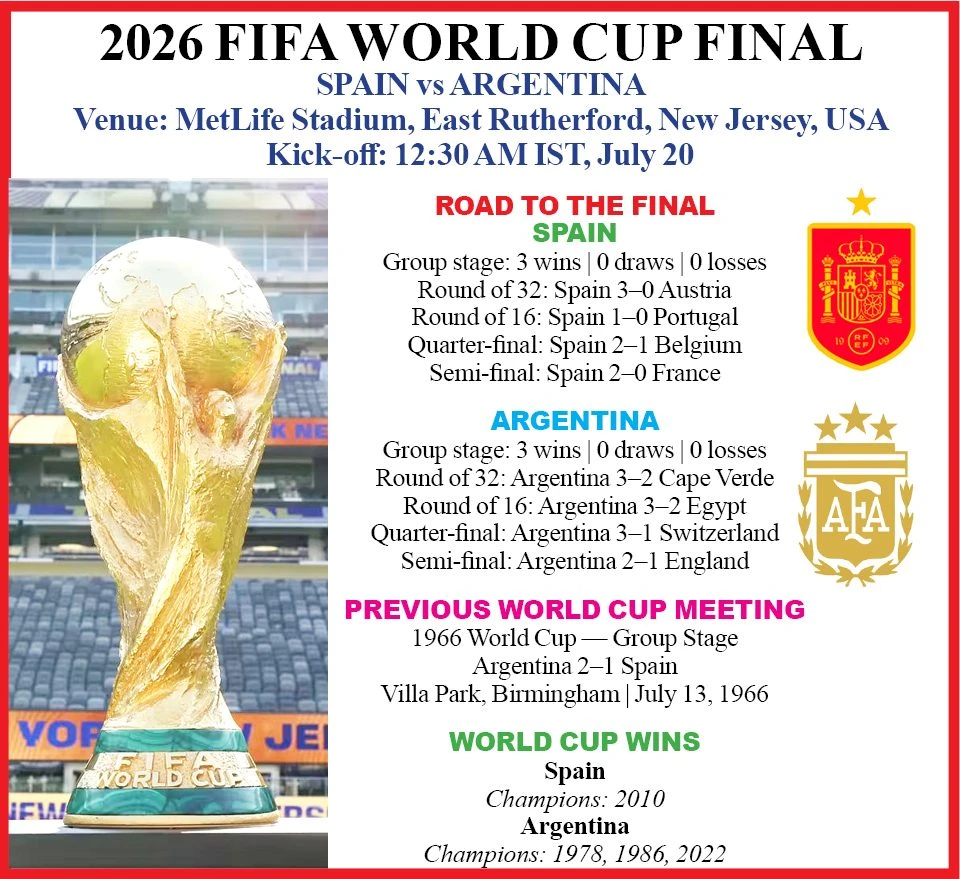
On Sunday, the champions of South America and Europe, and the top two teams in the FIFA rankings, meet at the New York New Jersey Stadium with the little matter of becoming champions of the world to settle.
For Argentina, history means a fourth star and back-to-back World Cups, something not achieved since Brazil in 1962.
For Spain, it is the chance to add a second crown, 16 years after La Roja conquered the world for the first time.
Incidentally, this is only their second meeting at a World Cup. The first came 60 years ago, in 1966. Argentina won 2-1.
A lot has happened since.
When past meets future
Somewhere along the way, football decided to write a script that would probably have been rejected for being too melodramatic.
In 2006, a 19-year-old Lionel Messi, already tipped for greatness, posed for a charity calendar photograph bathing a baby.
The baby was Lamine Yamal.
Twenty years later, Messi and Yamal will walk onto the same field, on opposite sides, to play for glory.
One is 39, perhaps standing at the final great summit of a career that has already exhausted most adjectives. The other is 19, at an age when most footballers are still being introduced as “promising.”
The photograph has inevitably resurfaced. Football loves its mythology, and the image of an old master and possible heir, separated by two decades but bound by Barcelona, is simply too good to ignore.
Messi’s earlier (mis)fortune adds another dimension to Sunday’s final.
Ten years ago, after Argentina lost the 2016 Copa América final at this very venue, a devastated Messi announced his retirement.
Among those pleading for him to reconsider was a 15-year-old Enzo Fernández, who wrote an emotional letter asking his idol to return.
Messi returned. The boy grew up. They became teammates and world champions together.
And now they are back where, a decade ago, it seemed Messi’s Argentina story had ended.
Familiar ground, deeper ties
The connections between Sunday’s opponents, however, run deeper still. Nearly half of Argentina’s 26-man squad have at some point called Spanish club football home, while a sizeable contingent still ply their trade in La Liga. Others were shaped there from an early age.
Messi, of course, spent more than two decades at Barcelona. Even Lionel Scaloni’s ties to Spain stretch across his playing, personal and coaching life.
Thus, for many in the Argentine camp, Spain will be familiar territory, linked intimately by history, legacy and culture beyond football.
On the other end, when Scaloni undertook his coaching qualifications in Spain in 2017, Spain boss Luis de la Fuente was one of his instructors.
Roads to final
The two sides have been moulded differently by their journeys through this World Cup.
Spain looked like a machine: composed, technically assured and almost surgical in execution. Unbeaten and having conceded just once, they have built a growing aura of invincibility, the Spanish Armada sailing to the final virtually untouched.
Argentina’s voyage has encountered rougher seas. The defending champions have won all seven matches, but their journey has demanded resilience and an uncanny ability to summon moments of magic just when most would despair.
On Sunday, something has to give. Having already seen off the English, can Argentina find their Trafalgar moment against Spain’s seemingly invincible fleet? Or will the Armada sail on.
Will an era be extended, or will the next one be announced?
Football loyalties, Nagaland style
And then, thousands of kilometres away, there is Nagaland.
For generations, the World Cup here has never required geographical proximity. It arrives in living rooms and neighbourhoods, in flags and jerseys, sleepless nights and arguments conducted with the seriousness of matters of state.
Argentina, without much dispute, will probably command the larger share of support on Sunday with allegiance shared across generations.
For some, the love affair began when Diego Maradona lifted the World Cup in 1986, only to end in heartbreak in Italy four years later.
Another generation has grown older with Messi, from the breakout No.19 at Barcelona, burdened for years by the charge that he had yet to replicate his club greatness for his country, to the captain who finally conquered the world in 2022. In Peter Drury’s memorable telling, the little boy from Rosario had finally ‘shaken hand with paradise.’
Will Sunday bring another chapter of glory, or will the old heartbreak return?
At the other end, football loyalties work in strange ways. Traditional country rivalries remain, but another has increasingly complicated the equation: the seemingly eternal Messi versus Cristiano Ronaldo debate. Portugal may be out of the World Cup, but for some of Ronaldo’s most devoted followers, the tournament is apparently not quite over. An Argentina defeat, by the peculiar mathematics of football fandom, might still count as a form of comeuppance.
And so, some in Nagaland may find themselves Spanish for a night, simply because anyone-but-Argentina is as legitimate a footballing philosophy as any.
However, organically, Spain, the champions of Europe, have given their supporters plenty of reasons of their own to believe.
And then there will be one
So, when the lights come on in New Jersey, Nagaland too will choose its colours and team.
Friendships will be momentarily tested. Sleep will, once again, be considered optional. For 90 minutes, perhaps 120 or even perhaps penalties, Nagaland will join Buenos Aires, Madrid and the rest of the watching world.
Will Messi have the last dance, or will Yamal begin his own?
Will Scaloni graduate with another World Cup, or does teacher De la Fuente have one final trick in reserve?
The Spanish Armada sails on. Can Argentina find their Trafalgar?
In a narrow alley in Mokokchung, after Argentina beat England, a group of youths were seen carrying a speaker and belting out the popular Ao song, “Ku takum yamai dang, yamai dang linua li” roughly translated as, “Let my life always remain like this.”
It perhaps captured the state of mind of Argentina supporters better than any football commentary could.
Whether the same song will remain an anthem of celebration after Sunday, or take on the air of a wistful eulogy, only time will tell.
History beckons. Either way, it will be historic.
For now, there are two.
Come Sunday night, there will be one.