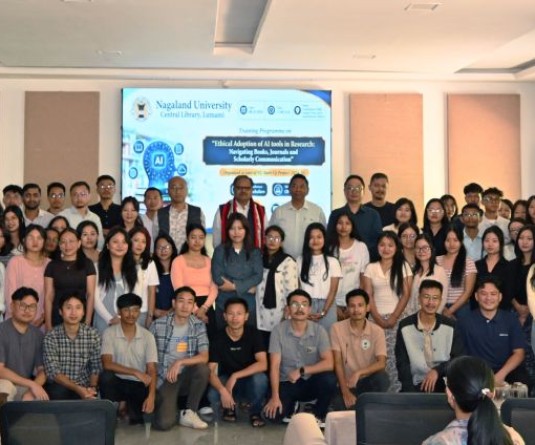
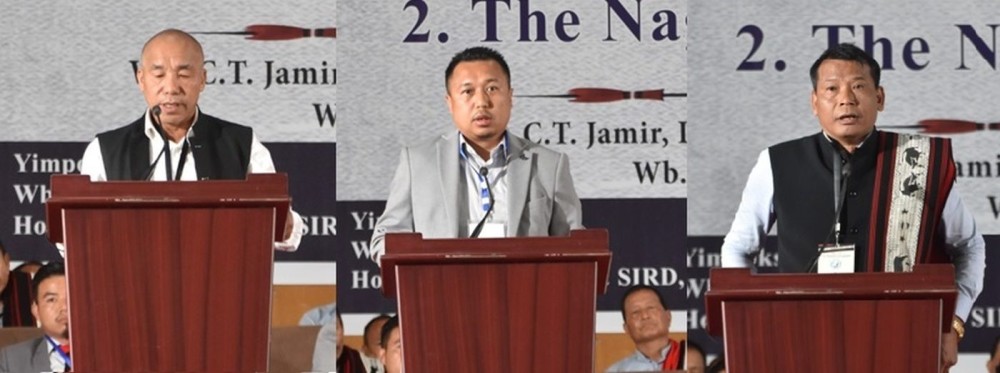
(Left to Right) Senior Advocate Gauhati High Court CT Jamir, Advocate Gauhati High Court Sentiyanger Pongen and Ao Senden President Marsanen Imsong address the seminar on Article 371(A) of the Indian Constitution and Nagaland Village Council Act, 1978 organised by the Ao Senden in Mokokchung on May 12. (Morung Photo)
Describes special provision as both restrictive and enabling
Morung Express News
Mokokchung | May 12
Cautioning against the popular misconception that Article 371A covers “everything under the sky,” Senior Advocate Gauhati High Court, C T Jamir on Tuesday described the special constitutional provision for Nagaland as as both restrictive and enabling, stressing that a deeper legal understanding of its scope is essential for safeguarding Naga rights and interests.
Addressing over 700 delegates at a seminar on Tuesday, the Ao Senden Legal Advisor asserted that while the Article serves as a vital safeguard for Naga identity, the community must move beyond general awareness toward a comprehensive legal understanding to effectively utilise the law for its own interests.
Various Ao Naga bodies, organisations, village councils, elected bodies, student unions, women organisations, DBs and GBs attended the seminar organised by the Ao Senden on Article 371(A) of the Indian Constitution and Nagaland Village Council Act, 1978.
Sharing on Article 371(A), Jamir noted that although every Naga was aware of the constitutional provision, many did not fully understand its scope and implications.
Proper understanding of the law was essential for achieving collective aspirations, cautioning that ignorance of legal provisions could create obstacles, he added.
Going back to 1842, Jamir explained the historical developments that led to the incorporation of Article 371(A) into the Indian Constitution and noted that present-day Nagaland was once administered as a district under Assam.
Describing Article 371(A) as a special constitutional provision for Nagaland, he urged Nagas not to take it “in a general way.”
He pointed out that the Article contains only four clauses and cautioned against the misconception that “everything under the sky” falls within its ambit.
Elaborating on both its restrictive and enabling nature, Jamir stated that Article 371(A) was enacted by the Indian Parliament and specifically intended for the benefit and protection of the Naga people and they must learn to utilise it properly for their own interests.
Village Council Act and Putu Menden
Speaking on the Nagaland Village Council Act (NVCA), 1978, Sentiyanger Pongen, Advocate, Gauhati High Court, highlighted key provisions governing the functioning of village councils under customary laws and practices.
He explained the processes relating to the selection of village council members, their powers and functions, and the tenure prescribed under the Act.
He noted that some sections of the Act could be misinterpreted if not properly understood.
Pongen stressed that village councils were not empowered to violate or curtail the fundamental rights of citizens.
Referring to practices such as excommunication and banishment imposed by certain villages, he said such actions, even if rooted in customary traditions, could conflict with constitutional guarantees, particularly the right to life and other fundamental rights.
He also observed that while most Naga village councils have a five-year tenure, among the Aos, the Putu Menden follows varying tenures depending on the village.
In this context, he raised questions over whether the Putu Menden and village councils are legally the same entity, and suggested that the matter requires further legislative deliberation.
Pointing out that the State Government has the authority to dissolve village councils under the Act, Pongen said the law remains silent on whether such powers extend to the Putu Menden.
He also called for additional functions and provisions to be incorporated into the Act where necessary.
Noting that the NVCA had already been amended five times, most recently in 2022, he described the powers vested in village councils as significant and urged village leaders to adopt progressive rules that would help move the community forward.
Earlier, in his introductory address, Marsanen Imsong, President, Ao Senden said the seminar was organised to deepen public understanding of the constitutional and legal safeguards protecting Naga identity, customs and traditions.
Tracing the historical background, he said that after the British entered the Naga Hills in 1832 and brought the area under administrative control, they refrained from interfering with Naga customary laws, traditions and social practices.
Instead, interpreters were appointed to better understand Naga culture and governance systems. He said the Government of India similarly acknowledged the distinct identity of the Nagas by incorporating Article 371(A) into the Constitution following Nagaland’s statehood.
Imsong stressed that merely knowing about rights was insufficient unless people understood them comprehensively.
He said the seminar aimed to equip participants with a deeper understanding of the provisions so they could effectively safeguard Naga rights and interests.
Imsong also clarified that no formal resolutions would be adopted during the seminar, though a detailed report would later be submitted to the Ao Senden Executive Council and General Conference for further deliberation, if required.