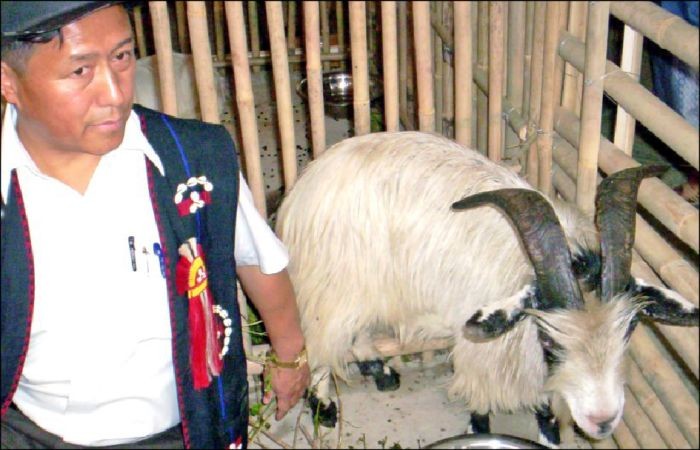
Dr. Pihoto Khalla Asst. Director (Piggery) crouching next to the goat ‘Asakushuwone’, which is indigenous to Nagaland during the ongoing Agri Expo. (MExPix)
A Botoking
Dimapur | March 31
WITH A view to advertise the biodiversity of Nagaland through the Agri- Expo, the Veterinary & Animal Husbandry Department of Nagaland has set up stalls to showcase the various animals and meat products available in Nagaland. A very rare animal being showcased in the agri - expo is the indigenous long haired goat of Nagaland. It is locally called ‘Asakushuwone’ and is known to be found in the Asuto area of Zunheboto district of Nagaland.
Dr. Pihoto said that the hair from the goat is used to decorate shawls, ornaments and various other ceremonial clothing. It is also regarded as having a certain degree of medicinal value. But due to public ignorance and the apathy on the part of the government in the past, this animal has become endangered to the point of near extinction. He added that the economic viability of the animal is good since it can serve a number of purposes.
Incidentally, the clipping of the hair is done every 2 years for which the monetary value from a single goat is approximately Rs.1500.
One of the main attractions being showcased is a huge pig weighing approximately 300kgs, 7 feet in length and 3.5 feet in height. It belongs to the ‘Jangza – Ak’ breed. Two local breeds being showcased are the ‘Suwo’ breed, which had just given birth to 15 piglets and the ‘Tenyivo’ breed which is larger in size.
Speaking to Dr. Pihoto Khala, Assistant Director (Piggery Division), it was learnt that the dept. has come up with various ways to build pigsties. He said that the first one is of a pigsty being built with stone blocks (stone walls & floor) instead of using cement extensively.
Even the feeding trough is made out of a single stone slab. The advantage in this method is that pigsties become more durable, thereby, preventing losses due to tear and wear. He recommended this method for those who are intending to raise pigs on a larger scale though it can be adopted by any layman.
Another method he advocated and recommended, especially for those are rearing only one or two pigs, is that of the pigsties being built using bamboo/cane extensively. The roof and floor is made of bamboo, while a pit is dug under the floor in order to prevent the faeces of the pig from flowing away freely. Thereby, the smell is reduced. The third method proved to be an interesting and innovative proposition, which will appeal to many pig rearers in Nagaland. Dr. Pihoto said that the pigsty is built in such a way that the pungent smell usually identified with pigsties is eliminated. In this method, the floor is made up of a mixture of sawdust, paddy husk, charcoal, IMO (Indigenous Micro Organism) and a certain amount of soil. And the manure produced through this method can also be used as a fertilizer.
He further added that if any individual is interested in acquiring more knowledge and information regarding these subjects can easily approach the Veterinary & A.H. dept.
He, further, stressed on the importance of the government implementing a consistent policy of encouraging the development of our own indigenous breeds of animals, which are readily available in our state. He also pointed out the enormous potential in producing meat products (sausages, meatballs & meat pickles) in a scientific and hygienic manner.
He said that a lot of hue and cry has been raised over the last 10 years by the consumers over the issue of producing wholesome meat products. Thus, the dept. is also showcasing and selling meat products in the agri – expo to promote this system of production and consumption.
Morung Express News