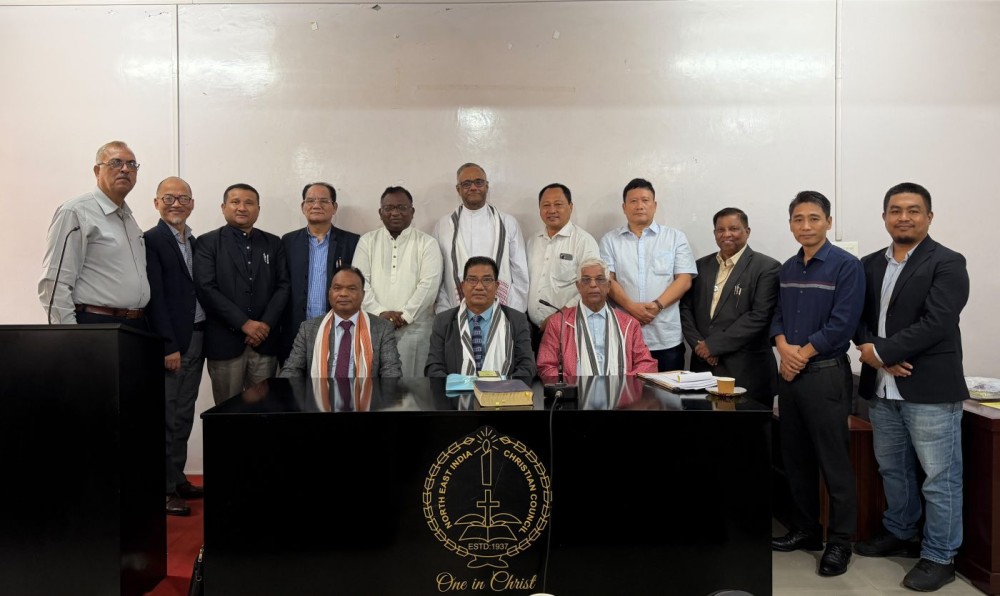
Leaders from CBCNEI, NEICC, Evangelical Fellowship of India (NEI), Catholic Bishop Council of NEI, Presbyterian Church of India.
Meyu Changkiri
Public opinion is a powerful force. It has the ability to unite people around truth, but it can also divide communities when built upon half-truths, assumptions, and sweeping generalisations. In today's age of instant communication, narratives travel faster than facts. Repeated often enough, even inaccurate statements begin to acquire the appearance of truth.
That is why, in any mature democracy, public leaders, media organisations, and citizens share a common responsibility - to ensure that public debate is informed by facts, fairness, and respect rather than prejudice or political expediency.
In recent months, particularly in the context of the proposed amendments to the Foreign Contribution Regulation Act (FCRA), an unfortunate narrative has gained prominence. Some political voices and social media commentators have suggested that churches across India have been built with foreign funds, that foreign contributions are primarily used to promote religious conversion, and that church leaders are raising concerns about the proposed amendments merely to protect their financial interests.
These assertions are serious. They deserve to be examined with honesty and historical accuracy.
The first and perhaps the greatest misconception is the tendency to treat every Christian institution as though it has the same history, the same purpose, and the same source of funding.
This is simply not true.
Many churches established before India's Independence were founded through the ministry of Christian missionaries working together with Indian believers and local communities, long before the FCRA came into existence. Since Independence, thousands of churches across the country have been built through the sacrificial giving of Indian Christians. Congregations have donated land, contributed financially according to their means, and offered voluntary labour to build places of worship for their own communities.
These churches are not products of FCRA funding.
It is therefore both historically inaccurate and unfair to suggest that churches in India have generally been constructed with foreign contributions received under the FCRA.
This misunderstanding becomes even more serious when churches are indiscriminately grouped together with hospitals, schools, colleges, hostels, orphanages, community development programmes, and other charitable institutions.
These are not the same.
Many Christian educational, medical, and humanitarian institutions have lawfully received foreign contributions under the provisions of the FCRA. Those contributions have supported education, healthcare, disaster relief, skill development, rural development, disability care, and numerous other humanitarian initiatives. Such institutions exist not for the exclusive benefit of Christians but for the welfare of society as a whole. To confuse these institutions with locally built churches is to overlook both history and reality.
There is another concern that deserves careful reflection.
Increasingly, isolated allegations against a few organisations or individuals are being projected as though they represent the entire Christian community in India. Such an approach is neither just nor consistent with the principles of the rule of law.
Every society has individuals who violate the law. Every institution has, at times, those who fail to uphold the standards expected of them. Where wrongdoing is established, it must be investigated impartially and dealt with firmly. Christians neither seek nor expect exemption from the law.
But justice requires that responsibility remains personal. The misconduct of a few cannot become the character of millions. It is neither reasonable nor constitutional to judge an entire community by isolated instances of alleged wrongdoing. The same standard of fairness that we expect for every other community should equally apply to Christians.
Against this background, an obvious question arises. Why are church leaders engaging with the Government on the proposed FCRA amendments?
The answer is straightforward.
They are not opposing the Government's authority to regulate foreign contributions. Every sovereign nation has both the right and the responsibility to ensure transparency, accountability, and national security. Christian organisations have consistently affirmed their commitment to comply with the laws of the land.
Their request is something different.
They seek meaningful consultation before major legislative changes are enacted. Such consultation is not an act of confrontation but an expression of democratic responsibility. Good laws are strengthened when those who will be affected by them have an opportunity to explain practical concerns, identify unintended consequences, and contribute to constructive solutions. This is how participatory democracy functions.
The concerns being raised are not limited to Christian institutions. They relate to the continued functioning of charitable organisations that have served millions of Indians for generations.
This brings us to perhaps the most important question of all. Who are the beneficiaries of Christian mission in India?
The answer is visible across the country. They are the children studying in mission schools, regardless of their religion. They are the patients receiving treatment in mission hospitals. They are the elderly cared for in homes for senior citizens. They are orphaned children, persons with disabilities, tribal communities, disaster victims, women, and families living in some of the most remote and underserved parts of our country.
The beneficiaries of Christian mission have never been Christians alone.
For more than two centuries, Christian institutions have walked alongside the people of India in education, healthcare, humanitarian relief, social development, and community welfare. Their contribution belongs to the shared history of our nation.
This is why the present discussion should not be reduced to a debate about Christians alone. It concerns every citizen who values quality education, compassionate healthcare, humanitarian service, and the important partnership between government and civil society.
India is a nation strengthened not only by its Government but also by countless voluntary organisations, faith-based institutions, and community initiatives that complement the work of the State. Together they have contributed to nation-building in ways that no single institution could achieve alone.
Public discourse should therefore reflect this larger reality.
It is neither wise nor fair to question the integrity of an entire community because of the alleged actions of a few. Nor is it responsible to repeat narratives that disregard history or blur the distinction between places of worship built through local sacrifice and charitable institutions supported through lawful foreign contributions.
We owe ourselves a higher standard of public conversation.
We respectfully appeal to political leaders of every party, members of the media, social media influencers, and all responsible citizens to exercise care in the language they use. Words have consequences. They shape perceptions, influence relationships between communities, and contribute either to trust or to division.
India's constitutional vision is built upon justice, equality, and respect for every citizen. Those values call upon us to judge people by evidence rather than assumption, institutions by their conduct rather than stereotypes, and communities by their overall contribution rather than isolated allegations.
As discussions on the proposed FCRA amendments continue, let us ensure that the debate remains informed, balanced, and constructive. Let us reject sweeping generalisations, preserve the dignity of every community, and encourage meaningful dialogue between Government and stakeholders.
Truth does not fear scrutiny. Neither does genuine service.
The history of Christian mission in India is not ultimately written in financial records or political debates. It is written in classrooms where generations have been educated, in hospitals where lives have been saved, in villages where hope has been restored, and in communities where compassion has been lived out.
Those who wish to understand the Christian mission need only look at its beneficiaries. They are found in every region of India, in every language, and in every community. That is the true narrative. It deserves to be told - and remembered.