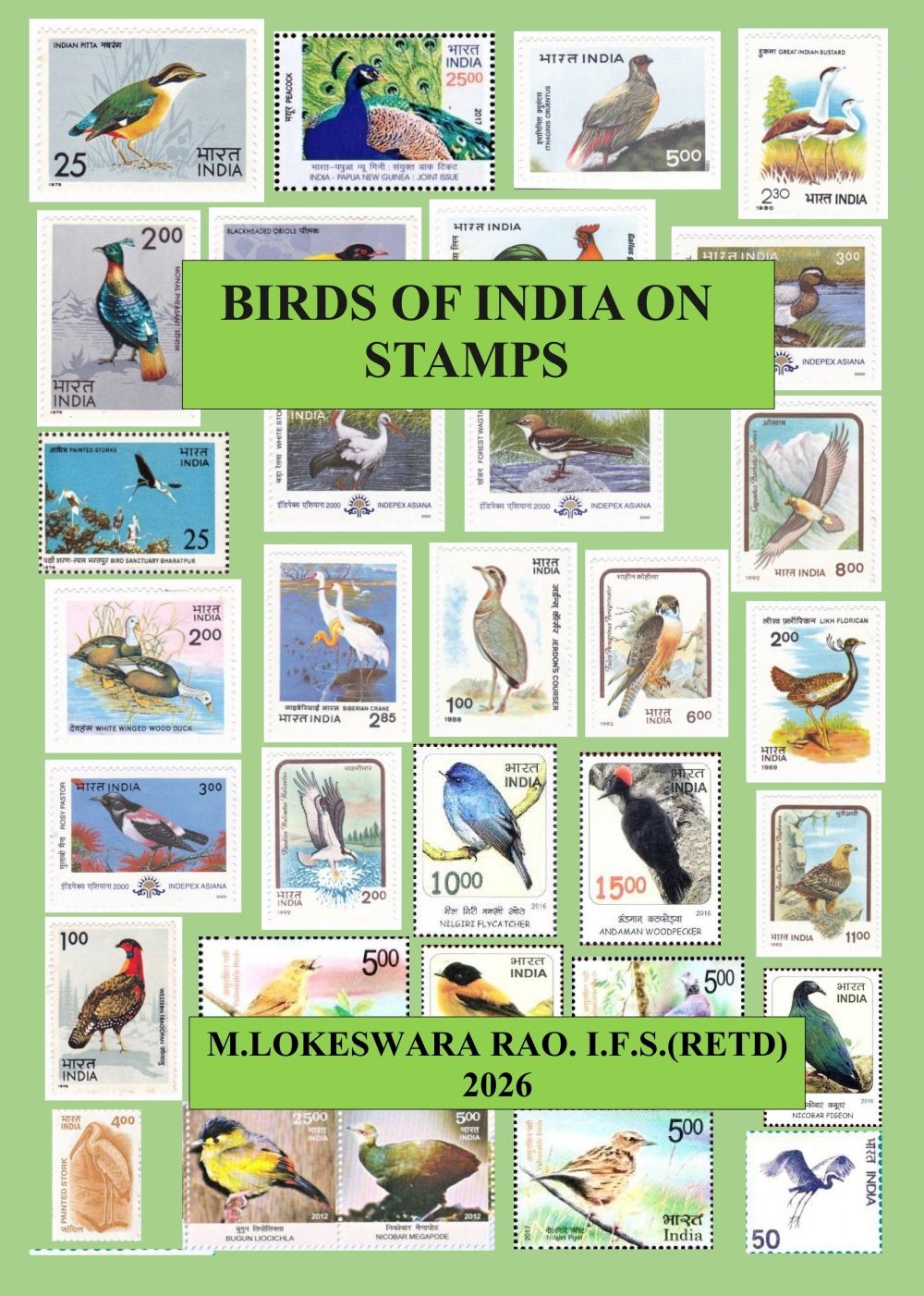
‘Birds of India on Stamps’ written by M Lokeswara Rao IFS (Retd)
Birds are biologically characterized by their feathers, toothless beaked jaws, a high metabolic rate, a four-chambered heart, a strong yet lightweight skeleton, and the laying of hard-shelled eggs. Found worldwide across all major habitats, birds range dramatically in size from the tiny from the 5.5 cm bee hummingbird to the 2.8 m common ostrich. while some species, like penguins, have lost the ability to fly, they have retained their wings and adapted to run, jump, swim, or dive. Beyond their physical marvels, birds play vital roles in sustaining ecosystem health. They act as pollinators, seed dispersers, predators, and scavengers, while also serving as crucial prey for other species.
In addition to their ecological value, birds have historically played diverse roles in folklore, religion, and popular culture, holding a deeply rooted place in Indian traditions. They frequently appear in the epic Ramayana as major characters, such as the loyal vulture siblings Jatayu and Sampaati. Indian mythology also reveres Garuda, the fierce "king of birds" who serves as a divine vahana (vehicle) for several deities.
Unfortunately, these vibrant populations face a steep global and regional decline. The State of the World’s Birds report, published on May 5, 2022, by an international team of nine avian specialists, revealed that 48% of the world’s 10,994 surviving bird species are suffering from declining populations. This trend is mirrored acutely on a national level. According to The State of India's Birds Report 2023, which synthesized observations from more than 20,000 birdwatchers tracking 942 species, much of India's bird population has declined sharply over the last few decades. The report identifies hunting and habitat loss as the two primary historical drivers behind this crisis, while collisions with electricity lines have emerged as a prime modern threat. Furthermore, the accelerating impacts of climate change—including rising temperatures, melting glaciers, erratic weather conditions, and shifting rainfall patterns—are fundamentally altering bird habitats across the Indian subcontinent.

In the face of these pressing modern conservation challenges, creative efforts to raise environmental awareness are more important than ever. A unique and artistic contribution to this cause is the book Birds of India on Stamps, written by M. Lokeswara Rao, IFS (Retd.), former Principal Chief Conservator of Forests and Head of the Forest Force. This volume focuses on the rich array of philatelic material issued by India Post, narrating the stories of different bird species across India's various zoogeographic regions while highlighting their conservation status and the threats facing their habitats.
This book is structurally divided into eleven distinct chapters, systematically guiding the reader through India's diverse ecosystems and avian life: 1. Introduction 2. Birds of Trans Himalaya, Himalaya and North Eastern India Zone 3. Birds of Desert Zone. 4. Birds of Semiarid Zone. 5. Birds of Western Ghats Zone. 6. Birds of Deccan Peninsula Zone. 7. Birds of Gangetic plain Zone. 8. Birds of Coastal Zone. 9. Birds of Islands Zone 10. House Sparrow 11. Conservation of Birds. Each regional chapter provides detailed profiles of the bird species unique to that specific biogeographic zone, with special emphasis placed on endemic species. To avoid repetitive entries, common birds that inhabit multiple regions are described in full detail within only one primary zone; however, their visual images are thoughtfully included across the various chapters representing their wider range.
Beyond individual species profiles and their conservation statuses, this book explores key avian habitats. It examines protected areas such as National Parks, Wildlife and Bird Sanctuaries, significant lakes, and UNESCO World Heritage sites across the different biogeographic zones.
The final chapter on bird conservation highlights the diverse protective measures enacted by various stakeholders, environmental agencies, and international programs. Notably, Chapter 2 captures the inspiring history of Amur Falcon conservation spearheaded by local communities in Nagaland. In Doyang, Nagaland, residents erected a stone monolith inscribed with the words, "We hunters became conservationists"—serving as a powerful, lasting symbol of grassroots ecological transformation. To visually anchor these narratives, the book includes a comprehensive record of relevant philatelic materials officially released by India Post. Readers will find an extensive array of archival collectibles, including: Postage stamps and stamp blocks, First Day Covers (FDCs), Miniature sheets, Maximum cards and postcards and Special covers.
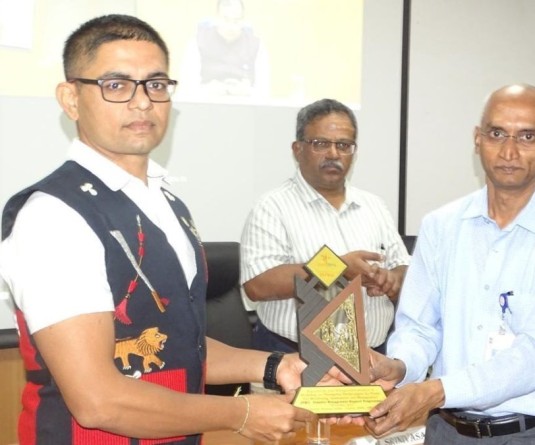
The book was released by Sidramappa Chalakapure, IFS, Member Secretary of the Nagaland Biodiversity Board in Kohima, Nagaland. On the occasion of its launch, Chalakapure commended the work, noting that the book is a highly comprehensive narrative of India's regional birds, beautifully showcased through philatelic history.He also highlighted that the book provides valuable, first-hand insights into the conservation of the Amur Falcon in Nagaland. This includes a feature on the special cover jointly released by India Post (Shillong) and the Nagaland Forest Department in 2014 to commemorate the satellite tagging of these remarkable migratory raptors. This book will serve as an invaluable resource for birdwatchers, students, academicians, foresters, and all other environmental stakeholders.
About the Book
Birds of India on stamps
Year of release 2026
No of Pages: 269
Author: M Lokeswara Rao IFS (Retd)
Published: M Lokeswara Rao IFS (Retd)
ISBN: 978-9360126407
MRP: INR 1700
Contact: WhatsApp - 9436215175, [email protected]