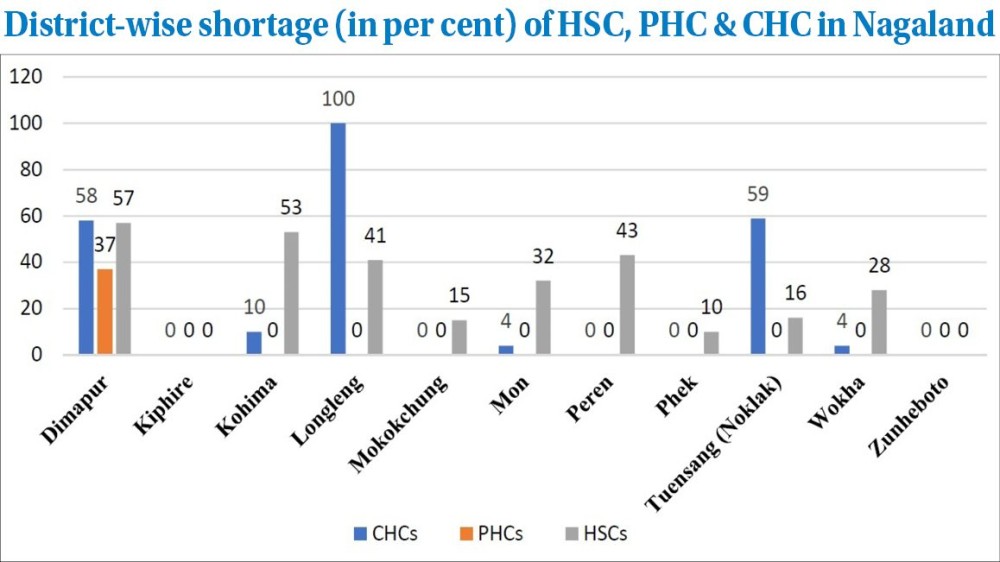
Data as it appears in the CAG report for the year ending March 31, 2023. (Source: CAG)
Morung Express News
Dimapur | April 5
The Comptroller and Auditor General (CAG) report tabled in the Nagaland State Legislature on March 26, 2026, has provide a disheartening depiction of the state’s primary healthcare infrastructure and management, revealing severe shortages in manpower, diagnostic services, emergency care and gross underutilisation, with the State also lagging behind national averages on most key health indicators.
The Subject Specific Compliance Audit on “Public Health Infrastructure and Management of Primary Health Services,” which covered the period from 2017-18 to 2022-23, was conducted under the social, economic, general, revenue and local government audit sectors.
The report noted that while the National Health Policy 2017 aims to improve population health through health promotion and disease prevention, with a renewed commitment to achieve Sustainable Development Goal 3 (Good Health and Well-being).
According to the audit, “significant shortages” of Community Health Centres (CHCs) were noticed in Longleng, Tuensang and Dimapur districts. Further, a shortage of Primary Health Centres (PHCs) was noticed in Dimapur district, while a shortage of Health Sub-Centres (HSCs) was noticed in all districts except Kiphire and Zunheboto.
In case of District Hospitals (DHs), major shortages existed in the cadre of specialist doctors, General Duty Medical Officers (GDMOs), Staff Nurses and paramedical staff. Though services of specialist doctors were to be made available in the CHCs as per the Indian Public Health Standards (IPHS), no specialist services were available in the CHCs in the state except in CHC Noklak, Pungro, Jalukie, Meluri and Tobu where only Obstetrics & Gynaecology service was available.
The shortfall in manpower in PHCs was in GDMOs, ANMs, lab technicians and pharmacists. Similarly, 52% of HSCs in the state had a shortage of manpower.
The report highlighted that tests like Endoscopy, Bronchoscopy, Stress Test, Arthroscopy, Hysteroscopy and Pulmonary function tests under Respiratory investigation were not available in any of the district hospitals. Diagnostic services like Pathology and Ophthalmology, which were required to be available in the CHCs as per IPHS, were missing entirely. Quality assurance in laboratory services as mandated under the IPHS was also not ensured. Only five out of eleven district hospitals in the state had blood banks as per prescribed norms.
Emergency and Trauma Care service was virtually absent in the sampled health facilities, the audit said. “Due to non-availability of emergency services and other specialist services, emergency patients and patients with cardiovascular diseases, were referred to the DHs and other Hospitals for better treatment putting the patients at distress involving higher out of pocket expenses.”
HSCs, which are responsible for providing Ante-Natal Care (ANC) services to pregnant women including outreach services, failed to deliver the desired level of care. As a result, more than 26% of registered pregnant women did not receive the recommended four ANC check-ups during 2022-23.
Hospital support services, including diet, laundry, linen service and infection control, were found operational in the sampled health facilities but without any standard operating guidelines. The Hospital Infection Control Committee (HICC) was found to have been formed in only five out of the eleven sampled health facilities and could not deliver any specific plan to control hospital-acquired infections.
Out of 11 sampled health facilities, only two — Kemipfupfe PHC and Seikhazou Urban Primary Health Centre (UPHC) — had a disaster management plan and a Standard Operating Procedure (SOP) on disaster management. Further, a fire prevention plan was not found formulated in any of the sampled health facilities except in Seikhazou UPHC.
The audit also revealed that no assessment was done to identify gaps in hospital infrastructure for utilisation of available additional infrastructure and equipment like ICU beds, ICU machines, and Oxygen Concentrators. “As a result, Oxygen Concentrators, Ventilators and ICU beds were found lying idle in the Directorate or hospital stores.”
Pressure Swing Adsorption (PSA) plants were installed in all 11 DHs, eight CHCs and in CIHSR, Dimapur. However, there was no reduction in the expenditure on oxygen cylinders despite the installation of PSA plants, as these plants largely remained un-utilised.
On the broader health indicators, the state is lagging in achieving the SDG-3 indicators in seven out of the ten targeted areas in comparison to national achievements, the report said. Spending on the health sector, which ranged between 3.22 and 5.19% of the state budget during 2017-18 to 2022-23, was lower than the norm of 9% of their budget by 2020 as envisaged in the National Health Policy 2017.
The audit also highlighted an “inordinate” delay in acquisition of land for the Nagaland Medical College at Kohima, which delayed commencement of civil works resulting in delay in completion of civil works.
Recommendations
The CAG has made a series of recommendations to the State government. It has urged the government to ensure posting of specialist doctors and provide necessary emergency services as well as other specialist services in the deficient health facilities as per IPHS norms.
It has called for providing necessary diagnostic services in the CHCs to reduce the pressure at the District and State Level Hospitals and mitigate the problems of travelling longer distances and incurring out of pocket expenses by patients.
The audit recommended ensuring formation of HICC in each health facility and strengthen the effectiveness of HICC by providing specific training and resources to develop comprehensive infection control plans tailored to each facility's needs.
It also advised to prioritise obtaining safety clearance from the concerned Department for all healthcare facilities to mitigate the risk of fire hazards and ensure patient safety.
Further, the CAG recommended improving improve the quality of services and patient care at PHCs with low bed occupancy and high referral rates by conducting assessments, identifying root causes of service deficiencies, and implementing targeted interventions to address gaps in service delivery.
The state has also been asked to assess the utilisation of the assets and equipment created and procured during pandemic and consider redistribution based on the requirement of the health facilities.
Finally, the audit called for ensuring adequate spending on health sector, prioritise the filling up of vacant medical and paramedical posts and implement effective monitoring mechanisms to achieve SDG targets.