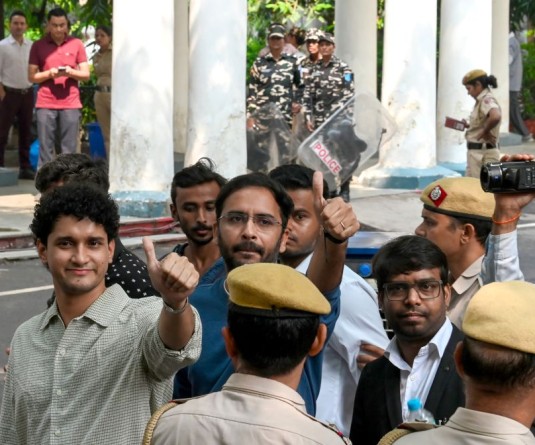
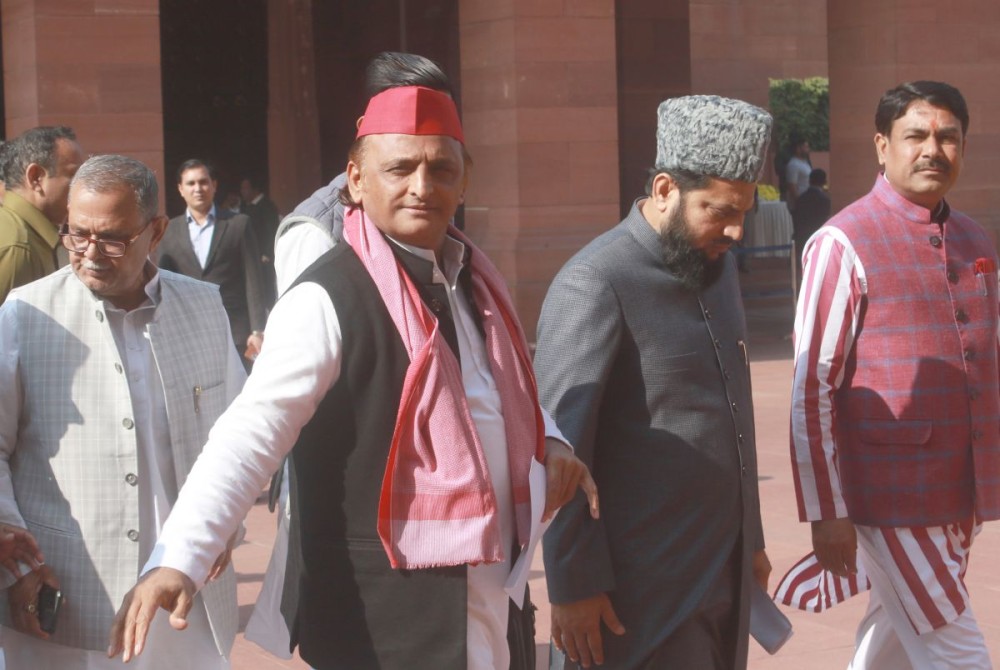
New Delhi: Samajwadi Party (SP) MPs Akhilesh Yadav, Anand Bhadauriya, and Mohibbullah Nadvi at the Parliament House premises during the winter session of Parliament in New Delhi on Tuesday, December 09, 2025. (Photo: IANS/Qamar Sibtain)
New Delhi, December 9 (IANS) As Lok Sabha debated the crucial issue of electoral reforms, the Opposition took to expected lines, seeking a stop to Special Intensive Revision (SIR) of India’s electoral rolls and a return to paper ballot.
Initiating the debate for the Opposition, Congress MP Manish Tewari raised both issues, as did other INDIA bloc allies, including Samajwadi Party leader Akhilesh Yadav. They cited examples of other countries, such as the USA and Germany.
However, as of 2024, India's population is well over four times that of the United States, while Germany’s population, at over 70 lakh, is less than even that of West Bengal.
When Leader of Opposition Rahul Gandhi intervened, he too echoed similar issues, but mainly reiterated his “vote chori” slogan. What the Opposition chose to ignore is that SIR is not a new exercise, and is done by the book. Since preparing for India’s first general election, SIR has been conducted eight times to cleanse the electoral rolls of ineligible, duplicate, or deceased voters.
Section 21(2) of The Representation of the People Act, 1950, provides that “unless otherwise directed by” the ECI, the electoral roll “be revised in the prescribed manner” before election and by-election. It also adds, this roll “shall be revised in any year in the prescribed manner by reference to the qualifying date if such revision has been directed by the Election Commission…”
As per Section 21(3) of the Act, the ECI “may at any time, for reasons to be recorded, direct a special revision of the electoral roll for any constituency or part of a constituency in such manner as it may think, provided that the electoral roll for the constituency remains in place until the process is completed.
Meanwhile, regarding the use of EVMs, when the then Chief Election Commissioner (CEC) S. L. Shakdhar asked the Electronics Corporation of India Limited (ECIL) in 1977 to study the possibility of such a machine, the Bharatiya Janata Party (BJP) was yet to be officially formed. Neither was it there in its present avatar in 1979, when a prototype was developed.
EVM has since been introduced in a phased manner to cover all elections, except for some local body polls in some states. But since its introduction, it has usually been the losing side raising doubts over “tampering”.
There is a widely-quoted excerpt from former CEC S. Y. Quraishi’s book ‘India’s Experiment with Democracy: The Life of a Nation Through Its Elections’, which says, “The issue of ‘tamperability’ of EVMs has been doing the rounds ever since they were first introduced. Every time a political party loses an election, it blames the machine. However, none of them has been able to prove their allegations against the credibility of EVMs, and neither do they apologise when they win the elections where the same EVMs have been used.”
Similarly, former CEC Navin Chawla too has mentioned, "The EVM continues to be buffeted in stormy seas…” in his book ‘Every Vote Counts: The Story of India’s Elections’. Going by examples of democracies returning to paper ballot, countries like the Netherlands has a population much less than Delhi, while in Ireland it is less than a quarter of the National Capital. Thus, counting ballots physically would run into days in India, maybe weeks in some cases.