Morung Express News
Kohima | February 22
Civil Engineering has emerged as the clear favourite among students pursuing technical education in Nagaland, both at the degree and diploma levels, an analysis of consolidated official enrolment data for the previous four years indicates.
The figures reveal a pronounced concentration in a limited number of courses, with Civil Engineering leading by a wide margin, followed by computer-related streams. Several emerging and strategically relevant sectors continue to record negligible or zero uptake.
All roads lead to Civil
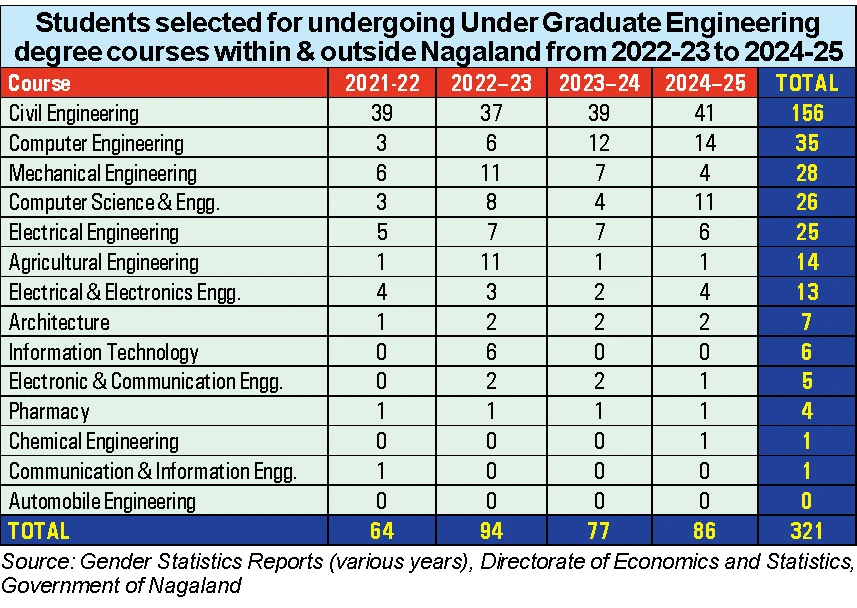
At the undergraduate degree level, total enrolment over four years (2021–22 to 2024–25) stood at 321 students, as per collated data from annual Gender Statistics reports published by the Directorate of Economics and Statistics, Nagaland.
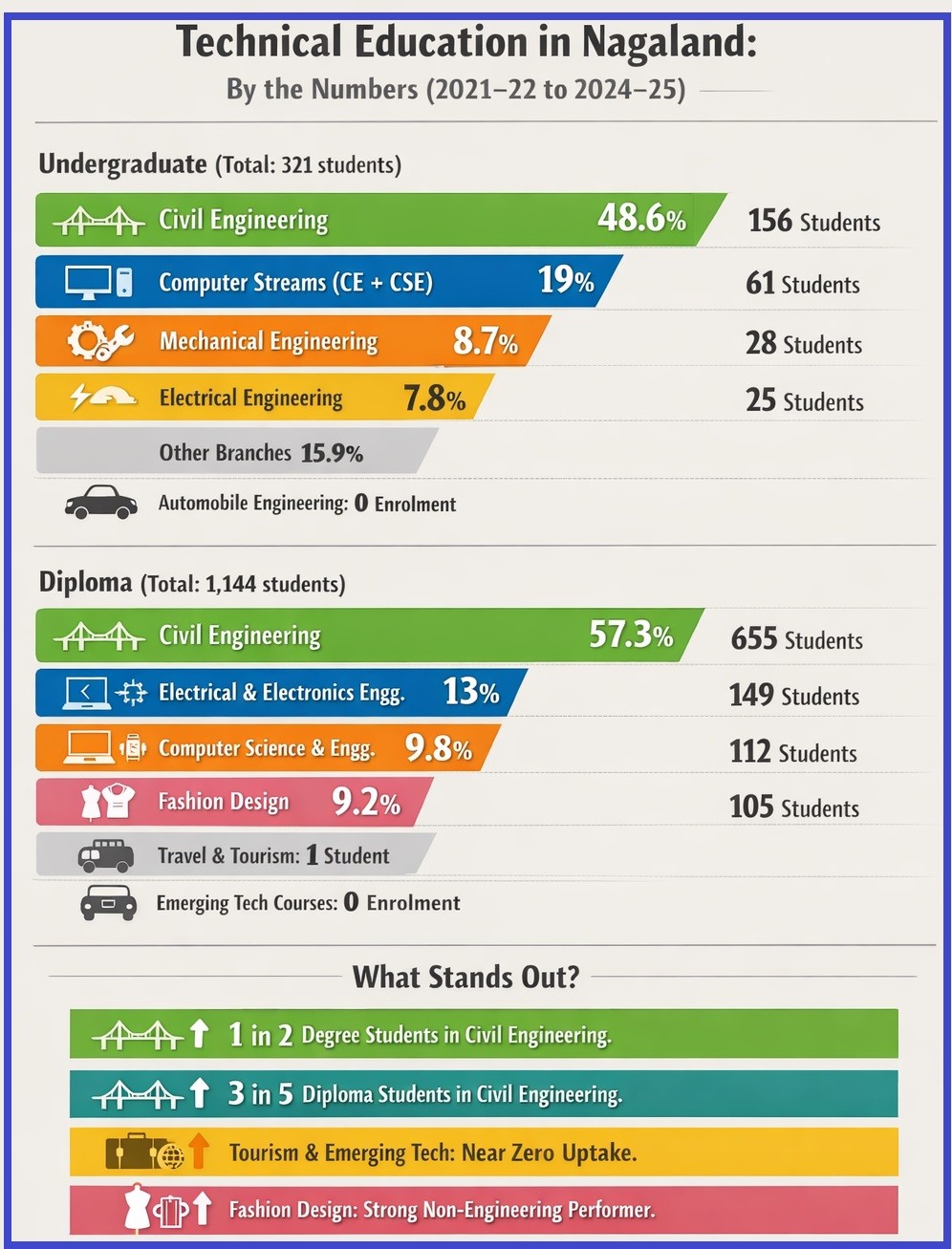
Civil Engineering alone accounts for 156 students, or 48.6% of total enrolment, meaning nearly one in every two engineering students opted for the discipline.
Annual intake, inclusive of both within and outside the state, remained consistently high, ranging between 37 and 41 students.
Computer Engineering (35 students, 10.9%) and Computer Science & Engineering (26 students, 8.1%) form the second cluster. Together, computer-focused streams account for nearly 19% of total undergraduate enrolment.
Mechanical Engineering enrolled 28 students (8.7%) and Electrical Engineering 25 students (7.8%), reflecting moderate but largely stagnant demand.
At the lower end, Agricultural Engineering accounted for 14 students (4.4%), while Electrical & Electronics Engineering recorded 13 students (4%). Architecture (7 students, 2.2%) and Information Technology (6 students, 1.9%) remained marginal.
Chemical Engineering and Communication & Information Engineering registered just one student each over four years, while Automobile Engineering recorded zero enrolment.
The undergraduate pattern therefore shows that nearly half of all students chose Civil Engineering, and close to one-fifth opted for computer streams, leaving the remaining branches to share roughly one-third of total enrolment.
The concentration becomes even more pronounced at the diploma level.
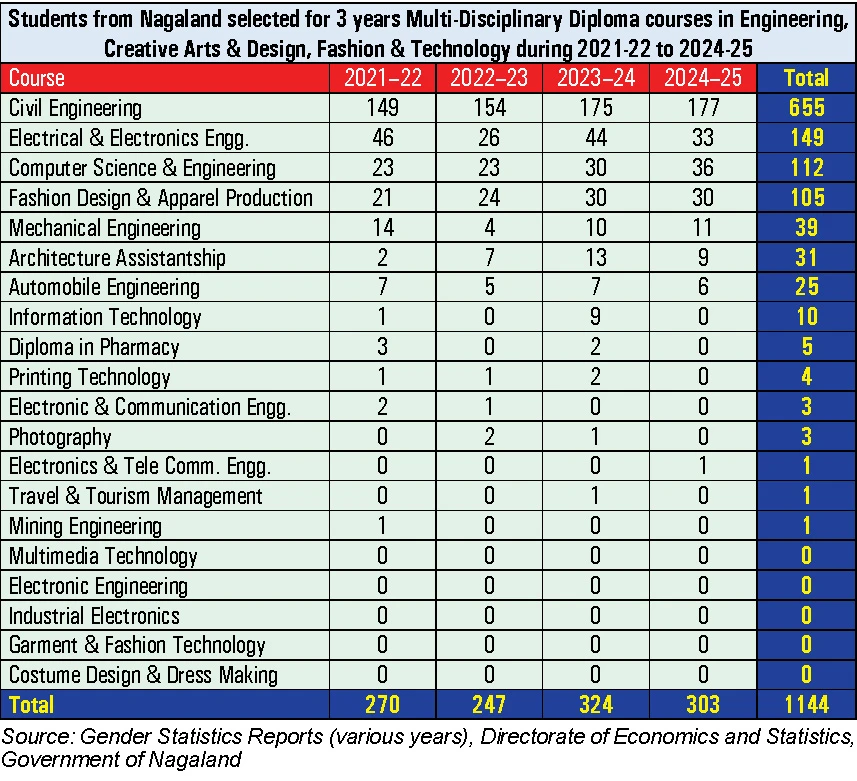
Between 2021–22 and 2024–25, total selected students for 3 years Multi-Disciplinary Diploma courses reached 1,144 students.
Civil Engineering alone accounts for 655 students, or 57.3% of total diploma enrolment. In other words, nearly three out of every five diploma students chose Civil Engineering. Annual intake in Civil rose steadily from 149 to 177 over the period.
Electrical & Electronics Engineering enrolled 149 students (13%), while Computer Science & Engineering recorded 112 students (9.8%), forming the next tier.
Fashion Design & Apparel Production accounted for 105 students or approximately 9.2% of total diploma enrolment making it the strongest non-engineering stream. Its consistent annual intake suggests steady vocational demand.
Mechanical Engineering recorded 39 students (3.4%), and Architecture Assistantship 31 students (2.7%).
Several other streams remained negligible.
Travel & Tourism Management recorded just one student over four years, or less than 0.1% of total diploma enrolment, despite tourism being widely promoted as a priority sector.
Multimedia Technology, Industrial Electronics, Garment & Fashion Technology, and Electronic Engineering recorded no enrolment at all during the period.
Narrow concentration
Across both levels, the data reflects a clear structural pattern: Civil Engineering alone accounts for nearly half of degree enrolment and more than half of diploma enrolment, while computer-related streams collectively form the second most significant cluster.
Fashion Design emerges as the only non-core technical stream with sustained demand.
Several emerging or industry-relevant fields remain under-enrolled or entirely absent, with the enrolment distribution suggesting limited diversification within the state’s technical education choices.
It must also be noted that alongside engineering streams, another major area of student preference after secondary level is Medical & Allied and Para-Medical/Agri. & Allied courses. During the period from 2022–23 to 2024–25, a total of 845 students opted for this sector, including 338 in 2024–25 alone, the data highlighted.
Meanwhile, given that Civil Engineering dominates so significantly, expectations inevitably extend to infrastructure outcomes. Roads, bridges, public buildings, and government housing remain central to public discourse in Nagaland.
Yet infrastructure quality continues to be a recurring concern. While the data does not explain infrastructure outcomes, it establishes one measurable reality: the state is producing civil engineers at scale.
Whether systemic execution gaps, governance constraints, or broader structural challenges account for persistent infrastructure issues lies beyond the enrolment figures.