Morung Express News
Dimapur | March 9
Nagaland’s economy is projected to cross the Rs 50,000 crore mark in 2025–26, reflecting steady growth over the past decade.
However, the Nagaland Economic Survey 2025–26 also underscores persistent structural challenges, including heavy dependence on central transfers, rising wage and pension liabilities, and declining capital expenditure.
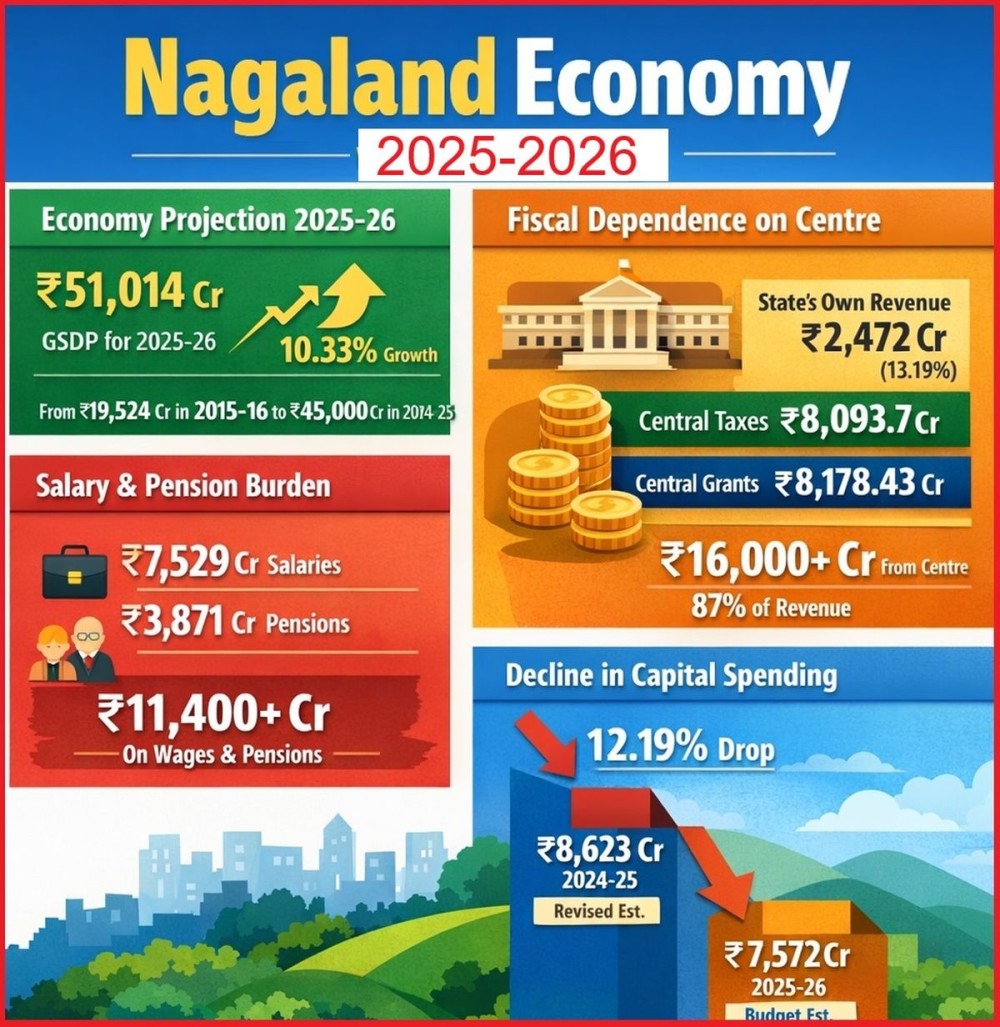
According to the survey tabled in the Eighth Session of the 14th Nagaland Legislative Assembly on March 9, the state’s economy is expected to grow by 10.33% in real terms and 13.03% in nominal terms in 2025–26 as per Advanced Estimate (AE).
In absolute terms, the Provisional Estimate (PE) of the Gross State Domestic Product (GSDP) is projected to increase from Rs 45,133 crore in 2024–25 to Rs 51,014 crore in 2025–26, marking a significant milestone for the state’s economy.
Correspondingly, the quantum of the economy in real terms is estimated to have increased from Rs. 23262 crores in 2024- 25 (PE) to Rs. 25665 crores in 2025-26 (AE)
Over the past decade, the size of Nagaland’s economy has expanded considerably with the GSDP rising from Rs 19,524 crore in 2015–16 to over Rs 45,000 crore in 2024–25, it added. The per capita income more than doubled during the same period from Rs 82466 to Rs 192282 (AE).
However, the survey reflected that the structure of the economy remains heavily dependent on the tertiary sector, which contributes more than two-thirds of the state’s GSDP at 66.64 percent 2025-26 (AE) while the primary sector and the secondary sector contribute 22.76 percent and 10.60 percent respectively.
Heavy reliance on central transfers
Even as the state economy grows, Nagaland’s fiscal structure continues to rely overwhelmingly on central transfers.
The survey estimated that State Own Revenue Receipts (SORR) will amount to about Rs 2,472 crore in 2025–26, accounting for only 13.19% of total revenue receipts.
By contrast, central transfers constitute the bulk of the state’s revenue. The state is expected to receive about Rs 8,093.7 crore as its share of central taxes, in addition to Rs 8,178.43 crore as grants-in-aid from the Centre.
This means that more than Rs 16,000 crore of the state’s revenue receipts originate from central transfers, underscoring the state’s continued fiscal dependence on the Union Government.
Wage bills dominate, capital expenditure declines
Meanwhile, the report also highlighted the growing pressure of the state’s wage bill and pension liabilities on public finances.
For 2025–26 (EE), the state has projected Rs 7,529 crore for salaries and wages, while pension expenditure is estimated at Rs 3,871 crore.
Taken together, Nagaland is expected to spend over Rs 11,400 crore on wages and retirement benefits alone, representing a substantial portion of the state’s revenue expenditure.
This leaves limited fiscal space for development spending, particularly in sectors requiring large investments such as infrastructure and industrial development.
Another key finding of the survey is the decline in capital expenditure. The Budget 2025–26 has allocated Rs 7,572.48 crore for capital expenditure, compared to Rs 8,623.35 crore in 2024–25 (Revised Estimates), marking a decline of 12.19%.
At the same time, revenue expenditure continues to dominate the state budget, accounting for nearly 69% of total expenditure in 2025–26.
‘Viksit Nagaland @2047’ vision
The Economic Survey also reiterated Nagaland’s growth trajectory within the broader national vision of “Viksit Bharat @2047,” which aims to transform India into a developed country by the centenary of Independence. Under this vision, the Indian economy is expected to reach $30–40 trillion by 2047, with a targeted per capita income of $15,000–$18,000.
For Nagaland, the scale of the challenge is significant. To align with the benchmark, the survey noted that State’s economy would need to expand dramatically.
Per capita income would have to increase to around $15,000, implying that the state’s economy must grow from about $5 billion to nearly $68 billion (around Rs 6.1 lakh crore) by 2047.
Achieving this would require sustained annual growth of 10% or more over the next two decades, it added.