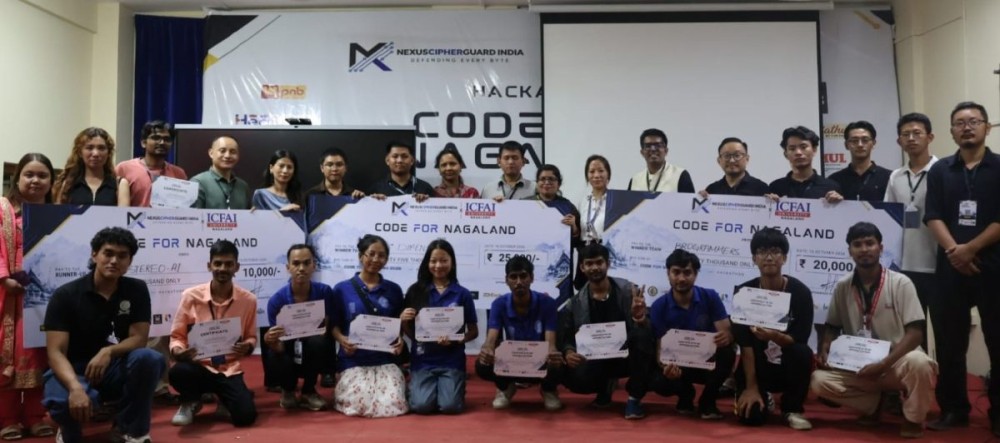
A 26-hour hackathon, Code For Nagaland, held on October 15 and 16, was organised by NEXUSCIPHERGUARD INDIA in collaboration with ICFAI University Nagaland.
• 113 students compete in 26-hour hackathon
• Six teams win across three tracks
Sovima, October 18 (MExN): A 26-hour hackathon, Code For Nagaland, concluded with six teams emerging winners across three tracks, as 113 students from eight colleges and universities competed for a total prize pool of Rs 1,00,000.
The event, held on October 15 and 16, was organised by NEXUSCIPHERGUARD INDIA in collaboration with ICFAI University Nagaland. It was designed to encourage practical problem-solving, creativity, teamwork and the application of technology to challenges relevant to communities and everyday life.
In the Naga Heritage, Culture and Community Tech track, Team 4th Dimension from the School of Engineering and Technology, Nagaland University, Meriema Campus, secured first place, while Team Merge Conflict from St Joseph's University, Chümoukedima, finished second.
The Campus, Youth and Community Life track was won by Team Brogrammer from ICFAI University Nagaland, Sovima, with Team L from the National Institute of Electronics and Information Technology (NIELIT), Kohima, securing second place.
In the Wildcard Track: Open Innovation, Team Set Kalua from the School of Engineering and Technology, Nagaland University, Meriema Campus, emerged as the winner, while Team Ostereo-Ai from the National Institute of Technology Nagaland secured the second position.
The three tracks were structured to accommodate different areas of interest, from the application of technology to Naga heritage and community development to challenges affecting students and campus life, alongside an open category allowing participants to explore ideas beyond predefined themes.
One of the defining features of the event was its non-stop 26-hour format. As the competition continued through the night, teams worked to develop their projects, resolve technical difficulties, refine features and prepare their solutions for evaluation.
The format was deliberately designed to create a sense of urgency and simulate some of the pressures associated with real-world project development. Participants were required to prioritise tasks, distribute responsibilities, make quick decisions and adapt when their initial approaches did not work as planned.
The participating teams were evaluated by a panel comprising professionals from entrepreneurship, business and academia, including Neikepekho Shosahei, Associate Director (Entrepreneurship) at YouthNet; Rishav Sethi, Chief Executive Officer of NITI Group; and Er Shanchamo Yanthan, Assistant Professor in the Department of Information Technology at the School of Engineering and Technology, Nagaland University, Kohima Campus, Meriema.
The programme also featured mentors and speakers from various professional fields, including artificial intelligence, technology and wellness, allowing students to engage with professionals, seek guidance and explore subjects beyond their immediate projects.
Speaking after the conclusion of the hackathon, Pangerkumzuk Longkumer, CEO and Director of NEXUSCIPHERGUARD INDIA, said the initiative was conceived to provide students with opportunities to apply their knowledge in a practical environment while developing skills beyond technical expertise.
“Code For Nagaland was built around a simple idea: students should have opportunities not only to learn about technology but also to build, experiment, collaborate and test their ideas in a practical setting. The 26-hour format challenged participants to manage their time, work as a team and make decisions when they had limited time to deliver a solution,” Longkumer said.
He said the organisers intended to develop the initiative into a recurring platform for young innovators across Nagaland.
“We do not see this as a one-time programme. Our intention is to make Code For Nagaland a recurring event and build it into a larger platform for students across the state. We are learning alongside the participants, understanding what worked, identifying what needs improvement and finding ways to make future editions better, more inclusive and bigger in scale,” he said.
Masetshiba Imsong, Director of Operations at NEXUSCIPHERGUARD INDIA, said the value of the hackathon extended beyond the final results and the recognition received by the winning teams.
“A hackathon involves much more than the hours spent developing a project. It requires planning, coordination, teamwork and the ability to respond when circumstances change. What matters to us is that students leave with something more than a result on the scoreboard. We want them to take away new skills, meaningful connections, a clearer understanding of their own abilities and the motivation to continue developing their ideas,” Imsong said.
He added that feedback from participants, mentors, judges and institutional partners would be important in shaping future editions.
The organizers in a press release said their longer-term ambition was to establish Code For Nagaland as a continuing platform that brings together educational institutions, mentors, professionals and students interested in developing practical solutions through technology.
The event brought together students with diverse ideas and approaches, creating an environment where innovation was tested not only through technical execution but also through collaboration, time management and the ability to make decisions under pressure.