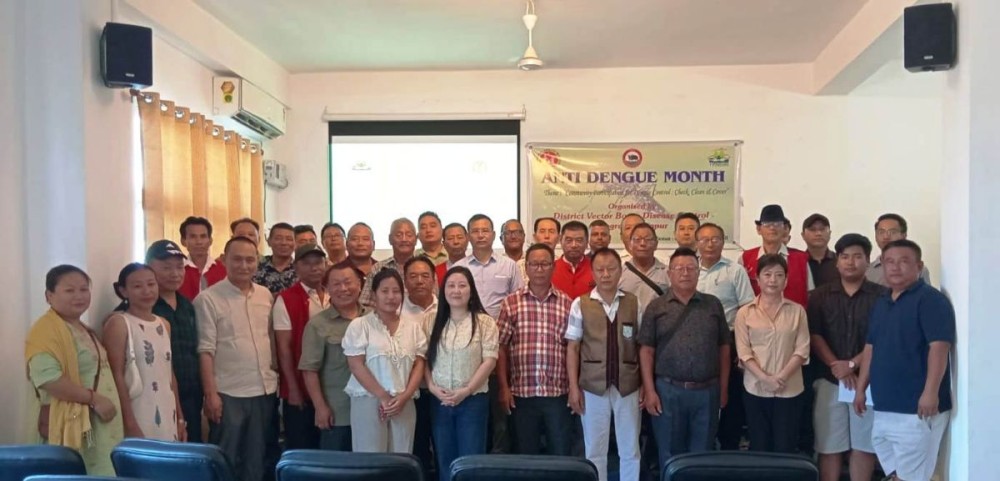
Health officials during the advocacy meeting held at the CMO’s Conference Hall in Dimapur on July 9. (Photo Courtesy: CMO, Dimapur)
Dimapur, July 9 (MExN): Health officials on Thursday urged greater community participation to prevent the spread of vector-borne diseases, including dengue, malaria and Japanese Encephalitis (JE), during an advocacy meeting organised as part of Anti-Dengue Month.
The meeting, held at the Chief Medical Officer's Conference Hall in Dimapur, focused on Dimapur, Chümoukedima and Niuland districts, particularly areas that had reported dengue cases in previous years. It was attended by community leaders from urban areas of Dimapur district.
Delivering the welcome address, District Programme Officer (CD-1) Dr Ayangla Saku said prevention and control of vector-borne diseases cannot be achieved by the government alone and requires active support and participation from the community. She called on all stakeholders to work together to tackle the growing threat of dengue, malaria and Japanese Encephalitis.
Consultant, District Vector Borne Disease (DVBD), Heanglih T Konyak presented the trend of malaria, dengue and JE cases in Dimapur between 2022 and 2026, while Assistant Director, Urban Vector Borne Disease Scheme (UVBDS), Kikolu Khieya briefed participants on the current disease situation in the district.
Officials said unplanned urban development and the accumulation of rainwater had created favourable conditions for mosquito breeding and disease transmission.
During the technical session, participants were told that source reduction remains the most effective method of controlling vector-borne diseases. Communities were advised to eliminate water-holding containers, keep stored water covered, maintain clean surroundings and organise regular cleanliness drives at the colony level to remove mosquito breeding sites.
The gathering was also advised to use mosquito repellents, wear full-sleeved clothing, sleep under mosquito nets and seek medical attention in case of fever. Officials said dengue should be confirmed only through ELISA testing at government or private health facilities.
Joint Director and State Programme Officer, National Vector Borne Disease Control Programme (NVBDCP), Dr Imnapokim said scientists had linked the sharp increase in dengue cases in 2023 to the strong El Niño effect. As similar climatic conditions prevail this year, there is a high likelihood of a rise in dengue cases, making preventive measures before any outbreak crucial, he said.
He urged community leaders to regularly remind residents to sleep under mosquito nets, use repellents, wear full-sleeved clothing and organise cleanliness drives. He also highlighted the effectiveness of larvivorous fish in controlling mosquito breeding and called on community leaders to identify suitable local water bodies where the fish could be released.
For immediate assistance in confirmed malaria cases, Imnapokim asked the public to contact the NVBDCP at 7630932587 for prompt intervention.
The meeting concluded with an interactive session during which community leaders shared experiences, suggestions and queries, besides proposing measures to strengthen vector control activities at the colony and ward levels. Officials appealed to participants to work collectively to build healthier and safer communities free from vector-borne diseases.