• State’s Vehicle Fleet Defies National Averages
• Nearly 40% of the state's registered vehicles are heavy vehicles
• Goods carriers account for over 83% of the transport fleet
Moa Jamir
Dimapur | July 8
If vehicle registrations are any guide, Nagaland appears to have quietly become one of India's biggest trucking states. Nearly two out of every five vehicles registered in the state are heavy goods vehicles.
Nagaland’s registered vehicle fleet has crossed the five-lakh mark. While the milestone is significant, the bigger story lies in the composition of the state’s vehicle fleet.
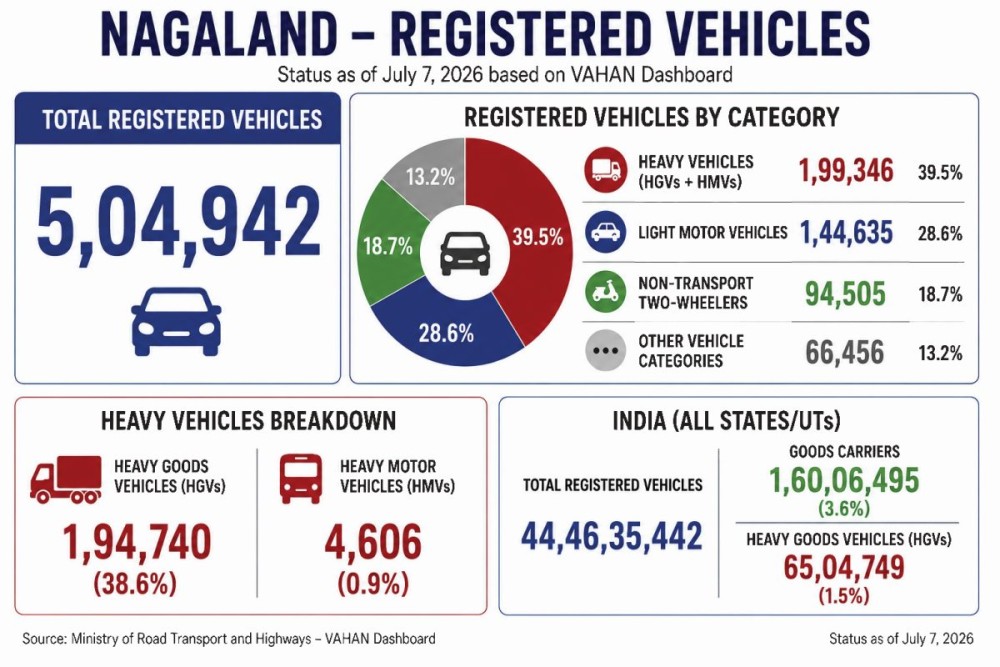
According to the Ministry of Road Transport and Highways’ VAHAN Dashboard, India has over 44.46 crore registered vehicles. Of these, Goods Carriers account for about 1.60 crore (3.6%), while Heavy Goods Vehicles (HGVs) number around 65 lakh (1.5%) of the national fleet.
Nagaland stands in sharp contrast.
As of July 7, 2026, the Dashboard recorded 5,04,942 registered vehicles in the state. The most striking feature, however, is the composition of the fleet.
Nearly two out of every five registered vehicles (39.5%) are classified as HGVs or Heavy Motor Vehicles (HMVs). Together, they number 1,99,346 vehicles, including 1,94,740 HGVs and 4,606 HMVs. By comparison, Light Motor Vehicles account for 28.6% of the registered fleet, while non-transport two-wheelers comprise 18.7%.
The contrast becomes even more apparent when viewed by vehicle class.
Of Nagaland’s 5.04 lakh registered vehicles, 2,50,800 are classified as Transport vehicles and 2,54,309 as Non-Transport, an almost even split.
Within the transport vehicles, 2,08,299 or more than 83%, are classified as Goods Carriers.
Passenger transport vehicles are comparatively few, comprising 13,328 passenger three-wheelers, 6,766 buses, 5,429 motor cabs and 2,105 maxi cabs.
Based on the 2011 Census population of 19.79 lakh, Nagaland has roughly one registered vehicle for every four residents and one registered heavy vehicle for every 10 people.
The VAHAN database, however, does not distinguish between active and inactive vehicles.
The fleet’s fuel profile tells a similar story. Diesel powers 2,84,750 vehicles, accounting for more than 56% of all registered vehicles, while petrol and Petrol (E20) vehicles together number about 2.15 lakh.
Electric mobility, meanwhile, remains limited, with the database recording just 44 Pure EVs, 74 Battery Operated Vehicles (BOVs) and 144 Strong Hybrid EVs.
Revenue data adds another dimension. The VAHAN Dashboard shows transport revenue collections rising steadily from Rs 191.89 crore in 2022 to Rs 265.23 crore in 2025.
The State Transport Department’s Annual Administrative Report 2025–26 records a transport revenue target of Rs 24,000 lakh (Rs 240 crore) for the fiscal year, broadly comparable with the Rs 265.23 crore in transport revenue collections recorded on the VAHAN Dashboard for 2025.
Permit data a clue?
Permit data provides another clue to Nagaland’s commercial transport profile. State records show that 1,40,667 permits have been issued so far, with the overwhelming majority processed by the Transport Commissionerate (NL-99).
Of these, 1,15,981 (82.5%) are National Permits, indicating that most permits issued in the state are intended for inter-State commercial operations.
Within the National Permit category, Multi-Axle Goods Vehicles (up to 50 tonnes) account for 75,308 permits (64.9%), followed by Heavy Goods Vehicles (23,712) and Multi-Axle Trailers exceeding 50 tonnes (15,407).
The permit issuance, however, has fallen sharply from 43,886 in 2022 to around 19,800 annually thereafter.
The numbers raises several pertinent questions. Why do HGVs, Goods Carriers and diesel dominate Nagaland’s registered vehicles? Why no takers for electric mobility? What explains the unusual state’s registration profile? And so on.
The VAHAN Dashboard provides the data, but not the explanations. The Morung Express has sought clarification from the Commissionerate of Motor Vehicles Department, and this report will be followed up upon receipt of the Department’s response.
Clarification: This article has been updated to correctly reflect that the State Transport Department’s Annual Administrative Report 2025–26 records a transport revenue target of Rs 24,000 lakh (Rs 240 crore) for the fiscal year. An earlier reference to approximately Rs 25 crore was incorrect.