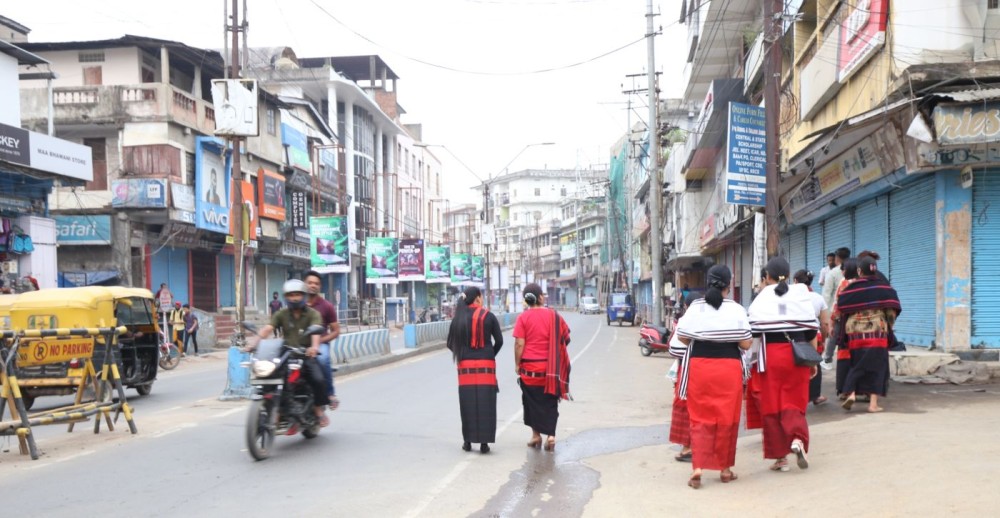
A group of Naga women walking in the streets of Dimapur. Naga society today exists at a dynamic crossroads, where traditional roles and modern ideals of gender often intersect and compete. (Morung Photo)
Morung Express News
Dimapur | March 14
Is the correlation between men and women in modern Naga society fundamentally unequal, or are their roles designed to complement one another? The weekly public poll conducted by The Morung Express revealed a society tackling with tradition, modernity and the evolving definitions of gender parity. Responding to the poll, a majority of 57% respondents leaned towards the roles being complementary, a 27% argued they remain unequal, with 16% others offering different perspectives.
Tradition and progress
Respondents of the “complementary” view argue that Naga society has historically functioned on a model of mutual interdependence. One respondent articulated this view, stating, “When you see it from the Naga viewpoint, the roles men and women played are complementary. They always go hand in hand. It was not possible for villages and communities to survive without assuming complementary roles.”
Few pointed to modern examples of women breaking glass ceilings, suggesting that this progress is being built upon a foundation of mutual respect. They cited the landmark 2023 election of Hekani Jakhalu and Salhoutuonuo Kruse as the first women to the Nagaland Legislative Assembly, and S Phangnon Konyak's historic election to the Rajya Sabha in 2022 as proof of a shifting landscape.
Furthermore, some highlighted the role of women in the local economy, particularly in the textile and handicraft sectors, and the influential presence of mothers’ unions in community affairs. One respondent linked this to the state’s Christian ethos, arguing, “Naga society as a Christian majority state have shaped the perspective... which view men or women as fearfully and wonderfully created so there is no discrimination.” Another added, “True equality would be a nightmare. We were made to complement each other's strength and cover up each other's weaknesses.”
However, sounding a note of caution one commenter lamented that “With modern culture rapidly eroding Naga society, this complementary role is being lost and is now replaced by modern roles which are unequal.”
Customary laws and patriarchy
On the other side, the respondents who labelled the role as “unequal” pointed to structural issues. The most frequently cited obstacle was the weight of customary laws and patriarchal mindsets that continue to exclude women from formal decision-making bodies.
“Naga society is slowly changing but the existence of customary laws limit women in partaking in decision-making,” one response read. “Naga society, to date, does not allow women to head the village council though capable. The Naga customary laws give more power to men for decision-making.”
Another person noted the absence of women in “hohos/bodies” and apex bodies, particularly at the local village and colony levels. The influence of the church was also highlighted as a space where leadership remains predominantly male.
Ironically, some argued that inequality persists despite women excelling. One respondent noted, “In comparison, women outperform men in almost every field with the switching of education. But being a patriarchal society, we Naga still hesitate to accept the fact based on performances.”
Another critique of the gender equality suggested it has become a “fake” endeavour that overlooks men. It argued that true equality would remain elusive as long as society does not equally champion issues like International Men’s Day.
A society in transition
The respondents who chose “Others” reflected a reality where tradition and modernity coexist uneasily.
“Roles of men and women seem complementary and is true for most part,” one person wrote. “However, in areas like property and in the functioning of hohos/bodies, there is little or no room for women and are therefore fundamentally unequal in these areas.”
This view of a “heavily complementary” society with significant ground to make up on equality was a recurring theme. One respondent challenged both men and women to move beyond ingrained assumptions, asking why more women do not pursue traditionally male-dominated trades like carpentry or electrical work, suggesting that equality requires effort from all sides.
One respondent noted, “We are living in a time where we are in a transition.” Whether that transition leads to a new model of complementarity or a decisive shift towards equality remains a defining question for the state’s future.