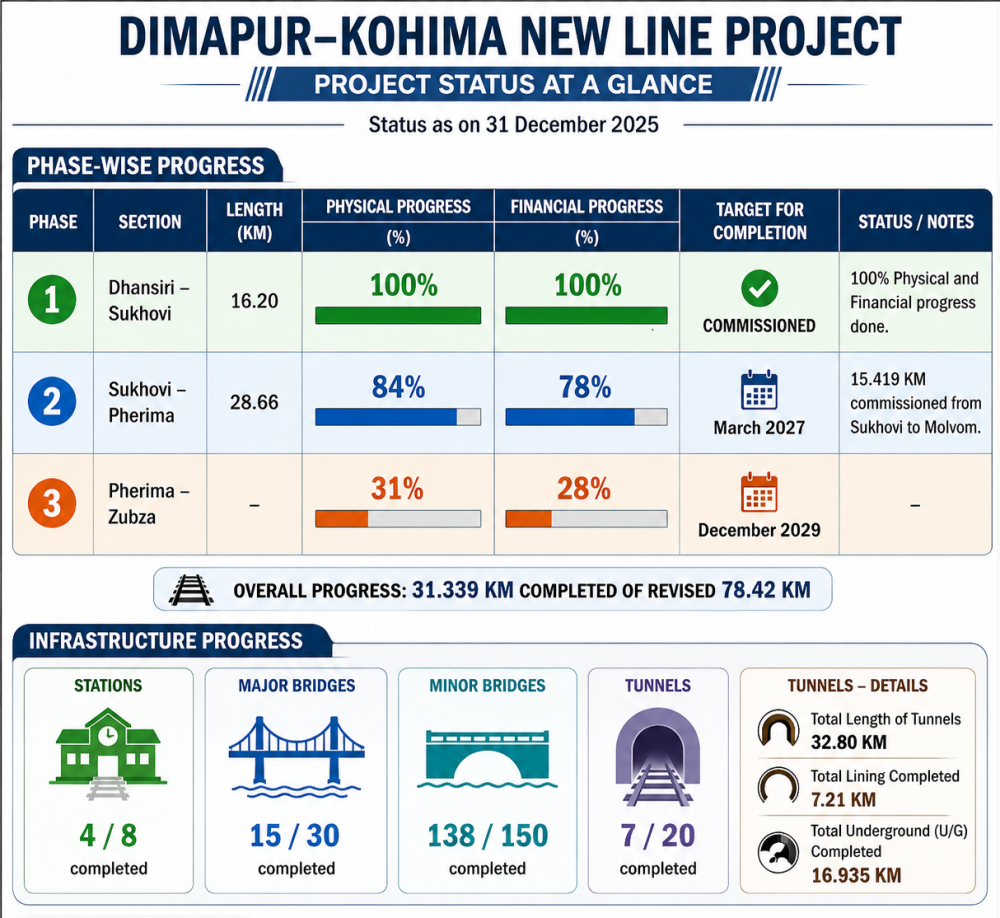
The project timeline as of December 31, 2025, furnished by the Union Railway Ministry to the Parliamentary Public Accounts Committee (2026-27) on the construction of the Dimapur-Kohima New Line Project, Northeast Frontier Railway. (Image created with AI assistance based on PAC Report)
Moa Jamir
Dimapur | August 9
Apart from cost escalation, slow progress, inadequate initial surveys and land acquisition issues, the Public Accounts Committee of Parliament has flagged the 8 percent establishment charge levied by the Government of Nagaland (GoN) on land acquired for the Dimapur-Kohima New Line Project.
The Committee has also raised concerns over geological risks around two tunnels, where ‘ongoing land movement’ was observed during inspections in September 2025.
The findings are contained in the 52nd Report of the Public Accounts Committee (2026-27), titled “Construction of Dimapur-Kohima New Line Project: Northeast Frontier Railway,” of the 18th Lok Sabha. Based on the Comptroller and Auditor General of India’s Report No. 35 of 2022 relating to the Ministry of Railways (Railway Board), it was presented in the Lok Sabha and laid in the Rajya Sabha on August 4.
8% establishment cost issue
One of the key issues flagged by the PAC concerns the 8 percent establishment cost levied by the GoN on compensation for railway land acquisition.
The PAC noted that the applicable Railway provision allows reimbursement only of additional expenditure actually incurred towards land acquisition staff and contingencies for Central Government projects.
The State's 8 percent levy, including a 4 percent component treated as State revenue, has resulted in Rs 18.72 crore in irregular payments, according to the Committee.
Railways raised the issue with the State government through letters dated May 26, 2023 and December 17, 2025, stating that the 8 percent charge was contrary to the applicable Railway provision of 4 percent.
.webp)
The State government, however, reiterated that 8 percent remains its standing policy, with no separate rate prescribed for National Highways or Railways.
The matter remains unresolved.
Accordingly, the PAC recommended that the Ministry of Railways take up the matter with the GoN at the highest level and, if the State persists, seek Ministry of Home Affairs intervention to ensure land acquisition for Central projects in Nagaland is conducted at rates consistent with the applicable Railway provision.
Geological risks around key tunnels
The PAC has raised concerns over the geologically sensitive terrain around Tunnels 7 and 10, where ‘ongoing land movement’ was observed during inspections as recently as September 2025.
Tunnel 7, the longest on the project at 6.1 km and located at Tsephama village, commenced construction in November 2025.
The Committee questioned whether adequate geological and geotechnical investigations were carried out before the alignment was sanctioned, given the steep and landslide-prone terrain between Zubza and Kohima.
The Ministry said the project was preceded by surface geological mapping, borehole investigations, laboratory testing of soil and rock samples and slope-stability assessments. Stage-wise investigations were also undertaken for Tunnels 7 and 10, with geological mapping, probe drilling and instrumentation during construction. An independent consultant has also been engaged for regular tunnel safety audits.
While acknowledging the progressive approach, the PAC noted that the initial alignment decisions lacked the level of comprehensive geological investigation and mapping demanded by the terrain, contributing to cost and time overruns.
It recommended continuous geological monitoring with real-time instrumentation in Tunnels 7 and 10, adaptive design mechanisms, contingency plans and adequate funding for emergency geological interventions.
41 of 42 extensions without penalty
The PAC also flagged contract management concerns. Of 42 extensions of time granted since 2015, 41 were without penalty. Railways attributed the extensions to land disputes, local agitation, landslides, road blockages, the COVID-19 pandemic and requisitioning of vehicles for local elections. Only one extension attracted a penalty for contractor-attributable delay.
The Committee said the large number of extensions pointed to weaknesses in project scheduling and tender-stage risk assessment, contributing Rs 42.38 crore in additional price variation costs.
It recommended that signalling and telecom works be executed through EPC tenders, as now adopted, to avoid premature procurement. It also called for monitoring the shelf/codal life of procured materials and synchronising procurement with civil works.
For specialised tunnelling and communication equipment, it recommended developing indigenous or Make-in-India alternatives to reduce import dependence and procurement risks.
Completion timeline and others concerns
As of December 2025, 31.339 km of the revised 78.42-km project had been completed. Phase 1 (Dhansiri-Sukhovi) was commissioned, Phase 2 (Sukhovi-Pherima) was at 84 percent and targeted for March 2027, while Phase 3 (Pherima-Zubza) was at 31 percent with a December 2029 target.
The Ministry, however, also referred to a 2028 completion target, leaving the overall deadline unclear.
The project's cost had risen sevenfold from Rs 850 crore at sanction in 2006-07 to Rs 6,663.20 crore by May 2022, while physical progress was below 25 percent as of March 2022.
By December 2025, four of eight stations, 15 of 30 major bridges, 138 of 150 minor bridges and seven of 20 tunnels had been completed, with 16.935 km of underground excavation done.
The PAC also questioned the lack of accountability for land acquisition lapses, including Rs 141.70 crore in infructuous expenditure, and flagged Rs 11.44 crore in premature signalling procurement, an Audit-assessed Rs 879.05 crore tunnel-design liability disputed by Railways, and Rs 6.14 crore in avoidable expenditure from subsequent tunnel design changes.
It recommended that future EOTs in hill-railway and complex-terrain projects be individually justified with documentary evidence and subjected to senior-level financial scrutiny.
It also said land acquisition should begin only after the alignment has been formally frozen and approved, and not while the underlying survey is under review or revision.
Overall, the PAC cited shortcomings in surveys, land acquisition, design, procurement, contract management and accountability, and recommended a comprehensive Codal Compliance Framework with mandatory checks at every stage and accountability for specific lapses.