Chizokho Vero
Kohima | November 14
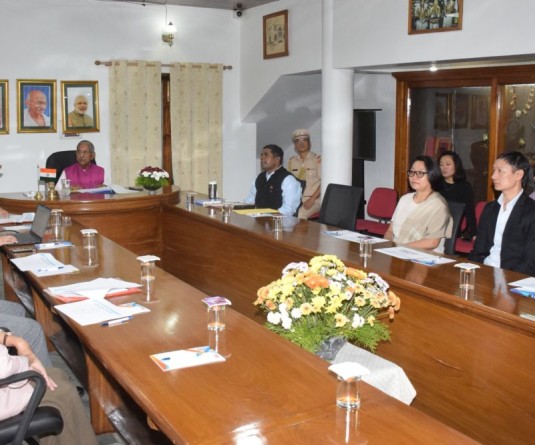
Minister for Urban Development Dr. Shurhozelie Leizietsu today regretted that there were so many smaller towns that are mushrooming in different parts of the state without any planning. “These are small quasi-urban settlements such as administrative headquarters and small scale industrial townships growing and inheriting urban characteristics requiring planning intervention,” Dr. Liezietsu told the Urban Development Department Officers’ annual conference here today at Hotel Japfu. He also stated that there are at least 66 such towns including the district headquarters identified for provision of basic infrastructure. Since Nagaland achieved statehood in 1963 the total population has increased by 5.3 times in terms of absolute number while urban population increased by 18.4 times which is remarkable, the Minister said.
“At this rate it is expected that by the next 20 years or so, half the population of Nagaland will be living in towns and cities. The Minister regretted that the towns are grossly inadequate in terms of basic infrastructure as well as recreational facilities and went on to add that slums are the part and parcel of the process of urbanization. Our development activities should be comprehensive and holistic enough to cover these areas as well, he added. The Minister also advocated that the towns and cities are in urgent need of renewal, adding that renewal process provides the means and opportunities whereby cities can fundamentally readapt to meet contemporary and future needs.
Unless cities are renewed as part of a continuing process they cannot hope to survive through period of growth and changing needs, he said adding that there must be a real recognition and understanding of the continually changing needs and ideas of urban man as for instance with the use of more electronic gadgets such as computers, per capita requirement of electricity is much higher than that was required just a decades ago.
“Also we must ensure that the new development increasingly bring about a proper urban balance, economically, socially and functionally, with an overriding concern for maintaining the city as a healthy, living organism and a fit place for its occupants,” he added. To make our towns and cities more energy efficient and less polluting should be at the focus of our developmental activities, he maintained.
He also regretted that lack of proper urban land management poses serious challenge to policy makers, adding that in any urban developmental activities, the availability of sufficient land at the ideal location and at affordable prices is crucial. “Over the last few years, there have been cases of large land speculations especially in the fringes of Dimapur and Kohima which is very disturbing, he said adding that steps to curb this land speculation by few individuals should be devised “if our towns and cities are to grow in a desired manner.”
A rethinking is also required on the implications of the provision of Article 371 (A) on our land holding system, he said adding that while the objectives of such constitutional provision is to safeguard the interest of the community, it has only served as an obstacle to our development process in many occasions. The process of urbanization in Nagaland is a skewed phenomenon as is evident in the fact that Dimapur and Kohima alone constitute 54.30 per cent (i.e. 1, 91, 630 persons) of the total urban population which does not reflect a desirable process, he said. “As a long term urbanization strategy, we have to device a system that would ensure a certain degree of balanced and uniform urban growth pattern in Nagaland,” the minister added.