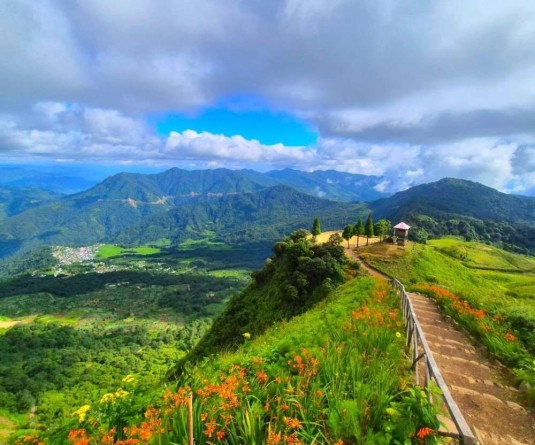
Preservation or tourism? The path chosen now will decide whether Dzükou Valley remains a sacred grassland or becomes another casualty of development. (File Photo)
Morung Express News
Dimapur| December 27
2025 will be remembered as a year when Dzükou Valley once again reminded Nagaland of both its ecological vulnerability and symbolic importance. The year ended under a cloud of environmental concern as authorities and conservationists grappled with the aftermath of a wildfire and public debate over proposed tourism development in the ecologically sensitive region.
The wildfire that erupted in the western part of the valley on December 12 burned across rugged terrain for several days, prompting the suspension of trekking activities and triggering multi-agency firefighting efforts. The Southern Angami Youth Organisation (SAYO) announced an immediate ban on all trekking, citing safety risks until the blaze was fully extinguished.
The blaze was accidentally triggered by four trekkers who lit a fire at their campsite and left it unattended, allowing the flames to spread rapidly through dry grass and vegetation before they were rescued.
Officials from the Nagaland State Disaster Management Authority and volunteers from the Khonoma Youth Organisation, forest personnel and disaster teams battled the flames in difficult terrain, with strong winds and dry vegetation accelerating the fire’s spread towards the Japfu range. Authorities requisitioned a helicopter equipped with a Bambi bucket through the Nagaland State Disaster Management Authority to support containment operations.
After a joint spot survey by local organisations and the State Disaster Response Force, the wildfire was declared completely extinguished by mid-December, with no active flames observed and containment operations officially called off.
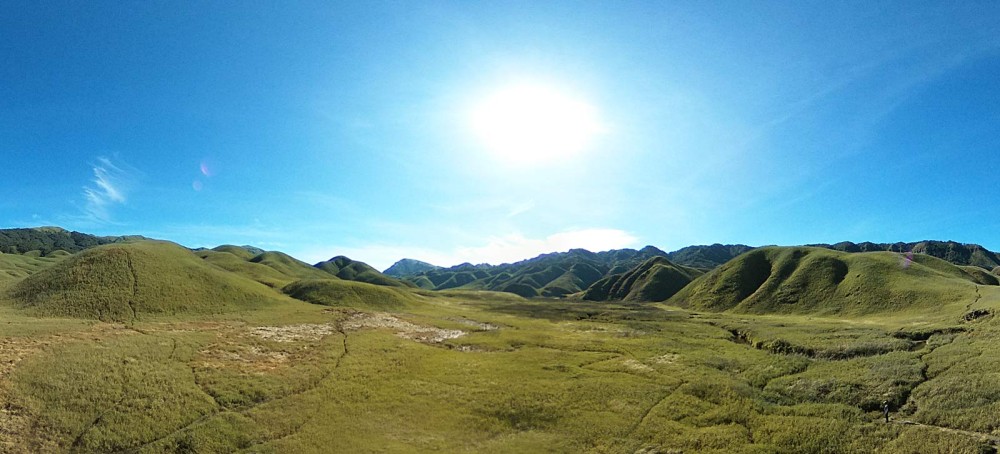
The valley, situated at about 2,452 metres above sea level and shared between Nagaland and Manipur, hosts a wealth of biodiversity including rare wildflowers such as the Dzükou lily, rhododendron species and unique fauna. Its fragile ecosystem has historically been vulnerable to periodic wildfires that can rapidly spread through dry grasslands and inaccessible slopes.
Alongside wildfire management, environmental debates intensified over proposals to develop the Dzükou Valley as a world-class eco-tourism destination. Nagaland’s Tourism Department have put forward a Rs 250-crore development plan aimed at transforming the valley into a global tourism hub, including the establishment of eco-resorts, trekking infrastructure and modern visitor amenities. Proponents argue the project could boost local employment and position the valley as part of India’s “50 World-Class Tourist Destinations” initiative.
However, the proposal has drawn sharp criticism from environmentalists as well as concerned citizens who warn that even “eco-friendly” developments, such as a luxury hotel or resort perched above the valley, risk disturbing the pristine ecology and water catchment systems of the region.
They described large-scale infrastructure plans as potential threats to the valley’s delicate landscape, cautioning that poorly managed tourism development could lead to habitat loss, soil erosion and recurrent fires.
For conservation advocates, the wildfire and the development debate underscore longstanding concerns about the valley’s vulnerability. The Dzükou ecosystem, which has periodically suffered fires in past decades, continues to draw attention for its rare species, important wildlife habitats and cultural significance for tribes in both Nagaland and Manipur.
One can also recall the 2020–21 Dzükou Valley wildfires, which broke out on December 29, 2020, affecting areas in both Nagaland and Manipur and was confirmed fully doused by January 11, 2021 only. The blaze caused extensive environmental damage in the ecologically sensitive Dzüko Valley, destroying around 200 acres of old-growth forest.
In recent years, Dzükou Valley has also never been more visible, with its reach expanding far beyond traditional trekkers and nature enthusiasts. The rise of social media, travel vloggers and digital influencers has propelled the valley into the national and global spotlight, with curated images, drone shots and destination reels drawing unprecedented attention.
While this exposure has boosted interest in Nagaland’s tourism potential, there are also concerns that unregulated digital promotion and increasing footfall, often without adequate ecological awareness, have further strained the valley’s fragile ecosystem, amplifying concerns over waste, fire hazards and long-term environmental sustainability.
The events of 2025 have therefore rekindled a larger question-should Dzükou Valley be developed for tourism, or protected from it? Or is there a middle path that genuinely prioritises conservation over revenue? Whether it emerges as a model of sustainable conservation or a cautionary tale of development outpacing ecology, will depend on decisions made now.
For Nagaland, the question may no longer be about how to showcase Dzükou to the world, but how to ensure it survives for generations yet to walk its grasslands.