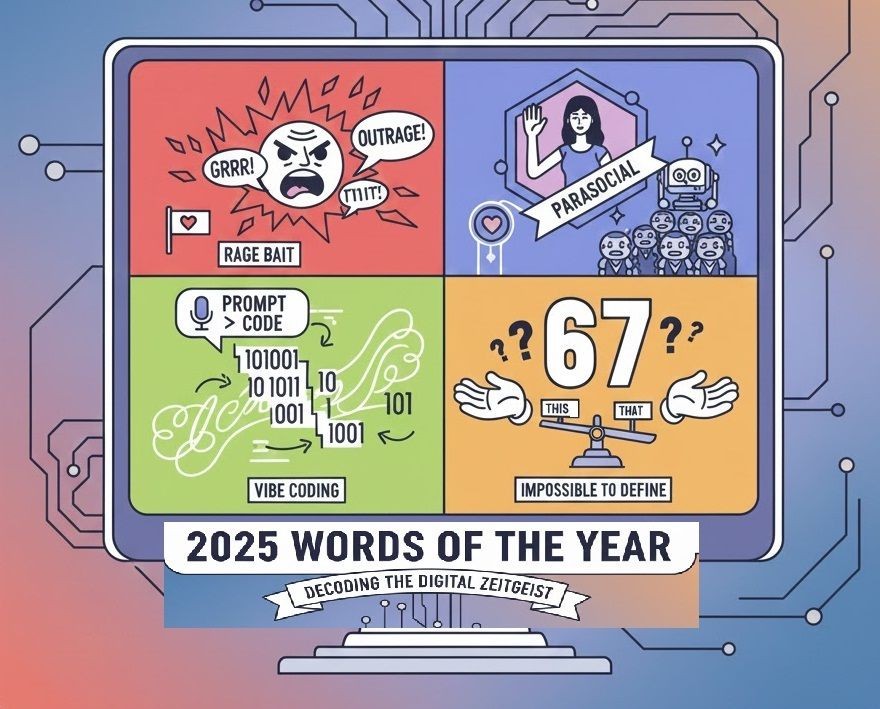
The 2025 Words of the Year 2025 capture how deeply technology permeates everyday life. (Image/Concept generated by Gemini)
Morung Express Feature
When Oxford Languages declared ‘rage bait’ as its Word of the Year 2025 (WOTY), the choice resonated across the selections of Collins, Cambridge, and Dictionary.com, collectively mirroring the digital zeitgeist.
It underscored how our online and offline lives are becoming increasingly intertwined, offering a cultural snapshot of a world negotiating identity, intimacy, performance, and power within digitally mediated spaces.
The Morung Learning presents a lowdown on the 2025 Words of the Year, unpacking what they reveal about life shaped by the screen, directly or otherwise.
Oxford’s ‘rage bait’
Oxford’s winner, rage bait, is defined as “online content deliberately designed to elicit anger or outrage by being frustrating, provocative, or offensive, typically posted in order to increase traffic to or engagement with a particular web page or social media content.”
According to Oxford University Press, which publishes the Oxford English Dictionary, though first recorded in a 2002 Usenet post referring to deliberate agitation between drivers, the word has since evolved into internet slang used to describe viral tweets and a “shorthand for content designed to elicit anger by being frustrating, offensive, or deliberately divisive in nature, and a mainstream term referenced in newsrooms across the world and discourse amongst content creators.”
It’s also a proven tactic to drive engagement, commonly seen in performative politics, it added.
While rage bait is two words, Oxford’s WOTY can be a singular word or expression denoting a single unit of meaning.
Oxford’s shortlist further captured the self-curation and self-optimisation trends that dominate online life:
• Aura farming: The cultivation of an impressive, attractive, or charismatic persona or public image by behaving or presenting oneself in a way intended subtly to convey an air of confidence, coolness, or mystique.
• Biohack: To attempt to improve or optimise one's physical or mental performance, health, longevity, or wellbeing by altering one's diet, exercise routine, or lifestyle, or by using other means such as drugs, supplements, or technological devices.
67: A number denoting everything & nothing
If Oxford identified outrage, Dictionary.com captured the absurdity of digital culture with its pick: 67.
Pronounced “six-seven,” the number went viral thanks to TikTok, a trending song, and a child influencer dubbed the “67 Kid.” Searches rose more than sixfold from June 2025. The origin of this most modern use of 67 is thought to be a song called Doot Doot (6 7) by Skrilla.
As per Dictionary.com, what 67 means is part of its charm—and frustration. It can stand for “so-so,” or “maybe this, maybe that,” especially when paired with its signature hand gesture, where both palms face up and move alternately up and down. Perhaps the most defining feature of 67 is that it’s impossible to define, it added.
Dictionary.com’s shortlist offered a richer picture of the year’s anxieties:
• Agentic – marking the rise of AI capable of autonomous action.
• Clanker – a mocking label for robots and AI, echoing techno-scepticism.
• Broligarchy – satire of the billionaire tech elite’s political influence.
Other words included Gen Z stare, overtourism, tariff, tradwife, kiss cam, dynamite emoji (TNT, Taylor ‘n’ Travis), and aura farming.
Collins’s coding by vibe
Meanwhile, Collins Dictionary turned its attention to AI with vibe coding as its WOTY. As per Collins, vibe coding, coined and popularised by AI pioneer Andrej Karpathy, refers to the “use of artificial intelligence prompted by natural language to write computer code.”
It offers a glimpse into a world where humans increasingly instruct machines through conversational prompts rather than technical syntax.
Collins’ shortlist reinforced how deeply technology permeates everyday life:
• Taskmasking – feigning productivity in return-to-office environments.
• Clanker – shared with Dictionary.com, indicating widespread unease about AI replacing human roles.
• Micro-retirement – short intentional breaks taken to avoid long-term burnout.
• Coolcation – choosing cooler climate holidays in response to heatwaves.
Other shortlist entries included HENRY (high earner, not rich yet), biohacking, glazing, and broligarchy.
Cambridge feeling ‘parasocial’
If the other dictionaries focused on provocation, performance, and AI, Cambridge centred on the emotional fallout with its choice: parasocial.
It defined parasocial (adjective) as “involving or relating to a connection that someone feels between themselves and a famous person they do not know, a character in a book, film, TV series, etc., or an artificial intelligence.”
Lookups spiked in June following discussions on Meta and OpenAI’s chatbots, and again when YouTuber blocked a fan who declared himself the creator’s “number 1 parasocial.” By September, Cambridge updated its definition to acknowledge AI as a new object of parasocial attachment.
Two other words shortlisted for Cambridge’s WOTY had a technological focus. Pseudonymisation (noun) is defined as a “process in which information that relates to a particular person… is changed to a number or name that has no meaning so that it is impossible to see who the information relates to.”
Memeify (verb) means to “turn an event, image, person, etc., into a meme—an idea, joke, image, or video that spreads very quickly on the internet.”
Other words under Cambridge’s radar included glazing, bias, vibey, breathwork, and doom spending.
Another prominent dictionary, Merriam-Webster, is yet to announce its WOTY 2025. Another prominent dictionary, Merriam-Webster, is yet to announce its WOTY 2025.