(Photo: IANS)
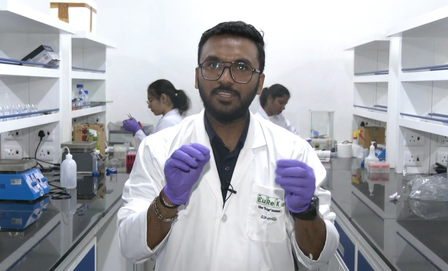
Gandhinagar, April 19 (IANS) In a landmark achievement, the IIT Gandhinagar has developed a hydrogel-based technology with potential of spurring further innovations -- thereby resulting in "simplification" of surgery for colon-related tumours.
The hydrogel-based technology uses biocompatible polymers to provide localised, controlled, and intelligent drug delivery, leading to treatment efficacy while minimising systemic toxicity.
According to Harshil Dave, the young scientist from Mehsana, who is reported to have achieved the breakthrough in the field of medical science explained the tech-oriented leap in treating patients with colon tumour.
Notably, the hydrogel-based technology aids in the surgical removal of colorectal polyps -- tumors that carry the potential to evolve into cancer.
Research scholar Harshil noted that the hydrogel he created possesses a unique "shear-thinning" property.
This means that when pressure or force is applied to it, it transitions into a liquid state; conversely, once the force is removed, it reverts to its solid (gel) form.
Due to this, doctors can easily inject the substance using a long catheter or an endoscope. Once injected, the substance creates a cushion beneath the tumor, facilitating the doctor's ability to easily lift the tissue and remove it with greater precision.
During the endoscopic surgery, saline solution or dextrose is injected beneath a colon tumor to elevate it, however, this liquid tends to dissipate quickly.
In contrast to this, the new hydrogel-based technology causes the tumor to remain elevated and stable, thereby significantly simplifying the surgical procedure.
Mukesh Danka, Assistant Professor in the Department of Biological Sciences and Engineering at IIT Gandhinagar, backed his findings and said, "Harshil began his research on this subject three years ago. We procured DGMS molecules from plant sources. Upon dissolving them in water to analyse their properties, we observed that they formed a nanofibrous hydrogel. Harshil subsequently commenced his work on developing this material."
He noted that small cancerous tumors often develop within our gastrointestinal tract.
Harshil Dave's research has been published in an acclaimed international journal, and he has also been honoured with the 'Vikram Sarabhai Young Scientist Award 2026' for this work.
At present, the technology has successfully undergone pre-clinical trials and testing on large animals.
Preparations are underway to advance this technology to the clinical trial stage, with the aim of facilitating its widespread application in the treatment of colon cancer in the future.