CAG finds 24 government employees enrolled as ‘unskilled workers’; Rs 6.04 lakh paid to 19
Moa Jamir
Dimapur | September 7
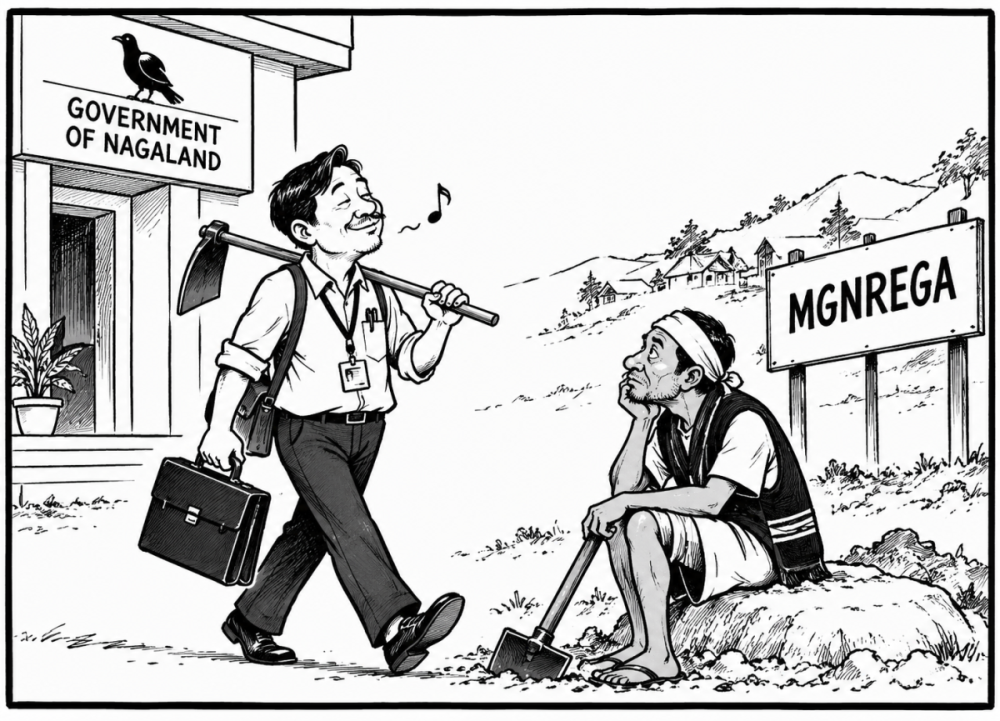
Government employees appear to have found an unlikely second calling under the rural job guarantee scheme, with 24 government employees enrolled as unskilled workers under MGNREGA and Rs 6.04 lakh paid as wages to 19 of them, the Comptroller and Auditor General of India (CAG) has found.
The ironic twist to rural poverty alleviation emerged during the CAG’s performance audit of the Implementation of under the Mahatma Gandhi National Rural Employment Guarantee Scheme (MGNREGA) in Nagaland for 2019-20 to 2023-24.
The finding is based only on 32 test-checked villages, not a statewide count and therefore, the actual number of government employees on MGNREGA rolls could be higher.
Among those identified, the highest wage payment was Rs 58,878 to a Public Health Engineering Department employee, followed by Rs 58,538 to a Power Department employee and Rs 50,713 to an employee of the Fire & Emergency Services Department.
As per the CAG, the State Government accepted the audit observation in December 2024 and stated that directives had been issued to Programme Officers to identify and cancel the Job Cards of government employees.
The audit report, however, does not indicate whether any Job Cards were subsequently cancelled or what action was taken against the employees identified.
Rs 29.53 crore diverted from administrative funds
The audit flagged wider financial management concerns, including diversion of Rs 29.53 crore meant for administrative expenses towards salaries of functionaries already engaged by the State, vehicle purchase and repairs, and other scheme-related expenditure.
The Government cited administrative-fund shortages and said some transfers were temporary and recoverable.
The CAG rejected the rationale, noting that MGNREGA guidelines prohibit the use of administrative funds for vehicle purchase or maintenance and salaries of existing government staff.
The diversion amounted to misutilisation at the point of diversion and weakened planning, monitoring, grievance redressal and technical quality control, it noted.
The State also accumulated Rs 22.37 crore in penal interest due to delayed release of State Employment Guarantee Fund (SEGF) funds during 2019-21. Moreover, the State matching share fell short by Rs 104.39 crore during 2019-23. The Government stated that the issues had been taken up and that the 2023-24 matching share was released in full.
Only 46 days of works offered
Despite MGNREGA’s legal guarantee of employment for up to 100 days, households received an average of only 46 days of employment during the five-year audit period.
The Government maintained that 100 days was the maximum permissible employment and that work was provided based on approved labour budgets and demand.
However, a CAG survey of 323 beneficiaries across 32 test-checked villages found that 280, or 86%, were willing to work more days than they had been offered.
The audit further found that annual door-to-door verification of Job Cards was not conducted in the 32 test-checked villages.
Aadhaar seeding and authentication also remained low, at 51% and 43% respectively statewide, with the figures falling to 47% and 39% in the four test-checked districts.
The State attributed the shortfall to limited Aadhaar enrolment centres, data mismatches and the presence of 23 unbanked rural blocks out of 74.
Projects that existed only on paper?
Another major finding, 10 projects costing Rs 2.87 crore reported as completed were found not to physically exist. The audit also detected short execution in 51 projects amounting to Rs 8.69 crore, indicating possible misappropriation.
The problem extended beyond who was on the rolls to what the scheme was paying for. Fourteen impermissible works involving Rs 9.56 crore were taken up, including Panchayat buildings exceeding the permissible cost ceiling, bridge construction and livestock distribution to individual households.
The State Government said the works addressed local needs, employment and livelihoods, citing the limited applicability of the permissible works list in Nagaland, and said District Programme Coordinators and POs had been directed to reject such proposals. The CAG, however, observed that the explanation effectively confirmed that inadmissible works had been executed under MGNREGA.
Independent oversight found wanting
Though State and District Quality Monitoring Cells were constituted in 2019, no inspections were conducted during the progress or completion of works, and the teams were not reappointed after their three-year terms. The CAG said relying on POs for monitoring compromised independence as they were directly involved in implementation.
The audit further found a 59% shortfall in social audits, with 2,676 not conducted against a target of 4,536 during 2019-24. Ombudsman offices were non-functional in all three test-checked districts, while Citizens’ Charters were unavailable during the audit period.
The State Government attributed the social-audit shortfall to paucity of funds and unfavourable climatic conditions for travel, and said POs had been directed to settle audit observations. It also cited a workshop for appointed Ombudspersons and instructions to district agencies to ensure their proper functioning.
The CAG found the explanations inadequate, noting that biannual social audits are mandatory and that funding and climatic constraints should have been anticipated in annual planning and budgeting. It also said the prolonged non-functionality of Ombudsman offices reflected failure to address the issue in time, while the persistent audit shortfall despite PAC recommendations pointed to systemic weaknesses in planning, fund management and statutory compliance.
Planning gap at the foundation
The audit also found that no baseline survey was conducted during 2019-24, despite guidelines requiring periodic assessment of Job Card holders at the Gram Panchayat level. The absence of updated surveys meant there was no reliable basis for village development plans and labour budgets.
The Government cited the use of older survey data and constraints in engaging expert institutions. The CAG said pre-2016 data could not adequately reflect subsequent changes in population, migration, new Job Cards and workers’ preferences.
The audit also found no IEC plan was prepared during 2019-24, with no IEC funds reaching block offices or VDBs and only limited activities at the Directorate.
The State cited earlier annual plans and the Ministry’s IEC calendar, but the CAG found the response inadequate as it did not meet the requirement for a structured, pre-planned IEC strategy under the MGNREGA Operational Guidelines.
CAG recommendations
To address the deficiencies, the audit recommends that Nagaland conduct baseline surveys and prepare village development plans; ensure timely release of SEGF funds; stop diversion of administrative funds; and follow GFR, 2017 for procurements above Rs 25 lakh.
It also calls for appointment of Gram Rozgar Sahayaks (GRS) and Mates at village level, annual door-to-door Job Card verification, 100% Aadhaar-Based Payment System coverage and comprehensive Information, Education and Communication (IEC) activities.
For accountability and quality control, the CAG recommends restoring independent State and District Quality Monitoring Cells, conducting social audits twice a year and publishing Citizens’ Charters.
The findings collectively point to gaps not only in beneficiary verification and fund management, but also in planning, execution, monitoring and statutory accountability of MGNREGA implementation in the State.