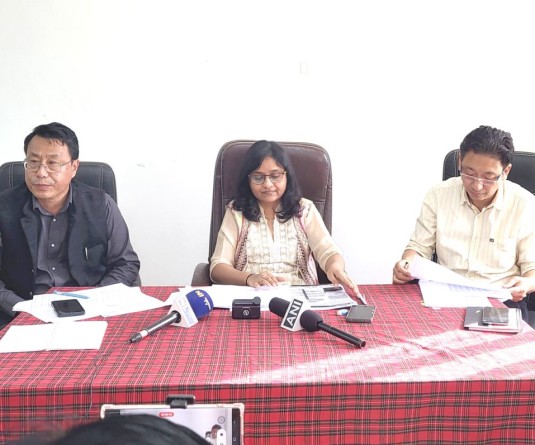
NSF President Mteisuding Heraang (centre) and ILRC-NSF chairperson Senchumo NSN Lotha (right) at the press conference in Dimapur on August 22. (Morung Photo)
ILRC-NSF to debate BEFR 1873
Morung Express News
Dimapur | August 22
The Inner Line Regulation Commission-Naga Students’ Federation (ILRC-NSF) is all set to host what it described as the “first of its kind” seminar in Nagaland on the Bengal Eastern Frontier Regulation (BEFR), 1873.
The two-day seminar scheduled on August 28 and 29, at the Dimapur Town Hall, will feature advocates of the Supreme Court and academics examining the constitutional dimensions of the colonial era regulation.
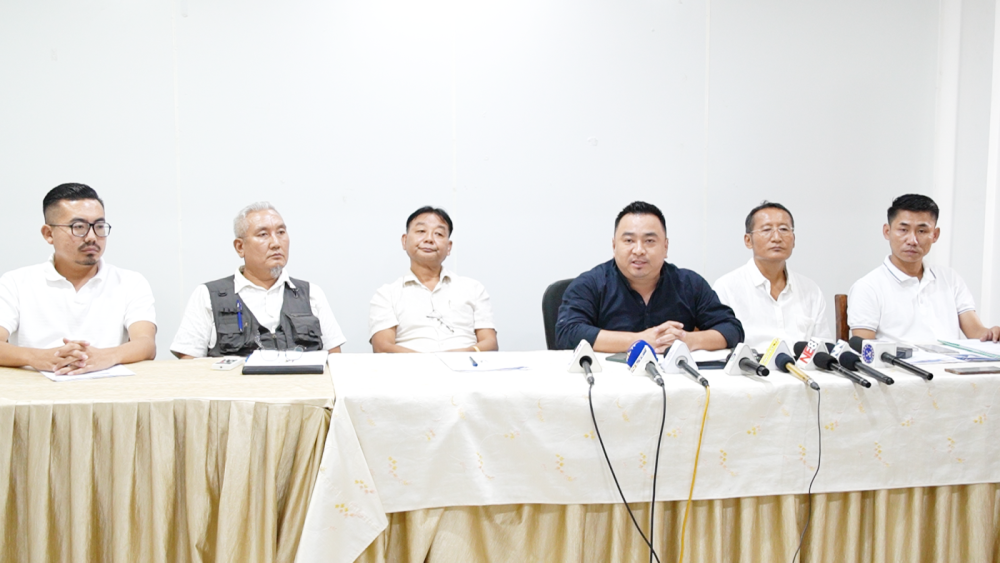
NSF President Mteisuding Heraang termed the event as “very historic and the first of its kind in the Naga homeland.” “The purpose of why we are coming up with a national seminar on BEFR 1873 is to educate and to let our people know the importance of the ILP in our state,” he told a press conference in Dimapur, on August 22, jointly addressed with the ILRC-NSF Chairperson, Senchumo NSN Lotha.
The NSF established the ILRC in December 2024 to address perceived loopholes in the state’s Inner Line Permit (ILP) regime. Heraang said that the commission has submitted “certain representations” to the state government but has yet to get any response.
The ILRC-NSF described the implementation of the ILP in Nagaland as rather “facilitative” than enforcement, and existing only on paper. According to him, the alleged laxity in enforcing the regulation has transferred economic control away from the indigenous population.
He said that the perceived laxity necessitates a centralised and independent implementing authority to replace what it described as temporary, “piece-meal” checking measures in place at present. He said, “If this Inner Line Pass system is implemented in letter and spirit, it will become the economic life jacket of the Naga people.”
He added that the enforcement of the regulation must be systematic without exploiting or discriminating against genuine non-native citizens. “The only concern that we would like to convey to them is that they must abide by the existing provisions and laws of the state,” he said.
The seminar seeks to bring perspectives from Mizoram, Manipur, Assam, Arunachal Pradesh, and also from the “mainland” India, and the relevance, or otherwise, of the ILP in a globalised world.
Lotha said that it would be an “open book” that would bring to light many questions and clear doubts about the enforcement, particularly in Nagaland.
As per the programme schedule, day one will focus on the enforcement of the BEFR in Manipur and Arunachal Pradesh. The sessions will be led by Professor Dr Ch Priyoranjan Singh of Manipur University and Professor Nani Bath of Rajiv Gandhi University, Arunachal University.
On the second day, Dr Lallianchhunga of Mizoram University will present a case study on Mizoram, which the ILRC-NSF regards as a successful model of “regimental” implementation. Senior Advocates from the Supreme Court of India, Prashant Bhushan and Shomona Khanna, will speak on fundamental rights, constitutional correlation, and safeguarding the rights of hill tribes.
Professor Shantanu Chakravarty of Girijananda Chowdhury University will present a mainland Indian perspective on constitutional safeguards. Nagaland Home Commissioner is scheduled to deliver the state government’s response regarding the administration and implementation of the ILP.
The sessions will be moderated by K Elu Ndang, Former General Secretary of the NSF;
Paukizonne Mariam, Assistant Professor at Peren Government College; Dr Ngiplon Rachel Chohwanglim, Head of the Commerce Department and Assistant Professor at Kohima College, Kohima; and Ariben, Advocate. Supreme Court advocates Ashhab Ahmed Khan and Astha Saxena were also listed as “observers,” who will participate in the discussions but will not present papers.