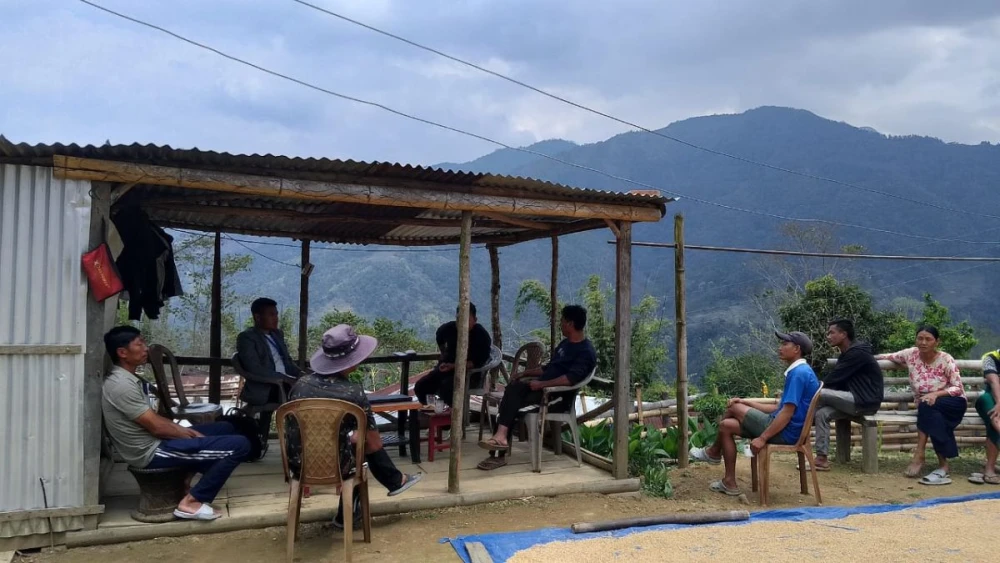
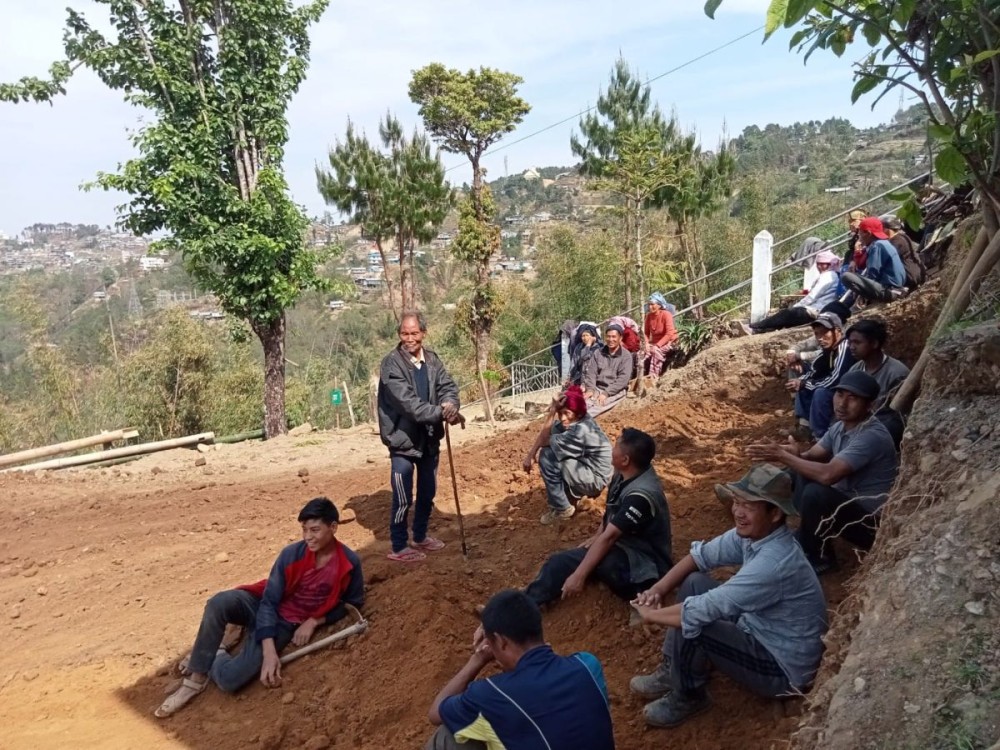
The chief of Natha New Village, Zunheboto who is also the ‘oldest grandfather’ narrates his life stories and Sumi history to the younger generation during the village mass social work. (Morung Photo)
An urgent call to save an Indigenous language
Tokavi K Zhimo
Zunheboto | February 20
One Sunday afternoon in Zunheboto, an elderly man speaks fluently in Sütsa after church service. Around him, a group of young people listen attentively. Nevertheless, when they respond, English slips out more easily. It is not defiance. It is habit.
February 21 marks International Mother Language Day. Globally, it celebrates linguistic diversity. Locally, it raises an uncomfortable reality: Sütsa, the mother tongue of the Sumi Naga community, is weakening, not loudly, but quietly.
Moving one step ahead with Sütsa
The Sumi Kukami Hoho, President, Hetoho S Zhimomi, emphasised that mother tongue is vital because it identifies oneness within the community. Even within the Sumi community, he noted, there are slight linguistic differences. Migration, displacement and shifting settlements have gradually refined speech patterns. Modern ways of speaking have also influenced pronunciation and vocabulary.
Yet despite variations, Sütsa remains the foundation of identity. “You may rise above others in education or profession,” he said, “but if you do not know your mother tongue or your roots, it is of no use.”
He urged students to opt for Sütsa as a subject, stressing that it cannot be ignored. Those who have completed their studies should at least pursue three-month crash courses. Theological students should also consider six-month courses to strengthen proficiency, he suggested.
Proficiency in Sütsa, he added, opens doors to teaching professions and helps preserve identity. In places like Dimapur and Kohima, many Sumis converse in Nagamese, English or Hindi due to limited Sütsa-speaking communities. He encouraged youth and students to use vacation periods to improve their mother tongue.
Zhimomi also addressed the limited presence of Sütsa on social media. Educated youth, he suggested, should create innovative content, animations, cartoons, digital posts in Sütsa, moving alongside technological change, even with the help of artificial intelligence. “Initial stages may struggle,” he observed, “but it can take over our market if we start now.”
He encouraged speaking and texting in Sütsa during social gatherings and on social media platforms. Institutions, he added, should align with the aims and objectives of the Sumi Literature Board (SLB) to strengthen structured implementation.
To revive the language, programmes and events should be conducted in Sütsa. On the occasion of Mother Language Day, he acknowledged pioneers who initiated such efforts and thanked SLB for organising observance programmes at Aghunato. “Sütsa is our identity. We must move one step ahead,” he said. “I admire those who speak bold Sütsa.”
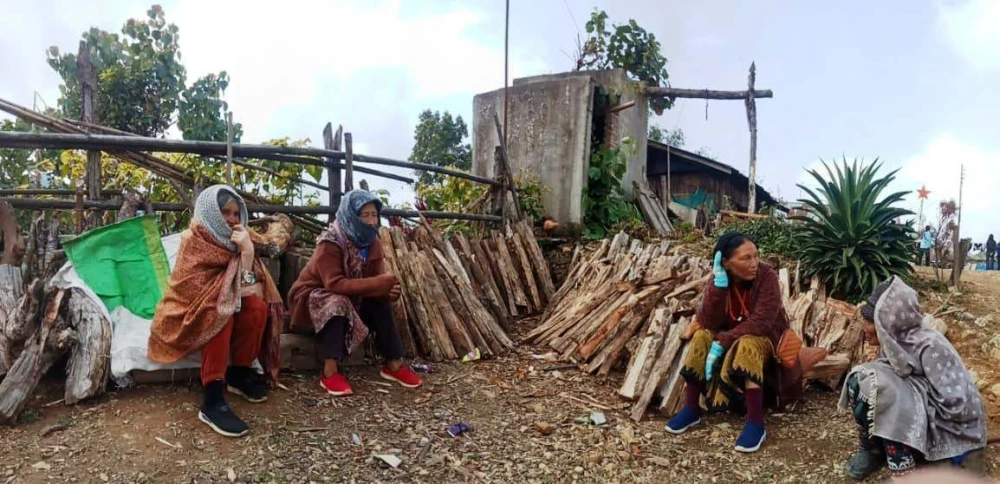
Bridging the gap in language
Newtoli Yeptho, Assistant Professor at Zunheboto Government College, has witnessed the academic implications. “One of the common problems among students is weak Sütsa vocabulary and sentence structure,” she said. “Those who command their mother tongue grasp lessons faster and express themselves with clarity and confidence.”
Government teacher Yesaho Kiba noted that nearly 50% of students at GHSS Zunheboto now opt for MIL (Sütsa) instead of Alternative English and perform well. “Interest is still there,” he said. “But revival must start from the family.”
Kupuli T Yeptho of Natha New Baptist Church highlighted challenges within church ministries, where English frequently dominates sermons and programmes.
Revival must begin at home
Kivili H Zhimo, Chairperson Women Executive SBAK Nito Mount reflected that there was no single moment when she noticed the decline. “It did not happen suddenly. It has been a gradual shift over the years,” she said.
Growing up in the Sumi tribe of Nagaland, she remembers a time when the mother tongue was naturally spoken at home, in villages, during festivals and in daily life. It was the primary language of identity and communication.
However, over the last decade or two, the shift has become more visible. With the spread of English-medium education, urbanization and digital media exposure, younger generations increasingly use English or Nagamese in daily conversations. She clarified that this is not about disrespect. “The environment has changed, and so have linguistic preferences. The decline has been gradual but significant.”
One visible indicator, she noted, that many young people understand Sütsa but lack confidence in speaking it fluently. Vocabulary has narrowed. Traditional expressions are slowly disappearing.
Another sign is the reduced use of Sütsa within families. Earlier, children naturally grew up speaking it at home. Today, communication often happens in English or Nagamese even between parents and children. Zhimo observed a subtle emotional and cultural gap emerging. Language carries identity, values, and ancestral wisdom. Certain emotions, forms of respect, and cultural meanings in Sütsa cannot be fully translated. When fluency declines, connection to stories, proverbs and traditions becomes less intimate. “The bond is not broken,” she said, “but it becomes weaker.”
She acknowledged efforts through schools, churches, and community initiatives. However, they are not always consistent or widespread. “Revival must begin at home,” she stressed. “Families play the most important role.” If passive attitudes continue, fluency may decline further, weakening cultural knowledge for future generations.
Meanwhile, Vihoshe Muru, Chairman of Sumi Literature Board (SLB), pointed out that Sümi remains largely unified compared to other tribes with multiple dialect divisions, which is an advantage. SLB has established research and academic cells, diploma and crash courses, and recently secured approval for Sütsa at BA level under the FYUGP framework. Yet challenges remain, fluctuating enrollment, limited textbooks, few research scholars and inconsistencies in revised publications.
Across interviews, one theme remains unanimous: revival begins at home. Parents must speak Sütsa to their children. The language must be heard in markets, workplaces and churches.
February 21 - International Mother Language Day must be more than symbolic. If a language fades from daily conversation, it does not disappear with noise it disappears with silence.
The question is no longer, whether Sütsa can survive, but whether the next generation will choose to speak it.