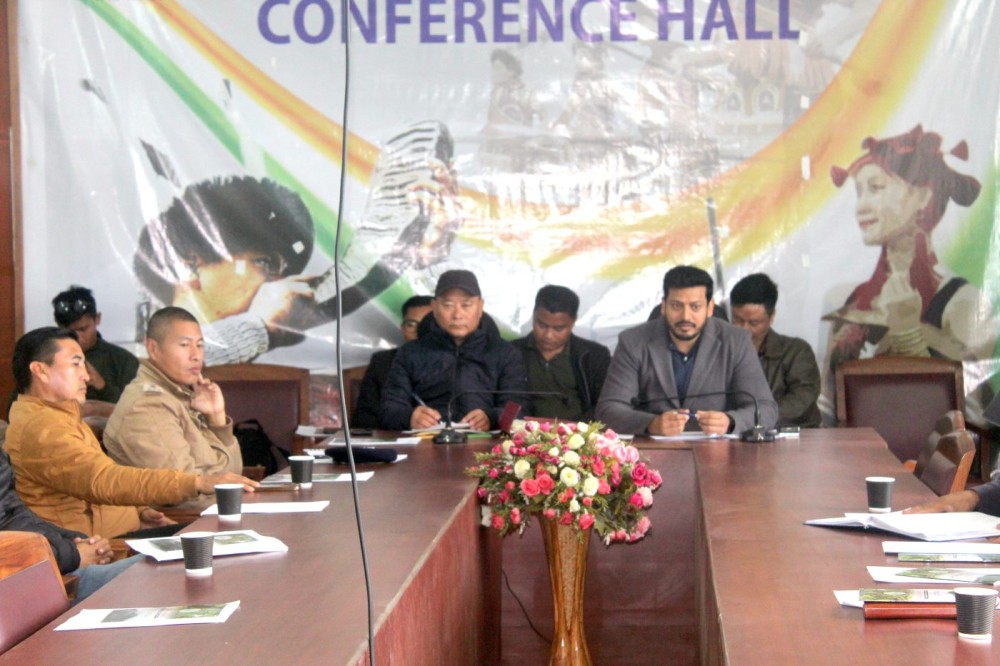
DPDB Vice Chairman and DC of Zunheboto, Dharam Raj, IAS addressing the board members on April 6. (Morung Photo)
Zunheboto DC questions board’s irrelevance
Morung Express News
Zunheboto | April 6
The District Planning and Development Board (DPDB) of Zunheboto has increasingly started functioning like a society registration body instead of a planning and policy-making forum, its Vice Chairman and Deputy Commissioner Dharam Raj, IAS, observed on Tuesday.
Chairing the board meeting at the Deputy Commissioner’s office conference hall in Zunheboto, Raj expressed serious concern that no information or discussion was taking place on key projects under the North Eastern Council (NEC), Special Assistance to States for Capital Investment (SASCI), or Minority Affairs.
“They want us to stop functioning as a DPDB or what?” the DC questioned, adding that the government appeared to be undertaking projects without the board’s knowledge.
He emphasised that the absence of meaningful planning and development discussions had led to a decline in interest among Heads of Departments (HODs) in attending the meetings. He also remarked that the role of the DPDB has been diluted, as important matters related to NEC, SASCI, and Minority Affairs are not being routed through the board.
“The entire financial year has already closed, and nothing has come. Why are we sitting here?” he asked.
He further stated that many people are unaware of the DPDB’s functions due to such shortcomings. “We are not proposing anything, and important matters are not discussed because they are not coming through us. We are going in the wrong direction,” he observed.
The DC reiterated his concerns over the board’s functioning, questioning, “Why do they insist on sitting every month as DPDB members?”
He pointed out that even Local Area Development Programme (LADP) funds were not being discussed adequately, calling it a “wrong precedent.”
“We never discuss policies or issues such as narcotics. This is supposed to be a policy-making and planning body,” he said. He further highlighted that the board had no knowledge about the renovation and maintenance of the District Sports Council Ground (Public Ground).
Raising concerns over the lack of basic infrastructure, Raj stated that Zunheboto town has no public toilets, including in schools, calling it a “manifestation of poor planning.”
The DC Zunheboto, who is transferred to Tuensang district, also reviewed a host of developmental programmes including an eco-tourism initiative, student internship scheme, and the condition of government schools.
The outgoing DC informed board members that the meeting would be his last in Zunheboto. During his tenure, he initiated two key programmes, the adoption of a Model Village and an internship scheme for college students.
The board reviewed previous agendas, including the registration of societies under the Societies Registration Act, 1860. The proposal for Sumi Baptist Akukuhou Kuqhakulu (SBAK) Aizuto was approved and forwarded. The establishing of a new Sub-District Industries and Commerce Center (SIDC) at Suruhuto was also discussed.
Er N Toky Chishi, General Manager, District Industries Centre (DIC) Zunheboto, raised concerns over the SIDC proposal, emphasising that such matters should be properly consulted with the concerned department before being placed before the board, particularly regarding site selection, feasibility, and manpower planning.
The DC acknowledged the initiatives of the District Forest Office, especially the “1st Satoi Connect: Connecting Forest, Community & Conservation” eco-tourism initiative organised by the Zunheboto Forest Division from March 26 to 28.
Obed Bohovi Swu, SFS and Divisional Forest Officer, said the initiative began during Wildlife Week on October 7, 2025, with the aim of promoting livelihoods through biodiversity conservation. He noted that the Satoi range represents a unique virgin forest patch and highlighted support from local MLA and Minister for Roads and Bridges, G Kaito Aye.
Though participation was initially capped at 150, only 81 attended due to accessibility challenges. Travel time to Satoi is approximately five hours from Kohima and an additional two hours from Dimapur. Swu added that the event is planned annually.
Swu also launched the Community Social Responsibility (ComSR) model, describing it as a transformative initiative encouraging collective responsibility for social welfare, environmental conservation, and infrastructure development. “Community first, conservation always,” he stated.
Dr R Bendangtemjen, Principal of Zunheboto Government College, noted improvement in participation for the internship programme, with the number of departments involved rising from 4–5 in 2025 to over 12 at present.
Earlier, the District Education Office made a PowerPoint presentation. The DC questioned why mid-day meals are not provided daily and raised concerns over the functioning of the Samagra Shiksha Abhiyan residential hostel at DC Hill. The hostel has a capacity of 50 students but currently has only 38 enrolled.
The DC questioned the student intake process and advertisement method. Officials said information is shared via WhatsApp groups. The DC termed the approach inadequate and directed that proper advertisements be issued through print media. “We never knew about this hostel because it was never advertised,” he added.
The DC also expressed concern over the condition of government schools, describing them as “pathetic and deplorable,” and said their condition appears satisfactory only on paper. He further questioned how many children of HoDs are enrolled in government schools, raising concerns over public confidence in the system.