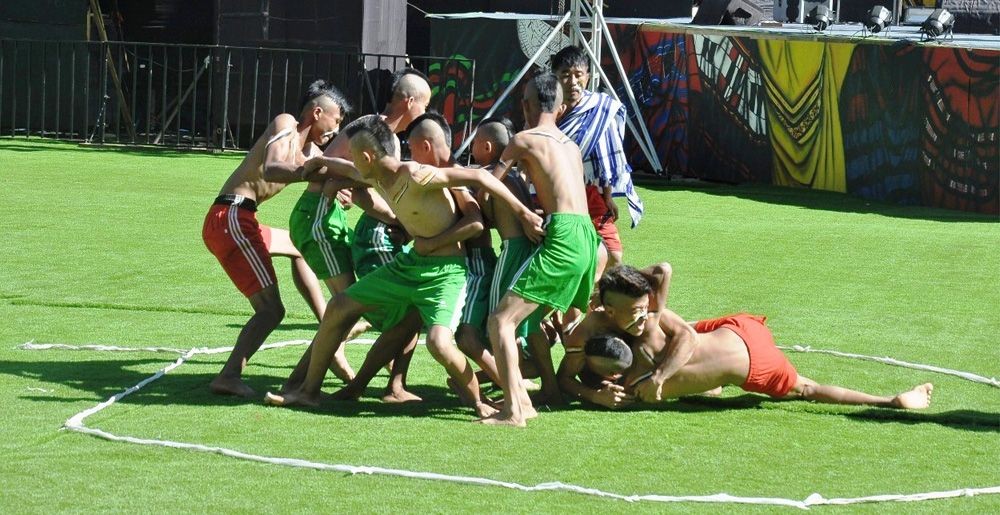
Youths from Changki village under Mokokchung district demonstrate the indigenous game ‘Hekko’ during a presentation by State Youth Resources and Sports Department during the 2019 edition of the Hornbill Festival at the Naga Heritage village Kisama on December 7. (DIPR/Morung File Photo)
Morung Express News
Dimapur | July 22
Under the Khelo India Scheme, a total of 8 sports infrastructure projects, 19 Khelo India Centres (KIC) and 1 Khelo India State Centre of Excellence (KISCE) have been sanctioned or notified in the State of Nagaland from 2018-19 to March 2022.
The initiatives are being undertaken under “Utilization and Creation/Upgradation of Sports Infrastructure” vertical of the Khelo India Scheme, the Union Minister of Youth Affairs & Sports (MYAS), Anurag Singh Thakur informed in a written reply in the Lok Sabha on July 19.
Under the scheme, the Ministry renders financial support for creation of basic sports infrastructure such as sports complex, synthetic athletic tracks, synthetic hockey fields, synthetic turf football grounds, multipurpose halls, swimming pools, etc, he said.
Replying to queries posed by lone Member of Parliament (Lok Sabha) from Nagaland, Tokheho Yepthomi regarding ‘Sports Projects for Nagaland,’ the Minister further informed that the erstwhile Urban Sports Infrastructure Scheme (USIS) was merged in Khelo India scheme in 2016.
Further, he highlighted that the MYAS is implementing several additional schemes for development of sports in the country, including Nagaland. The schemes include Assistance to National Sports Federations; Special Awards to Winners in International Sports Events and their Coaches; National Sports Awards; Pension to Meritorious Sportspersons; Pandit Deendayal Upadhyay National Sports Welfare Fund; National Sports Development Fund; and Running Sports Training Centres through Sports Authority of India.
Details of the above schemes are available in the public domain on the websites of the Ministry and the Sports Authority of India, he added.
Fit India Movement and Indigenous game
Meanwhile, under Fit India Movement (FIM), a people centric movement to be run with participation of citizens of the country irrespective of States/UTs, all initiatives or activities are intended to receive participation from all over India, Thakur informed.
Besides, under Ek Bharat Shrestha Bharat Programme, Indigenous Sports of the country are being promoted by FIM, he said.
Accordingly, ‘Hekko’ an indigenous game of Nagaland is being widely promoted by curating a video on the sport and webcasting it on YouTube and other social media platform of FIM, he added.
What is Hekko?
Hekko is an indigenous game originally played by the natives of Changki Village under Mokokchung district. Literally, Hek means– to dare and Ko – tiger, thus collectively, Hekko means “Daring the Tiger.” The game is based folklore when ‘Ami’ (human) and animals coexisted and ‘Akho’ (Tiger) was regarded most powerful and eldest, with first right to food. The human challenge the pecking order and the struggle over limited resources between human and tiger is the primary basis of the game.
kho’ (Tiger) was regarded as the eldest as well as the most powerful but when ‘ami’ challenged the might of the tiger, the challenge came to be known as “Hekko”-Hek means to dare and Kho means tiger.
As per the FIM promotional video made with input from DYRS Nagaland, Hekko is an 11-a side team game, where players compete to showcase ‘power, stamina and skills altogether’ and the most powerful persons and heroes among the youths of the village are determined.
In the game, one team is called Akho (Tiger Team) and the other Ami (Human Team), and the name of each team is decided by a toss before the game starts. It is usually played by the male member of the community.
To play, a circle is first drawn and the Ami team should always be within the demarcated circle by making a human chain while Akho team stays outside the circle. Initially, two members of Akho team enter the circle and try to snatch away the Amis outside the circle while the latter try to resist and keep their team within the circle. Whenever, an Akho is caught, he is not released till he says “Joko” (Surrender).
On other words, he is out and another Akho replaces him, and it continues till there is no replacement left. Conversely, when an Amis crosses the circle, he is out and he cannot be replaced. Whenever, a team manage to get an opponent out, a point is given and the team with maximum points within the allotted timing wins the game.
The fastest palyers of the Ami Team is awarded “Khozuba” and the most powerful player of Akho team is awarded “Khotiba.”