Officials along with the winners during the three-day workshop-cum-hackathon on “Agentic AI Saksham,” held at Kohima Science College on May 9.
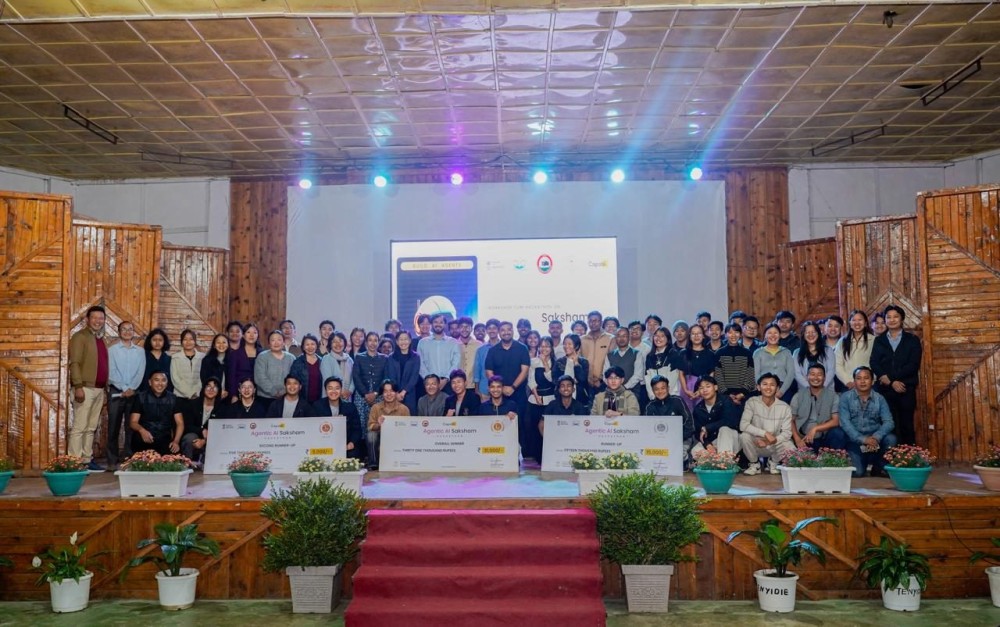
Kohima, May 10 (MExN): A three-day workshop-cum-hackathon on “Agentic AI Saksham,” held from May 7 to 9 at Kohima Science College, concluded with active participation from students, faculty members, scholars and resource persons.
The programme, organised in partnership with Capabl.in, aimed to introduce participants to emerging trends in Artificial Intelligence and provide hands-on exposure to practical AI tools and applications.
Following the inaugural programme on the first day, participants attended intensive hands-on learning sessions conducted by experts from Capabl. The sessions focused on no-code website creation and the development of AI agents using platforms and tools such as Google AI Studio and n8n.
The second day witnessed the visit of special guest Armstrong Pame, Joint Secretary (ICC & RUSA), Ministry of Education. A felicitation programme was organised in his honour at the college auditorium in recognition of his initiative in conducting the ongoing workshop-cum-hackathon at the institution.
Prior to the felicitation programme, Pame visited the workshop venue to review the ongoing activities and interact with participating students. The programme began with a welcome address by the Principal of Kohima Science College, Dr Temjenwabang, who highlighted the objectives of the workshop and acknowledged efforts to promote technological learning and innovation among students.
Addressing the gathering, Pame thanked the college administration and students for their enthusiastic participation despite ongoing examinations. He underlined the growing importance and future scope of Artificial Intelligence and encouraged students to learn how to create and responsibly use AI rather than depend on it for routine academic tasks.
Referring to his exposure visit to Hong Kong in August 2024, he shared insights on the importance of AI in education and innovation and stressed the need to implement it in Indian educational institutions. He also encouraged students to pursue original ideas, engage in research and startup initiatives, and effectively utilise technology in the modern world.
During the programme, faculty members and students shared testimonies on how the workshop enhanced their understanding of AI applications in areas such as website development and AI agent creation. Participants also showcased several AI-based projects developed during the workshop, including “Mindsync AI,” a platform designed to monitor student mental wellness, as well as projects such as “From Story to Animation” and “Wellness at Home.”
The final day featured the hackathon segment, where participating teams designed and developed AI agents using the tools and concepts learnt during the workshop. Out of 26 participating teams, eight were shortlisted for the final presentation.
The first prize was awarded to “The Corollary,” an AI-powered study engine application developed by MSc second semester Mathematics students Rongsenchiten T Jamir, Renjung Jamir, Nitish Deb Nath and Asarhii Chachei. The application was designed to create a personalised study space for students by allowing users to upload their syllabus, following which the AI generated customised study roadmaps, schedules and progress-based reward points to encourage consistent learning. Students could also personalise their study environment by selecting different themes within the application.
In addition, quizzes were integrated at the end of each study plan to help users assess their understanding and track academic progress.
The second prize went to Don Bosco Higher Secondary School Class 11 student Sentsu Yanthan for creating “Hill Alert,” a landslide reporting application intended for use in Nagaland. The third prize was awarded to MSc fourth semester Anthropology students Sentikaba and Amos Lalrolien Zote for designing “Anidex,” an AI-integrated wildlife encyclopaedia capable of identifying animals through image scanning and providing related information.
The hackathon featured a total prize pool of Rs 51,000, with Rs 31,000 awarded to the first prize winner, Rs 15,000 to the second prize winner and Rs 5,000 to the third prize winner.