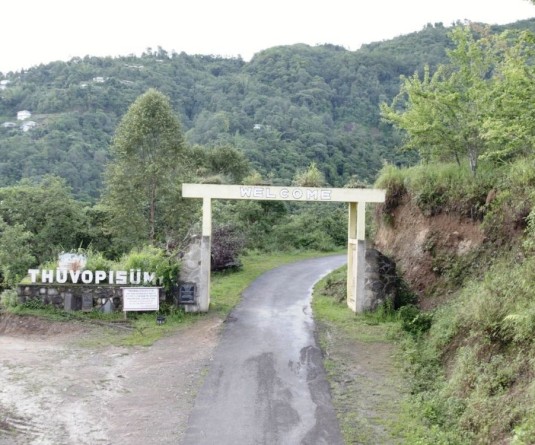
An Aerial view of Zunheboto Town. (Morung Photo)
.png)
Tokavi K Zhimo
Zunheboto | March 29
Zunheboto town, situated at an altitude of 1,874 metres above sea level and known for its rich cultural heritage and scenic attractions, is currently facing a serious civic issue, the lack of adequate public toilet facilities.
The district, with a population of over 1.4 lakh and a literacy rate of 82.26%, houses several key administrative offices, including the Deputy Commissioner’s Office, Additional Commissioner offices, SDO (Civil) office, and multiple EAC headquarters. It is also home to notable tourist attractions such as Satoi Wildlife Sanctuary, Ghosu Bird Sanctuary, and one of Asia’s largest Baptist churches located in the town.
Despite these developments, the absence of proper public sanitation infrastructure has become a growing concern for residents, visitors, and daily commuters.
“Who is responsible for building public toilets?” questioned several members of the public, reflecting widespread frustration.
Residents expressed embarrassment over the situation, stating that many are forced to depend on private homes during emergencies. “We feel ashamed to visit relatives or friends just to use their toilets, as there are no proper public facilities in town,” one local shared.
Another commuter recalled that there was once a public toilet near the post office area, but it is no longer functional. “There is one in the daily market area, but it is extremely unhygienic and in a pathetic condition,” the commuter added.
Highlighting the seriousness of the issue, a resident pointed out that even during picnics or camping, people prioritize constructing temporary toilets first, something that is lacking in an urban setting like Zunheboto town.
Concerns were also raised about the lack of clearly accessible toilets in banks and commercial areas, with poor signage compounding the problem for customers. However, bank officials stated that designated customer toilets for both men and women are available within their premises.
Due to the absence of proper facilities, many individuals are forced to resort to open defecation or unsanitary alternatives. This contributes to environmental pollution and increases the risk of diseases and other sanitation-related illnesses. The issue is particularly challenging for women, children, the elderly, and travellers, a student noted.
Citizens further observed that the lack of public toilets negatively impacts the town’s cleanliness and overall image, discouraging tourism and reflecting poorly on urban development.
In light of these concerns, residents have urged the authorities to take immediate action. The construction and proper maintenance of public toilets at key locations across the town, they said, is essential for improving hygiene, safeguarding public health, and enhancing quality of life.
“Providing public toilet facilities is not just a basic necessity, but a crucial step towards building a cleaner, healthier, and more developed Zunheboto,” an NGO leader added.
“Lack of toilet facilities in the town reflects society's social and cultural backwardness, where we, as concerned citizens, in one way or the other should also be held responsible to redress the issue to the appropriate authority. Due to those factors, people's lack of civic sense gets exposed. In a modern advanced society and Nations, toilets are maintained above all necessity,” one concerned citizen added. “Who are the people responsible for meeting these basic needs?” He questioned. Town councils and municipal councils. He assumes that there's not even a single civilized authority in our Town council to initiate the project, rather they find pleasure in supplying Eggs in the Market and restricting the business Communities to bring Bakery Products from other districts like Dimapur, Kohima and Mokokchung, busy collecting tax. He stressed.
Amid the growing concern, Er Ichirang Zeliang, Executive Engineer, Public Health Engineering Department (PHED), Zunheboto, clarified the department’s role and the challenges in constructing public toilets within the town.
Speaking during an interaction, he stated that PHED generally does not undertake construction projects in urban or town areas, particularly in district headquarters. “Such responsibilities are usually handled by the Town Council or Urban Municipal bodies,” he explained.
PHED Zunheboto Subdivision, in observance of World Toilet Day on November 19 have renovated selected public toilets. Including the public toilet at the Deputy Commissioner’s Office, Asukhomi Village Public Toilet, and Sukhalu Village Public Toilet. The department has identified three commonly used public toilets for renovation which are now completed.
However, he noted that PHED has taken voluntary initiatives in certain cases. “We have repaired and renovated existing public toilets, including the one at the DC Office,” he said, adding that such efforts were made in good faith despite facing criticism from some sections of the public.
Addressing reports about PHED’s willingness to construct new public toilets, Er. Zeliang confirmed that the department is open to the idea. “If land is made available without disputes, we are ready to construct public toilets,” he said.
He emphasized that land availability remains the biggest challenge. “In town areas, it is very difficult to obtain even a small plot of land, as no one is willing to part with land due to its commercial value,” he added.
“Without public cooperation especially in providing land it becomes difficult to implement such essential facilities,” he stated.
Officials from the Zunheboto Town Council informed that a public toilet has been constructed at the new ZTC building below the 35 A/C NPF office. However, they acknowledged that it is not easily accessible or feasible for widespread public use. “The matter will be discussed in the next meeting,” officials added.
“Adequate public toilet facilities in the town is a big concern for the Zunheboto Town Council as well but due to the unavailability of land to construct a public toilet is the problem. If land is available without any dispute, we are ready to construct clean hygienic toilets but the only problem is land issue in the town,” Herato Sukhalu, Chairperson of the Zunheboto Town Council (ZTC) added.