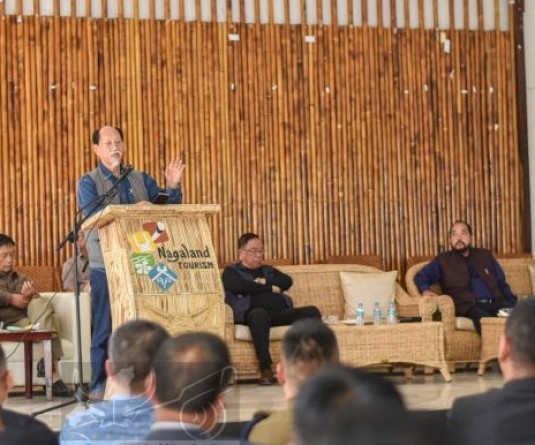
Participants of the training programme at Hotel Grand Vista, Dimapur on December 15.
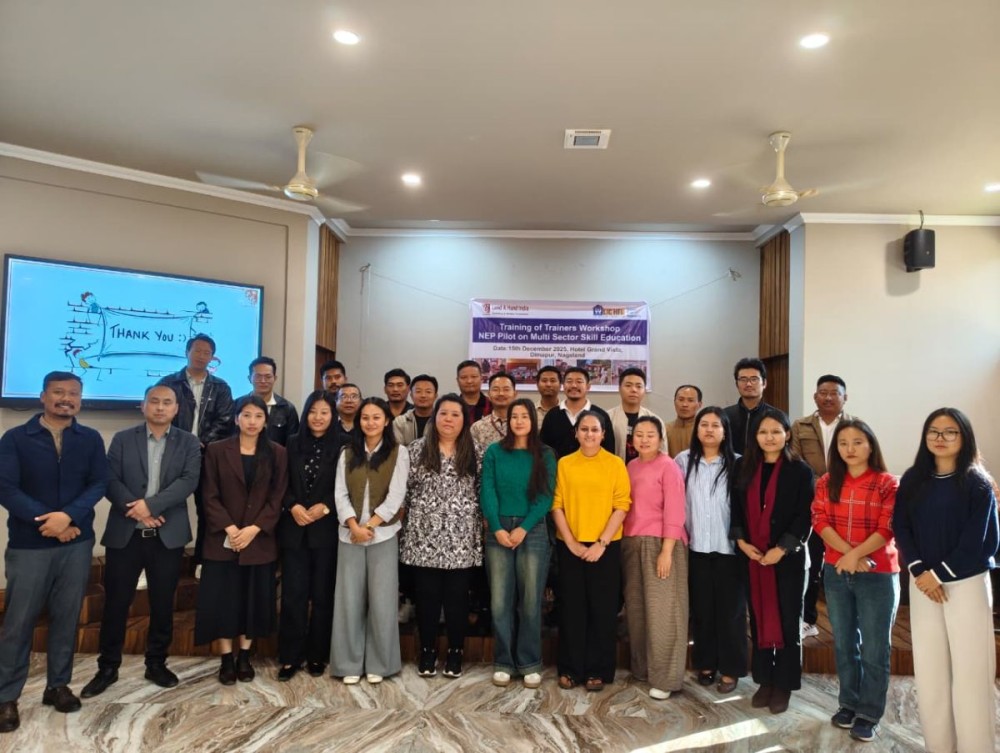
Dimapur, December 15 (MExN): The 3rd Capacity Building Training of Trainers (ToT) for vocational trainers under the NEP Multi Sector Skill Education initiative in Nagaland was held at Hotel Grand Vista, Dimapur on December 15. The workshop was organised by Lend A Hand India (LAHI), as technical and knowledge partner, in collaboration with Samagra Shiksha, Department of School Education, Nagaland.
A total of 24 vocational trainers representing 26 government schools from across Nagaland participated in the one day training. The schools are part of the ongoing NEP Multi Sector Skill Education pilot, which introduces students to multiple vocational sectors in line with the National Education Policy (NEP) 2020 and the National Curriculum Framework (NCF) 2023.
The sessions were facilitated by Ayushi Sharma, Manager (Training), Lend A Hand India, and MetseruyiTetseo, Senior Instructor (Multi Skill Foundation Course), Lend A Hand India. Drawing on previous rounds of training held earlier this year, the facilitators focused on deepening classroom pedagogy from a vocational education lens and supporting trainers to translate policy intent into day to day practice in Nagaland’s schools.
The workshop covered core themes such as understanding adolescents, knowing your students, creating supportive learning environments and enabling students to achieve clearly defined learning objectives and outcomes in skill subjects. Trainers reflected on how adolescents learn best, discussed ways to build confidence and curiosity, and explored strategies for connecting vocational content with students’ lived experiences and local contexts. Building on this foundation, the sessions moved into practical tools for lesson planning, sequencing activities, and articulating measurable learning objectives, outcomes and assessment criteria for modules such as Agriculture, Mechatronics, Finance, Fashion, Healthcare and Coding that are being implemented under the multi sector model.
Participants also worked in small groups to design sample lesson plans and micro teaching activities, integrating demonstrations, hands on tasks and questioning techniques that promote higher order thinking rather than rote learning. Discussions highlighted the need to balance theory with adequate time for practice, to make systematic use of student handbooks and trainer guides, and to draw on guest lectures and field visits as extensions of classroom learning. Trainers shared field experiences from the first phase of implementation, including ways they have been motivating students, managing large classes with limited tools, and collaborating with local hospitals, banks and enterprises to give students real world exposure.
Speaking during the workshop, the facilitators underlined that multi sector vocational education under NEP 2020 is not just about introducing a few new subjects, but about helping students build 21st century skills—communication, problem solving, teamwork and career awareness—through meaningful, practice oriented learning experiences. They emphasised that trainers play a critical role as mentors and facilitators, guiding students to connect skills with future pathways in education, employment and entrepreneurship.