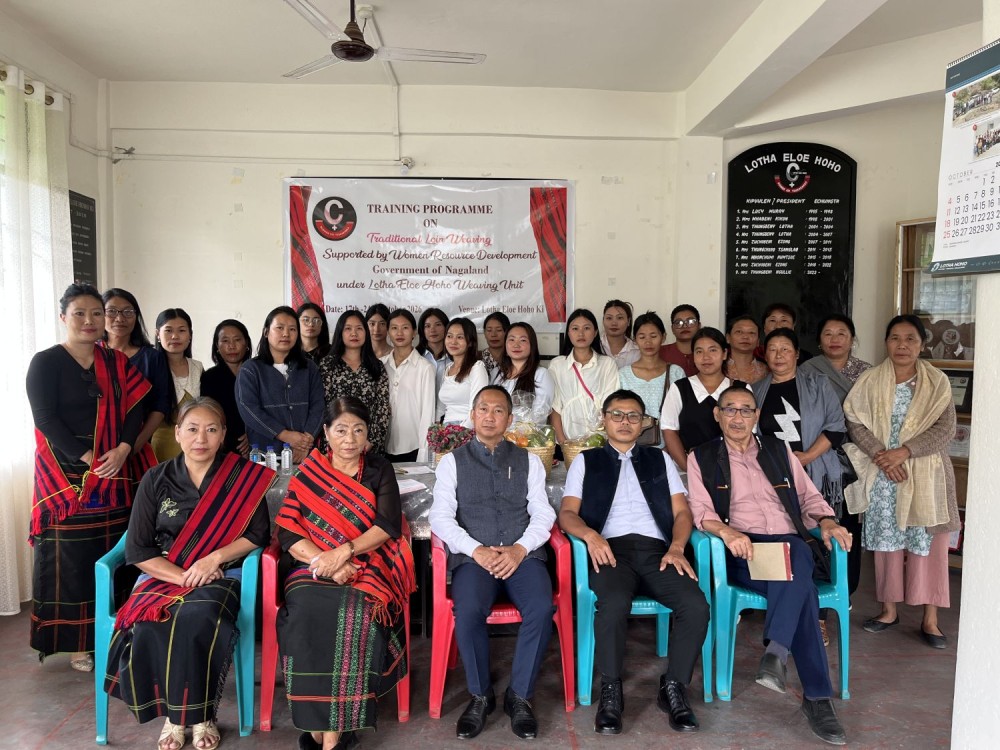
Lotha Eloe Hoho members and officials with others during the launch of traditional loin weaving cum training programme at Lotha Eloe Hoho Ki, Wokha on October 17.
Morung Express News
Wokha | October 17
The Lotha Eloe Hoho (LEH) launched a traditional loin weaving cum training programme at Lotha Eloe Hoho Ki, Wokha on October 17. The programme, running from October 17 to 24, is supported by the Women Resource Development, Government of Nagaland, under the District Resource and Development Programme 2026–27.
Renbomo Ezung, NCS, Additional Deputy Commissioner, Wokha, graced the launching programme as the chief guest and formally inaugurated the unit by cutting the ribbon.
In his address, Ezung highlighted the historical and cultural significance of traditional weaving, describing it as an integral part of the community’s identity and heritage. He acknowledged the contribution and hard work of women in preserving the craft through generations and stressed the importance of carrying forward this legacy.
Emphasizing the value of skill development, he encouraged the participants to approach the training with sincerity, dedication, and a strong commitment to learning. He urged them not to treat the program merely as a part-time activity but to give their best and make full use of the opportunity to develop their skills. ‘Learning a traditional craft requires patience, consistent practice, and a willingness to improve,’ he noted, encouraging the participants to take their training seriously and explore its potential for personal growth and self-reliance.
He expressed hope that the participants would develop their abilities to the fullest and use the knowledge gained to preserve traditional weaving while creating opportunities for themselves and others.
Nzanthung K Yanthan, Assistant Director, Department of Women Resource Development, Kohima said that the department extends its support to the initiative and stressed the need for collaborative efforts to preserve traditional skills. ‘The weaving unit could provide participants with opportunities to learn and practise the craft, enabling them to weave traditional garments for their own use while also exploring possibilities for income generation,’ he noted.
Yanthan encouraged the participants to approach the training with dedication, patience and a willingness to learn. He urged them to make full use of the opportunity to develop their weaving skills, explaining that the knowledge could serve both as a means of preserving cultural traditions and as a practical skill for self-reliance. He further called for a positive mindset and mutual support among participants to help the initiative achieve its objectives.
Er Mhondamo Ovung, Chairman, Lotha Hoho, emphasised that traditional skills such as weaving hold value irrespective of one’s educational qualifications or professional background. He noted that education provides knowledge and opportunities, while traditional skills offer a different kind of learning that connects people to their roots, culture and heritage.
He encouraged the participants to look at the training as an opportunity to broaden their knowledge and acquire a skill that has been passed down through generations. He stressed that learning traditional weaving should not be measured against one’s academic achievements, but appreciated as a meaningful step towards preserving cultural identity and promoting self-reliance. He urged the participants to take pride in learning the craft and contribute towards keeping the community’s weaving traditions alive.
Thungbeni Ngullie, President. LEH in her keynote address, expressed happiness over the participation of individuals in the initiative aimed at promoting and preserving the traditional art of weaving.
She highlighted the importance of keeping traditional weaving alive as an integral part of Lotha cultural heritage, emphasising the need to pass down indigenous knowledge and skills to younger generations. Such initiatives provide an opportunity for participants to learn traditional weaving techniques and develop a deeper appreciation for their cultural identity, she said.
Ngullie also acknowledged the support extended by the Department of Women Resource Development towards making the initiative possible. She expressed hope that the programme would encourage more people to take an interest in traditional weaving and contribute towards its preservation.
She further noted that learning traditional weaving can help participants develop practical skills, promote self-reliance and create opportunities for income generation. With traditional attire holding cultural and social significance, she stressed the importance of sustaining these skills and ensuring that the knowledge continues to be shared across generations.
She encouraged the participants to make the most of the opportunity and use the knowledge gained to preserve and promote the rich weaving traditions of the Lotha community.
The programme was chaired by Chanchano Patton, General Secretary, LEH with invocation by Meribeni Ngullie Kikon, Associate Women Leader, Tchuphyangza Baptist Church.