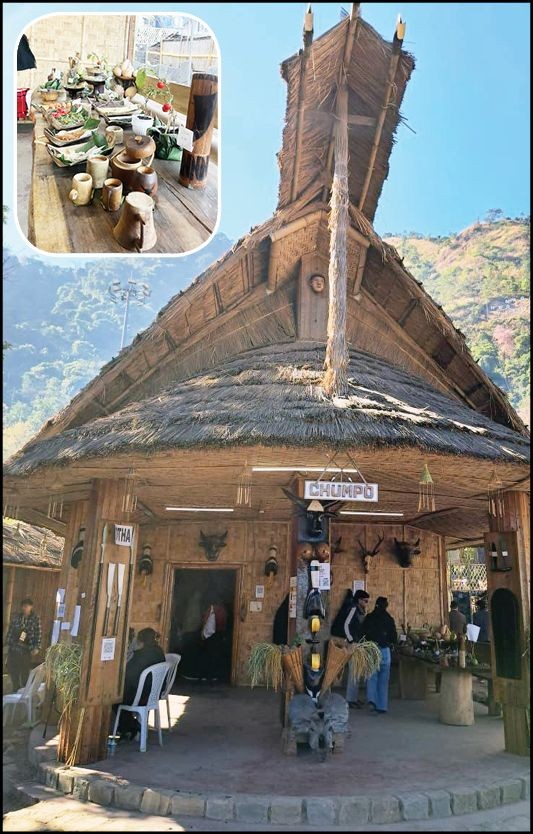
The Lotha Morung at the Naga Heritage Village, Kisama, the main venue of the annual Hornbill Festival. (Inset) Local foods items on display at the Lotha Morung. (Morung Photo)
Morung Express News
Kisama | December 7
The Lotha Morung, hosted this year by the Lotha Eloe Hoho (LEH) Wokha, is attracting significant attention at the 26th Hornbill Festival with its vibrant blend of traditional cuisine, cultural artefacts, and youth-driven hospitality.
In an interaction with The Morung Express, LEH President Thungbeni Ngullie shared that the Morung has been receiving an exceptional response from visitors this year. She explained that the diverse range of food items and cultural displays has quickly become one of the main attractions.
The menu features sticky local rice with chutney, local pork and chicken cooked with bamboo shoots, black sesame with dry beef, fried grasshopper, silkworm, Doyang local fish, and Lotha favourites known as machi han and hanpashan (a mixture of various vegetables). Traditional rice beer, Chumcho, is also being served.
All dishes are offered buffet-style, except for some curries.
Ngullie further revealed that the primary aim of hosting the Morung this year is to raise funds to support the LEH’s general conference scheduled for May 2026.
Hosting the Morung, she added, has been a privilege, expressing gratitude for the opportunity and stating that they will give their best to showcase the rich heritage and culture of the Lotha community.
Visitors have also appreciated the display of local produce such as tulsi, oranges, black rice, miler, fermented bamboo shoot, and locally brewed wine. All vegetables and ingredients used in the Morung are sourced from Wokha itself.
“Wokha is known as the land of plenty. Through this Morung, we want visitors to understand our culture, our land, and the rich potential of our district,” the LEH President added.
Cultural artefacts remain a major attraction, with many visitors admiring traditional attire over a hundred years old and an elephant skull believed to be nearly a century old, rare pieces that narrate the history of the Lotha people.
A strong youth presence has also shaped the functioning of the Morung. Young volunteers have taken up responsibilities ranging from serving food to guiding visitors, while a cultural troupe from N Longidang village, with around 40 performers, presents daily cultural displays.
Due to the heavy flow of visitors, many volunteers work from early morning until midnight, with some even staying overnight to ensure smooth operations.
Looking ahead, Ngullie said there are areas that need improvement to enhance the experience for both hosts and visitors. She pointed out that the kitchen section of the Morung requires renovation, particularly because there is currently no proper outlet for smoke during firewood cooking.
This creates inconvenience not only for hosts working inside but also for locals and tourists visiting the Morung.
Ngullie said the positive response at the Hornbill Festival has strengthened their resolve to preserve, promote, and celebrate Lotha heritage with pride.
“We are truly happy that visitors are enjoying our food, our traditional items, and the atmosphere of the Morung,” she said. “Their appreciation motivates us to keep our culture alive.”