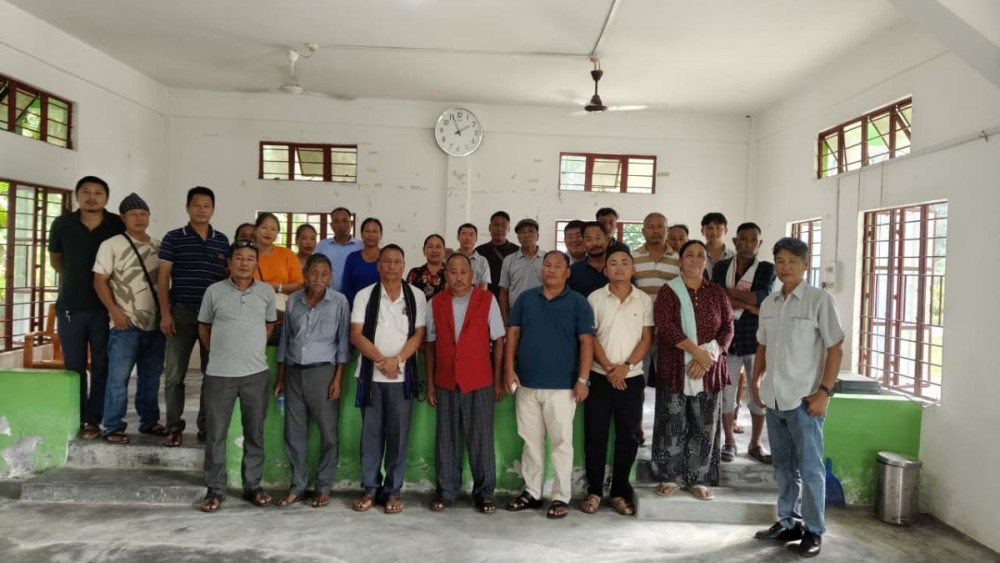
Representatives of civil society organisations and local stakeholders gathered at the Merapani Village Council Hall during the joint consultative meeting on October 6.
WOKHA, OCTOBER 6 (MExN): Lotha Lower Range and Lotha Middle Range stakeholders have given the Wokha district administration six days to intervene in the ongoing dispute with the All Commercial Vehicle Association (ACVA), warning that failure to act could lead to a “blanket ban on all commercial vehicles of Wokha town” beyond the Doyang Bridge at Thillong Village.
In a representation submitted to the Deputy Commissioner (DC), Wokha, on October 6, the stakeholders sought “immediate relief and intervention” against what they described as the “illegal notification and imposition of blockade” on commercial vehicles from other states and non-locals by the ACVA. They warned that if the administration failed to take “these pressing and urgent steps within 6 (six) days,” the undersigned would be “compelled to take their own course of action,” including restricting commercial vehicles from Wokha Town from entering their jurisdiction.
The stakeholders also stated that they “shall not be held responsible for any untoward incident.”
The representation was submitted on the same day as a joint consultative meeting of civil society organisations (CSOs) from the Lotha Lower and Middle ranges at the Merapani Village Council Hall, where the stakeholders resolved not to attend an ACVA meeting scheduled for October 8 at Lotha Hoho Ki, Wokha.
The meeting was spearheaded by the Lotha Lower Range Public Organisation (LLRPO) and Lotha Middle Range Public Organisation (LMRPO) and attended by representatives of the Merapani Village Council, Merapani Business Union, Yanmhon Area Public Organisation, LLRPO, LMRPO, Bhandari Town Councillors, Bhandari Lotha Hoho and Merapani Students' Union.
The house unanimously resolved that the participating organisations and stakeholders “shall not attend” the ACVA-convened meeting on October 8. It further resolved that they would “neither recognise nor participate in any discussion” on the matter unless the meeting was formally convened through the DC, Wokha, and conducted under the “authority and supervision of the district administration.”
The dispute stems from an ACVA notification dated July 13, concerning commercial vehicles from other states and non-locals.
According to the representation, various apex CSOs of the Lotha Middle Range and Lotha Lower Range met on August 6 and “termed” the ACVA notification as arbitrary. They resolved to “oppose the association's diktat in toto” and subsequently appealed to the ACVA through a letter dated August 17 to revoke the notification.
The stakeholders alleged that instead of addressing their grievances, the ACVA implemented its “egregious mandate” on October 2. They cited an alleged incident involving a commercial truck, carrying cement and plastic water tanks, which was travelling towards Wokha Town.
The stakeholders alleged that the truck was “waylaid by the association members” at Zero Point Junction and that the driver was threatened that the vehicle would be burnt before being made to return to Merapani. “Such act of barbarity by association is highly condemnable and punishable in the eyes of the law,” the representation stated.
The petitioners further alleged that members of the private transport association had established “unauthorised check points” at Zero Point Wokha to “forcefully stop, restrict and turn back commercial vehicles belonging to non-locals.”
They claimed that the alleged blockade was disrupting the supply chain of essential commodities and causing financial losses to small businesses, traders and drivers, besides causing public inconvenience across the district. The stakeholders also warned that the restrictions could invite retaliatory action from Assam.
“This monopolistic and selfish trade practices will bring retaliatory recourse from the neighbouring state Assam,” they stated, adding that this could create a “huge problem in one of the most volatile border areas of Nagaland.”
On the legal aspect, the petitioners contended that private transport unions or associations do not possess statutory or executive powers to regulate interstate commerce, dictate borders or restrict vehicle entry. They cited Article 301 of the Constitution of India and Article 19(1)(g), which they said protect freedom of trade and the right to carry on occupation, trade or business.
They asked the DC to take “immediate executive note” of the matter and issue a formal directive declaring commercial vehicle bans or physical blockades by unauthorised associations as illegal. They also requested the DC to instruct the Superintendent of Police, Wokha, to provide highway security and deployment along national and state entry routes, including the Merapani routes, to prevent “forceful stopping, intimidation, or wrongful restraint” of vehicles and drivers belonging to other districts or states.
Meanwhile, the joint consultative meeting resolved to constitute an Action Committee to safeguard the interests of affected stakeholders in the event of complications arising from the matter. The committee will be jointly spearheaded by the LLRPO and LMRPO, with all participating local civil society organisations serving as members.