Participants and resource persons during the one-day workshop on Community Conserved Areas at Kükhegwo Village Council Hall, Meluri, on September 1.
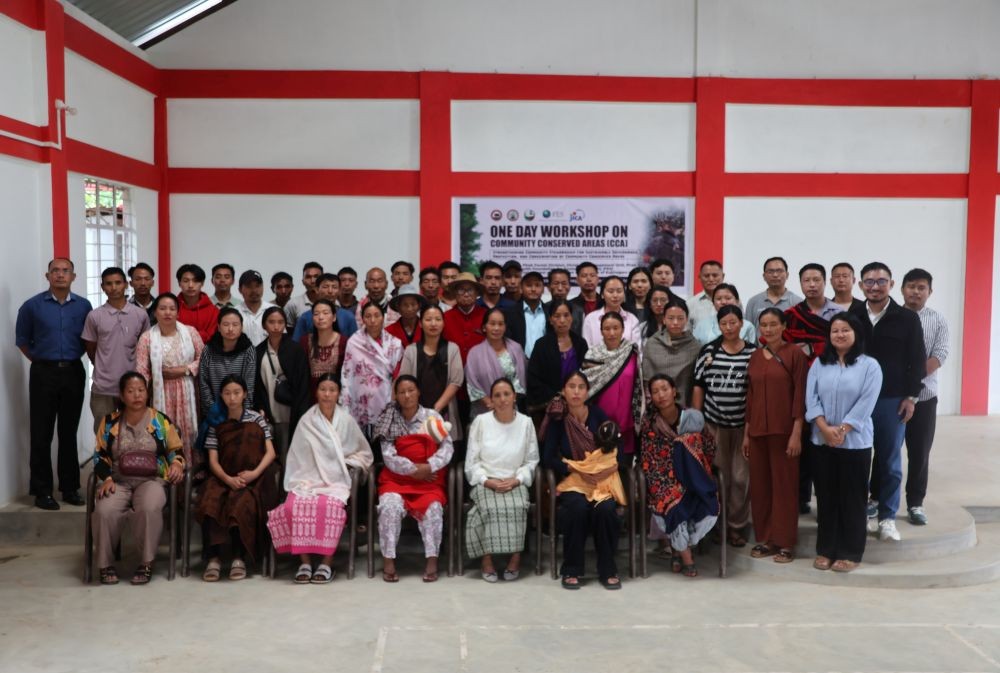
Meluri, September 1 (MExN): Strengthening community-led governance, inclusive decision-making and long-term planning for conservation were among the key issues discussed at a one-day workshop on Community Conserved Areas (CCAs) held at Kükhegwo Village Council Hall, Meluri, on September 1.
The workshop was organised by the Nagaland Forest Management Project (NFMP), Divisional Management Unit (DMU), Phek, in collaboration with the Foundation for Ecological Security (FES) and the Joint Forest Management Committees (JFMCs) of Kükhegwo and Akhegwo villages.
Chenibemo Odyuo, Senior Project Manager, FES and FNGO Team Leader, NFMP Phek, led a session on understanding CCAs, covering their role in biodiversity conservation and community wellbeing, forms of community conservation in Nagaland, and the importance of local institutions, traditional knowledge and collective decision-making.
Odyuo stressed that the strength of a CCA lies in the community itself and called for the inclusive participation of elders, women and youth in conservation and decision-making. He also encouraged communities to build on existing knowledge, institutions and practices in managing common natural resources.
Keneivito Christopher Sophi, Joint Secretary, Nagaland Community Conserved Areas Forum (NCCAF) and former Executive Secretary of Khonoma CCA, shared experiences from the early community conservation initiatives and discussed the evolution of CCAs in Nagaland.
Community members from Kükhegwo and Akhegwo, including elders, women, youth and community leaders, participated in group discussions on their CCA experiences, governance systems, rules and regulations, and changes since the establishment of the areas.
Discussions also examined challenges and opportunities concerning forests, biodiversity, water, climate and community institutions. Participants developed a five-year vision and identified priority conservation actions, besides discussing the institutional, technical, financial and human resources required for effective CCA management.
As per a press release, the workshop also explored the roles and support required from communities, government departments, NGOs and other agencies.
The programme concluded with presentations by the two village groups and consolidation of key priorities. A way-forward session was led by Imlikumba, Senior Project Manager, FES.
The consultation placed emphasis on documenting community experiences, knowledge and aspirations, with conservation decisions centred on communities traditionally dependent on and caring for the landscape.
The exercise is expected to provide a foundation for strengthening community stewardship, institutional coordination and locally owned action planning for CCAs in the Kükhegwo-Akhegwo landscape.
.jpg)