Limhachan Kikon
Duncan Bosti, Dimapur
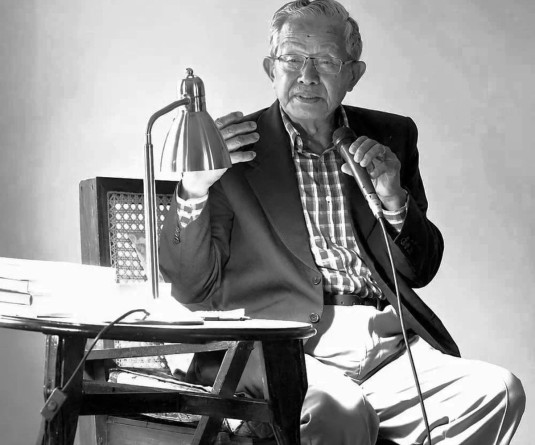
Perched at a certain vantage point in Zubza, Kerünyü Ki—the House of Listening—looked towards Kohima from a distance, but it did not feel like a retreat from the capital. If anything, the distance gave the place a different relationship with the city: close enough to see it, far enough to contemplate it. The compound was settled and unhurried, without frills or excessive foliage. The stonework was packed tightly into the walls, more for strength than ornament, while the road rose steadily towards the porch where Uncle Niketu received me.
There was nothing of refuge about the place. It felt more like a place of reflection—a place from which one could step back just far enough to see things whole. Somehow, it seemed to suit him.
It was our first meeting, yet I left with the distinct feeling that it would not be our last. The conversation had the unforced quality of two curious minds finding room to wander. We moved through history, politics, literature and memory, following one thread until it opened into another. There was an ease to Niketu's listening that made you want to continue the conversation, not conclude it.
We spoke of meeting again, of returning to some of these questions with more time, more books, perhaps more stories.
But the news of his demise was unexpected. It was hardly two months ago that, while trying to deepen my knowledge of my inheritance, I was brought to him through an arrangement with his nephew.
What remains is that first meeting, and the strange way some conversations acquire a life beyond the time given to them. I have since found myself returning to things we touched upon, following threads that began almost casually and discovering details waiting beyond the edge of our conversation.
The first was the Second World War.
Niketu described a Japanese column moving through the paddy fields of Khonoma towards Kohima. I could see the scene as he spoke: men threading their way across the fields, exposed against the landscape.
Then an Allied reconnaissance aircraft appeared.
The column instantly dissolved. Men hurried into the bushes and folds of the terrain, becoming almost indistinguishable from the landscape. They remained utterly still as the aircraft passed overhead. Then it moved away. The men emerged, the column re-formed, and the march resumed towards Garrison Hill.
There is something extraordinary about hearing such a scene from someone who had carried its memory. History books give us arrows on maps and movements of divisions; living memory gives us men, paddy fields, an aircraft in the horizon, the sudden silence of an entire column, instinct in motion, and then the resumption of the march.
For a moment, the Battle of Kohima becomes a landscape inhabited by human beings.
That conversation sent me back into the geography I already knew. My further enquiry led me to an oral testimony of a Japanese reconnaissance platoon that had crossed Chunglikha, in present-day Tseminyu, rested at Vankhosung in Wokha and descended towards the Inspection Bungalow at Yikhum to survey the Allied position across the Doyang River.
Beyond the Sanis ridge, not far from where they camped, lay the descent towards the Brahmaputra Valley and the plains of Upper Assam. From the airfields there, Allied aircraft carried supplies towards Kohima, Manipur, Burma and China—the CBI (China-Burma-India) theatre. To the American pilots flying that dangerous route over the mountains, it was the “Hump”.
Niketu had mentioned the Hump in our conversation, drawing upon what he had heard from American pilots he met after the war.
That immediately brought another memory to me. My father used to talk about the USAAF (United States Army Air Forces) supply planes slowly approaching from the direction of the present Doyang Dam and flying very close towards the crest of our village, Tsungiki, on a hill near Mt Tiyi. He could even see the pilot clearly in the cockpit.
Suddenly, the Hump was no longer distant history. It was the village of my ancestors.
There was another story. Around the same period, Khodao Yanthan had guided a company of Allied troops—British, American and Chinese—towards Morashen Hill near New Riphyim, suspecting a Japanese incursion. Learning the Japanese were nearby, they eventually withdrew further towards the Sanis ridge, whose height offered a commanding view of the surrounding terrain.
Meanwhile, the Japanese platoon, descending upon the Inspection Bungalow at Yikhum, tired and hungry, gestured through mimicry to the villagers for chicken, salt and rice. The villagers obliged. Humanity triumphed, for a moment. The war was forgotten.
There is still a place remembered locally in Yikhum as “Japan süükcho”—the edge of a ravine where, according to the oral account, a Japanese soldier fell to his death. After the platoon moved on, villagers went down and recovered his boot. They even tried wearing it. It stretched almost to their thighs. The glee and the usual teasing must have followed.
What caught my attention was the timing. This was immediately after the Battle of Kohima. We now know how the war ended. The soldiers did not.
For those moving through the Naga Hills in April 1944, the future was still open. They were surveying, calculating and looking for possibilities. Perhaps another “Banzai” was still imaginable to an Imperial army that had yet to internalize defeat even after Kohima. Hiroshima and Nagasaki were still more than a year ahead. History has a way of making its outcomes appear inevitable. They rarely are.
Seen from Wokha, the familiar story changes scale. The Naga Hills were not merely the setting of a battle; they were a strategic landscape being crossed and contested by forces whose horizons stretched towards Assam, Burma and China.
Had the Japanese reached Upper Assam, the loop might have closed. Upper Assam sustained the Allied theatre: its roads, railways and airfields fed the Hump. Cut those, and China would have been severed from the war. No gasoline.
There was another thread in our conversation: B. K. Nehru, Jawaharlal Nehru's first cousin and one of the early Governors of Nagaland. Niketu spoke of a meeting with him and the discomfort it left him with in Shillong.
Nagaland was then a young state, its institutions still taking shape. The Governor's establishment was still evolving; the first Raj Bhavan had been established in Kohima, but the arrangements were modest. Perhaps it was simply too early for a settled understanding of what the relationship between Nagaland and India should become. Perhaps it was simply too early for a settled understanding of what the relationship between Nagaland and India should become. Neither assimilation nor integration could yet carry a settled meaning—least of all the idea that such a relationship required consent. Its meaning would have to be built, with time, experience and by the people who inhabited that relationship.
Perhaps that was enough for one conversation.
And perhaps that was part of Niketu's particular gift. He listened in a way that made you feel something was being transmitted, uncovered rather than asserted. You did not feel instructed. You felt accompanied and accommodated.
When I finally rose to leave Kerünyü Ki, the rain began. The first drops fell lightly, then gathered force across the windshield, the road, the leaves and the hills. Niketu hurriedly got an umbrella and walked me to my car. We bid adieu.
At the time, it was simply a gracious gesture. Now, knowing there would be no second meeting, the memory has acquired another weight.
I drove away with the House of Listening behind me, the monsoon returning to the hills. We had spoken of a past that was not as settled as it appeared, and of a future that was not yet written.
Alas, there was to be no next conversation. But perhaps there was a continuation of another kind. A question mentioned in passing sends you searching. A forgotten village anecdote opens a map. A memory becomes a historical possibility. And suddenly, long after the conversation has ended, curiosity is still walking.
Perhaps that is what Uncle Niketu left behind for me: not answers, but an enlarged landscape—and the invitation to keep listening.