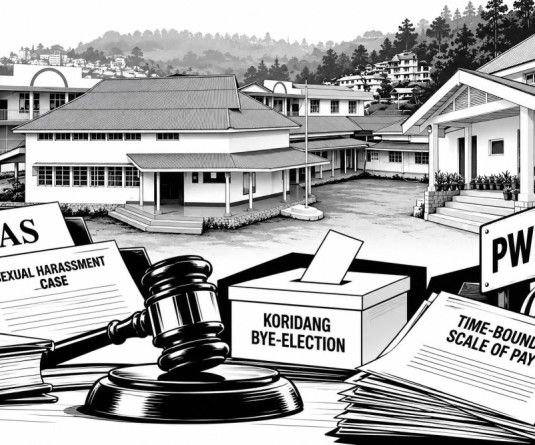
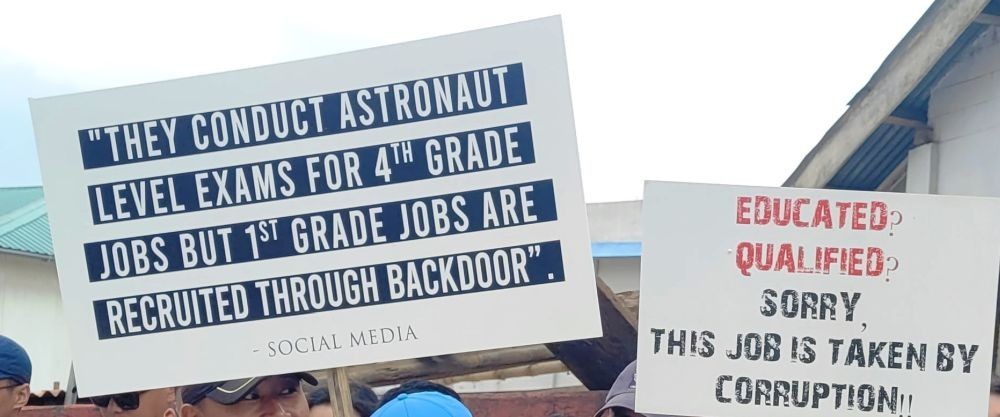
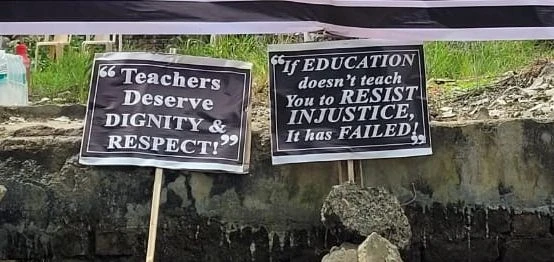
Placards used during CTAN/NNQF and RMSA teachers' protests in April and September respectively. (Morung File Photo)
Moa Jamir
Dimapur | December 29
Nagaland’s public life in 2025 was shaped by political consolidation and fragmentation, sustained protests across sectors, reconciliation initiatives, judicial scrutiny of governance, law-and-order challenges, and a mix of social, cultural and sporting milestones. Several developments unfolded in parallel, with many carrying forward into the next year.
New realignments
A major shift in electoral politics occurred in October. On October 15, the Naga People’s Front (NPF) was formally accepted as a full partner in the ruling alliance. This was followed on October 18, when the Nationalist Democratic Progressive Party (NDPP) announced its merger with the NPF after a resolution adopted at its general convention in Kohima.
The merger was subsequently endorsed at the NPF General Convention on October 21, where Chief Minister Neiphiu Rio was elected NPF president. On October 23, the Nagaland Legislative Assembly Secretariat notified Rio as the Leader of the NPF Legislature Party in the 14th House, with effect from October 18.
Splits within NPGs; a new entrant
While party politics moved towards consolidation, divisions continued among Naga political groups. On January 31, two rival groups separately claimed leadership of the Working Committee of the Naga National Political Groups (WC, NNPGs), announcing parallel conveners and leadership teams.
In July, the GPRN/NNC (AB) announced the impeachment of its acting president, triggering a series of rejoinders and counter-statements. In December, the president and Ato Kilonser of NSCN/GPRN (Akato) officially parted ways in what was described as an amicable split.
On September 21, the Government of Naga National Council – Democratic Socialist Republic of Nagaland (GNNC-DSRN) publicly announced its formation, adding to the list of existing Naga political groups.
Amid these developments, the Angami Youth Organisation and NSCN/GPRN (K) Khango signed a Letter of Reconciliation in December.
Reconciliation initiatives
Reconciliation processes continued alongside political splits. Consultations held at Ungma village resulted in the Ungma Statement, issued on August 23, calling for a “shared future” and rejecting divisions within Naga society.This was followed by other gatherings including the Zunheboto Resolution on September 27.
On October 18, the Naga Tribe Hohos and the FNR jointly declared that the formation of new Naga political factions would not be accepted.
Despite these initiatives, divergent positions persisted. On November 15, the Naga Public Forum issued statements expressing reservations over existing reconciliation frameworks and proposed common platforms, reflecting continued contestation over representation and political authority. The Nagaland Tribal Hohos Coordination Committee abstained from the event.
Agitation & more stirs
Agitations over Nagaland’s job reservation policy emerged prominently. On May 29, coordinated protests were held across districts dominated by the Angami, Ao, Lotha, Rengma and Sema tribes under the banner of the 5 Tribes Committee on Review of Reservation Policy.
The agitation expanded through phased protests and boycott calls. The issue persisted until October 20, the Committee on Review of Reservation Policy withdrew its boycott call after the Cabinet accepted key demands, including constitution of a commission .
One of the most sustained agitations of the year centred on the proposed regularisation of contractual assistant professors and librarians in government colleges. Protests led by the Combined Technical Association of Nagaland (CTAN) and the Nagaland NET Qualified Forum (NNQF) intensified in April, prompting the Cabinet to keep the order in abeyance on April 21 and revoke it on April 30.
It is featured in Court. On November 12, the Gauhati High Court, Kohima Bench (GHCKB) dismissed writ petitions on technical grounds, citing lack of locus standi, while recording serious concern over the State’s prolonged reliance on ad hoc and fixed-pay faculty. Appeals filed against the verdict pending at year-end.
Teachers from the RMSA 2016 batch launched an indefinite sit-in protest on September 8 seeking implementation of scale pay as per court orders. The agitation was suspended on September 23 after the government agreed to constitute a high-level committee to examine their grievances.
Government employee associations also staged phase-wise protests against amendments to eligibility criteria for induction into the Indian Administrative Service. The Joint Coordination Committee called off the strike on November 6.
In another high-profile service matter, the GHCKB on August 1 dismissed petitions challenging the regularisation of COVID-era medical officers, a decision upheld by a Division Bench on December 11. Following the ruling, the Department of Health and Family Welfare regularised 97 medical officers on December 16, a move opposed by the Naga Students’ Federation, which issued an ultimatum on December 20.
Other key developments
Law and order remained under close public scrutiny through 2025, with both breakthroughs and unresolved cases. In April, a 35-year-old woman was found dead in Pimla in a suspected rape and murder case, which remained under investigation at the end of the year. In October, the alleged murder of a young woman in Kohima came to light, triggering public outrage. On November 5, police announced the arrest of the prime suspect.
Beyond internal developments, Nagaland recorded notable external engagement including a visit by a Naga delegation to Pitt Rivers Museum, University of Oxford in June as part of ongoing dialogue on the repatriation of ancestral human remains and engagement with museum-held collections.
The year also witnessed significant losses in public life with Nagaland Governor La Ganesan passing away on August 15. Another major loss came with the death of serving minister and veteran Naga politician Imkong L Imchen on November 11.
Positive milestones
The Nagaland Super League (NSL) was launched in January, marking a significant development in organised sports in the State. Barak FC lifted the inaugural title on April 1 at the Chümoukedima Football Stadium.
Meluri was inaugurated as Nagaland’s 17th district on February 21. Three Nagaland districts featured in the top 10 of the NER District SDG Index Report (2023–24).
Budget announcements, skill development missions and projections of a $10 billion economy signalled forward intent but remain regarding the pace of implementations.
Nagaland 2025: A Timeline
January 7: Nagaland’s second English daily newspaper, Nagaland Page, draws the curtains after a 25-year run.
January 10: NHPS ‘reassures’ that services under both health insurance schemes remain fully operational.
January 12: ENPO expresses optimism over ongoing negotiations with the GoI on the Frontier Nagaland Territory.
January 19: CM Neiphiu Rio dismisses rumours regarding his health.
January 21: SC dismisses a SLP challenging the Gauhati HC, Kohima Bench judgment quashing the appointment of 935 police constables and 40 SI/UBSIs.
January 28: Nagaland Super League (NSL) officially kicks off.
January 31: Splits emerge two factions claim leadership of the Working Committee of the Naga National Political Groups (WC, NNPGs).
February 21: CM Rio inaugurates Meluri as the State’s 17th district.
March 6: CM Rio presents State Budget estimating gross receipts at Rs 24,849.01 crore and expenditure at Rs 24,699.01 crore, and announces several new initiatives.
April 1: Barak FC lifts the inaugural NSL title.
April 7: A 35-year-old woman is found dead in Pimla in a suspected case of rape and murder; the issue persists across the State throughout the year.
April 7: Neingulo Krome, Secretary General of NPMHR, reportedly faces travel restrictions.
April 16: CTAN and NNQF organise protest rally over the regularisation of contractual assistant professors.
April 21: State Cabinet decides to keep in abeyance its order to regularise 147 assistant professors; the government revokes order on April 30.
May 2: Dimapur Police reveal that a person has been masquerading as an MBBS doctor for over a decade.
April 30: Reliance General Insurance Company Limited appointed implementing insurer for AB PMJAY–CMHIS.
May 26: DPAR notifies a comprehensive new policy for engaging Short Term Workers (STWs) and new inclusion as ‘Casual Employees’.
May 29: Nagaland witnesses the first phase of agitation against the job reservation policy.
May 30: Rockfall claims another life on NH-29.
June 2: A massive road sinking near Phesama along NH-2 results in a total collapse.
June 2: Four major government employee associations condemn the GoN’ move to amend eligibility criteria for IAS induction.
June 8: A Naga delegation visits the Pitt Rivers Museum, University of Oxford, to strengthen efforts for repatriation of ancestral human remains.
June 13: Eviction of encroachments takes place at Dimapur Airport
June 21: Kohima Police arrest a suspect in connection with the Kohima Municipal Council robbery case.
July 1: GPRN/NNC (AB) announces the impeachment of its acting president, triggering a series of rejoinders and counter-statements.
July 8: Three Nagaland districts feature in the top 10 of the NER District SDG Index Report (2023–24).
August 15: Nagaland Governor La Ganesan passes away in Chennai; Manipur Governor Ajay Kumar Bhalla is given additional charge on August 16.
August 23: NH-2 near Phesama is partially restored for one-way traffic for light motor vehicles.
August 23: The Ungma Statement calls for a “shared future,” rejecting division; subsequent events include adoption of the Zunheboto Resolution on September 27.
September 8: RMSA 2016 batch teachers launch an indefinite sit-in protest demanding implementation of scale pay as per court orders.
September 14: Fresh disruption of normal life occurs at Chainage 126 on the Tsiedukhru range along NH-29.
September 21: A new Naga political group, the Government of Naga National Council – Democratic Socialist Republic of Nagaland (GNNC-DSRN), announces its formation.
September 22: GoN constitutes a Job Reservation Commission.
September 23: GoN decides to constitute a high-level committee to examine grievances of RMSA teachers; the agitation is suspended.
September 23: NMA advisor Rosemary Dzüvichü reportedly receives a death threat; Dimapur Police announce the arrest of a man on September 26.
September 30: Office of the DGP, Nagaland announces recruitment of 1,176 Constable (GD) posts.
October 14: JCC of CANSSEA, FONSESA, NIDA, NSSA and NF&ASA begins a pen-down strike.
October 15: NPF is officially accepted as a full-fledged partner of the ruling People’s Democratic Alliance (PDA).
October 18: NDPP unanimously agrees to merge with the NPF.
October 18: The Naga Tribe Hohos and the Forum for Naga Reconciliation declare that the formation of new Naga political groups will not be accepted.
October 20: CoRRP withdraws its boycott call after the Cabinet accepts key demands.
October 21: The NPF General Convention unanimously approves the merger; CM Rio is elected NPF President.
October 23: The NLA notifies CM Rio as Leader of the NPF Legislature Party in the 14th House, effective October 18.
October 25: Alleged murder of a 22-year-old woman in Kohima comes to light, drawing widespread condemnation.
October 29: Dimapur-based CSOs intensify demands for lifting the NLTP Act in Dimapur district.
November 5: Kohima Police announce the arrest of the prime suspect in the alleged murder of young woman in October.
November 6: The JCC calls off its pen-down and tools-down strike.
November 11: Veteran Nagaland politician Imkong L Imchen, passes way.
November 15: Nagaland Tribal Hohos Coordination Committee announces it will abstain from the proposed “Common Platform.”
November 18: Naga Common Platform calls for merging the two agreements into a single draft for final settlement.
November 28: Kohima Baptist Pastors’ Fellowship informs that Rev Franklin Graham will not attend the programme scheduled for November 30 due to visa issues.
December 1: Statehood Day is observed as the 26th Hornbill Festival commences.
December 2–5: Dimapur witnesses large gatherings at the Nagaland Revival & Healing Festival 2025 at the State Stadium.
December 7: President and Ato Kilonser of NSCN/GPRN (Akato) officially part ways in an amicable split.
December 10: The 26th Hornbill Festival concludes, recording 2,14,493 visitors.
December 16: Angami Youth Organisation and NSCN/GPRN (K) Khango sign a Letter of Reconciliation.
December 16: DoHFW announces regularisation of COVID-era doctors, following a Court judgment on December 13.
December 20: NSF opposes the decision, issues ultimatum.
(List not exhaustive)